


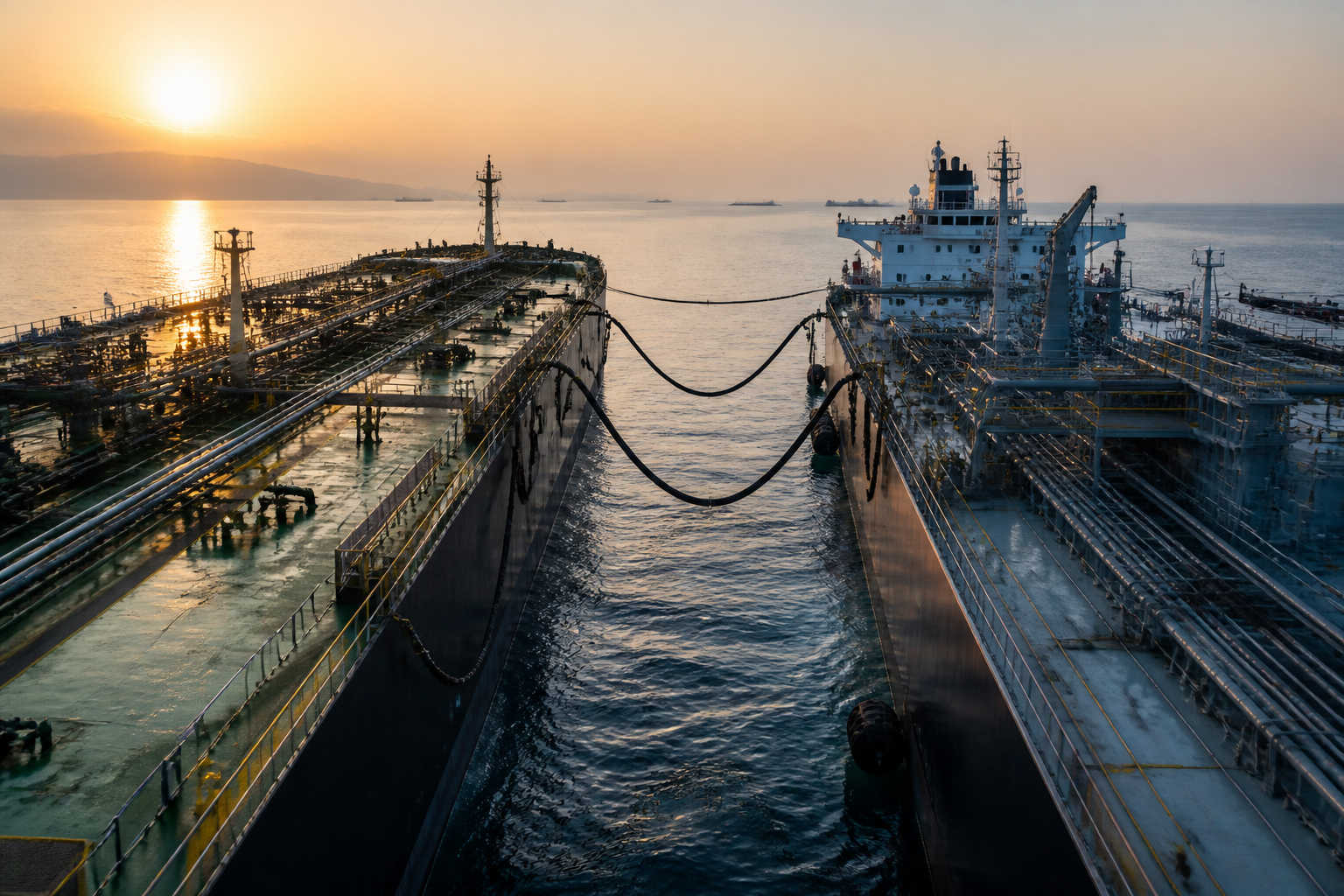
Ship-to-ship transfers off Oman are allowing Middle Eastern producers to keep Strait of Hormuz oil exports moving despite conflict-related disruption, but the workaround is making the global energy system more expensive, slower and more dependent on a narrow network of tankers, military escorts and temporary offshore logistics hubs.
The system has emerged as producers seek to reduce the exposure of large vessels to the Strait of Hormuz, one of the world’s most important energy routes. Several miles off Oman’s coast, tankers are anchoring alongside one another and transferring crude through hoses before the receiving vessel continues towards refineries, typically in Asia. The arrangement creates a floating bridge between Gulf oilfields and the international market.
According to the report published by Economic Times, citing Reuters and data from Kpler, exports through Hormuz reached about 6.5 million barrels per day in September, the highest level since a brief rise following the June ceasefire. The figure indicates that regional producers have restored a substantial flow of crude even as shipowners remain cautious about sending vessels through an active conflict zone.
The operational logic is straightforward. A shuttle tanker carries crude from Gulf terminals to safer waters in the Gulf of Oman. There, the cargo is transferred to a larger vessel that makes the longer journey to the buyer. The shuttle then returns through Hormuz to reload. By shortening the distance that any one ship must travel through the exposed corridor, producers can make greater use of a limited tanker fleet while reducing, though not eliminating, the risk associated with the strait.
That adaptation also shows how a chokepoint can remain operational without functioning normally. Before the conflict described in the report, the Strait of Hormuz handled roughly one-fifth of global oil consumption. When traffic was disrupted, producers faced two immediate problems: the physical difficulty of moving cargo and the unwillingness of shipowners to accept the risks without substantially higher premiums.
Abu Dhabi National Oil Company developed the shuttle model in April as an emergency response to the shortage of available vessels and the dangers facing normal round trips to Asian buyers. What was initially a company-level workaround has since expanded into a wider regional logistics system. UAE oil exports in September are expected to reach 3.6 million barrels per day, above the 2025 average of 3.4 million barrels per day, according to the report.
Saudi Aramco is also increasingly relying on ship-to-ship operations. The pressure on Saudi export routes has increased as disruptions around the Red Sea have reduced the effectiveness of the kingdom’s alternative outlet. The report said Iran-backed Houthi forces have tightened their grip on the Bab el-Mandeb Strait, while militants in Iraq struck Saudi Arabia’s East-West pipeline on September 10. The pipeline incident cut off roughly 4% of global oil supplies that had been moving towards international markets through the Red Sea port of Yanbu, according to the report.
The result is a more distributed but less efficient export architecture. Instead of one vessel completing a conventional voyage from a Gulf terminal to an Asian refinery, multiple ships, offshore transfer operations and additional coordination are required. Each transfer adds time, operational exposure and cost. The system can keep barrels moving, but it does not restore the previous efficiency of the trade route.
Kpler estimates that about 2.5 million barrels per day of crude could be loaded through ship-to-ship transfers in the Gulf of Oman in September, up from 1.4 million barrels per day in August. That volume is equivalent to roughly 40% of the crude currently moving through Hormuz, according to the report. The scale is important because it shows that the transfers are no longer an isolated emergency measure. They have become a material component of regional oil logistics.
The cost is most visible in tanker freight. Benchmark freight rates for a very large crude carrier moving Gulf crude to China have risen above $30 per barrel in recent months, the highest level on record according to LSEG data cited in the report. With crude prices around $105 per barrel, freight accounts for more than a quarter of the delivered cost. Before the conflict, freight represented about 2% to 3%.
That change alters the economics of the entire supply chain. Producers must either pass the higher transport cost to buyers, accept lower margins or offer deeper discounts to keep their crude competitive. Buyers, meanwhile, face greater uncertainty over delivery costs and timing. The immediate physical flow of oil may continue, but the price of maintaining that flow is being distributed across producers, tanker owners, refiners and ultimately energy consumers.
The tanker market is also being reshaped. The ship-to-ship model requires vessels to perform shorter shuttle journeys as well as longer onward voyages. This ties up more ships for each unit of crude transported and reduces the availability of tankers elsewhere. As demand for vessels rises, freight rates can increase across other routes, allowing tanker owners to capture a larger share of the value created by the disruption.
Keshav Lokhya, chief executive of HiLo Analytics, described the development as one of the biggest wealth transfers from oil producers to tanker owners. His observation captures the institutional effect of the workaround: a security problem affecting a maritime corridor becomes a capacity problem in the shipping market, which then becomes a cost problem for the wider energy system.
The Gulf of Oman transfer points are therefore functioning as temporary infrastructure. They were not designed as a permanent substitute for a fully functioning Strait of Hormuz, and their operation depends on favourable weather, available vessels, specialised crews, coordination between terminals and ships, and continued protection for the routes used by tankers. The report said an increasing number of vessels are crossing a narrow corridor along Oman’s coastline under US naval protection, with navigation systems switched off.
This makes the system operationally different from conventional port infrastructure. A port concentrates cargo handling in a regulated, fixed location with established equipment and procedures. Offshore ship-to-ship transfers distribute that activity across moving vessels and exposed waters. The arrangement can be deployed quickly, but it also increases the number of points at which an accident, delay or security incident could interrupt the chain.
The logistics shift also demonstrates the limits of alternative export routes. Saudi Arabia’s East-West pipeline and the Red Sea route offer important diversification, but their ability to absorb displaced volumes is constrained when conflict affects the Bab el-Mandeb Strait or the infrastructure leading to Yanbu. Diversification reduces dependence on one chokepoint only when alternative routes have sufficient capacity and remain secure at the same time.
For Asian refineries, the changing logistics means that the availability of crude cannot be judged only by whether Gulf barrels have been loaded. The condition of the entire chain matters: the tanker used for the shuttle, the transfer at sea, the onward vessel, the security corridor and the receiving refinery. A nominally available barrel can carry substantially higher transport and insurance costs before it reaches its destination.
The emerging network also shows why energy resilience is an infrastructure question, not only a production question. Oil producers may have the crude and buyers may still have demand, but the system can become fragile when maritime access, vessel capacity and alternative pipelines are simultaneously stressed. The physical supply has not disappeared; the routes that make it commercially usable have become more complicated.
The report presents ship-to-ship transfers as evidence of adaptation rather than paralysis. That distinction matters. The Gulf oil trade has not stopped, and the September export figures indicate a significant recovery in volumes. But adaptation is not the same as restoration. The higher freight rates, additional vessel movements and reliance on escorted corridors reveal a system operating under exceptional conditions.
The central question is whether the shuttle model remains a temporary response or becomes a lasting feature of Middle East oil logistics. The available evidence confirms that its use expanded sharply between August and September and that major regional producers are participating. It does not establish how long the conflict, maritime risks or elevated freight costs will continue. Future developments will depend on the security of Hormuz, the Red Sea and Bab el-Mandeb, the reliability of pipeline alternatives, and whether tanker capacity can meet the demands of this more complex export system.
