


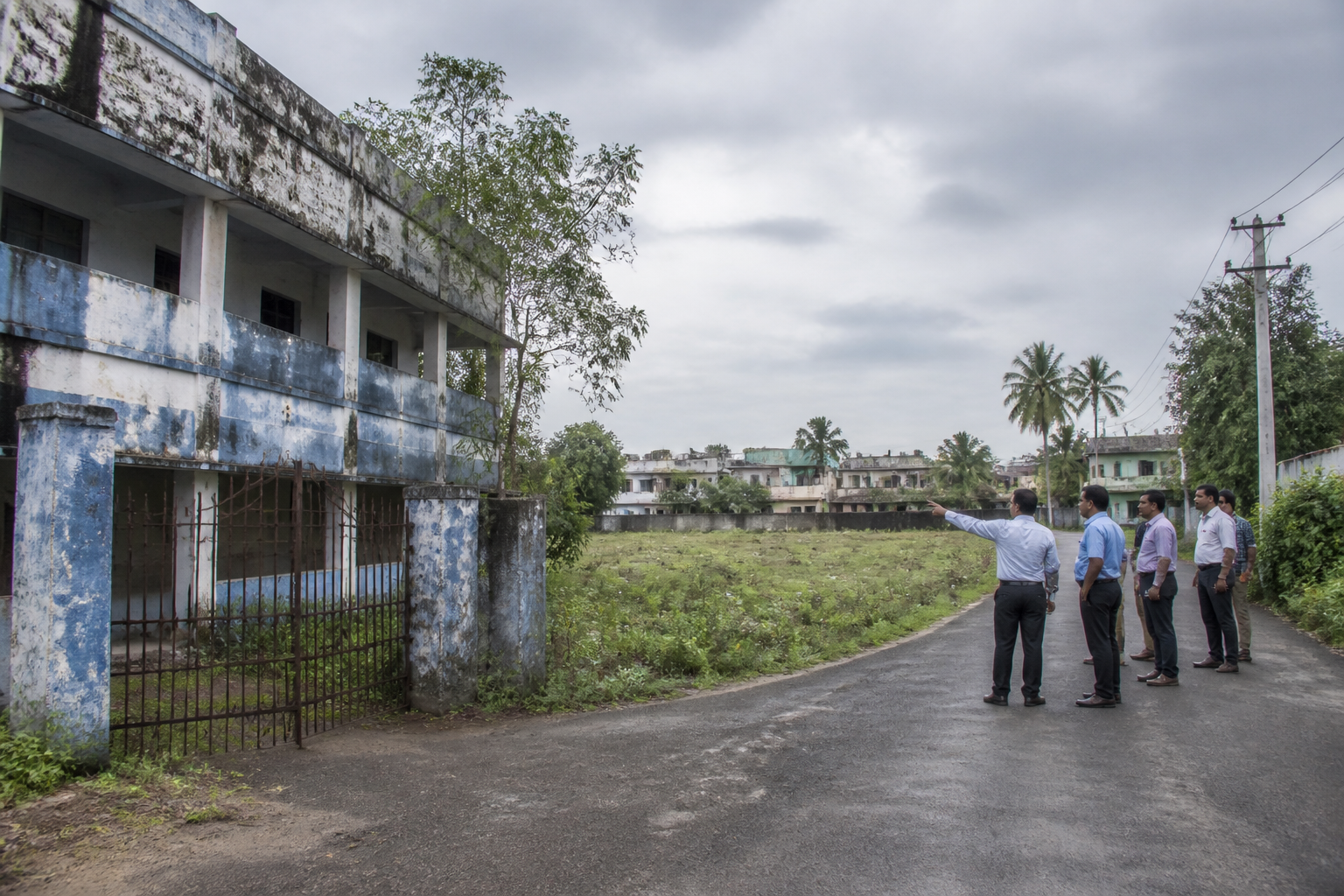
A directive to examine long-vacant government schools in West Bengal has opened a larger debate over whether unused public education assets should be revived, repurposed or made available through public-private partnerships. The education department has asked district magistrate-led teams to inspect schools with no students, verify their buildings and land, and assess whether they can be rebuilt, used for civic services or brought into other forms of public-private use.
The immediate issue is not simply that some school buildings are empty. It is that the state is beginning to treat these properties as an administrative and urban asset-management problem. The directive reportedly asks the district teams to examine the condition of the schools, the extent of their land and other property details before preparing a report. It also asks them to consider whether the premises can be used for activities other than schooling, provided that no student is denied access to education.
That combination of objectives creates the central policy tension. A vacant school may represent declining enrolment, but it may also be one of the few publicly owned buildings available in a village or neighbourhood. Its future affects not only education but also land use, the location of civic services and the distribution of public infrastructure. A decision to transfer or lease such property can therefore have consequences well beyond the education department.
The directive, as described in the report, does not itself establish that the schools will be handed over to private organisations. It provides for inspections and reports on possible uses, including public-private partnership arrangements. That distinction matters. A survey of public assets is different from a final decision on ownership, management or future use. The available material does not specify how many schools are covered by the directive, what criteria will define a student-less school, how long a school must remain vacant before review, or what approval process will apply to any later transfer or redevelopment.
Teachers’ organisations have interpreted the move as an attempt to withdraw government schools rather than repair them. Their criticism is that the state is considering alternative uses without first addressing why enrolment has fallen in rural schools or why families in urban areas are choosing private schools. One teachers’ representative also questioned whether a limited number of upgraded schools under the proposed CM Shri model could preserve the wider government-school network.
These objections point to a problem in the way school viability is often measured. A building can be empty because of demographic change, migration, poor transport access, inadequate staffing, weak facilities or the consolidation of nearby schools. The directive, according to the supplied report, asks officials to inspect property and infrastructure, but the available account does not indicate whether the proposed review will also examine these causes in a systematic way. Without that information, a low-enrolment school can be seen either as redundant land or as evidence of a deeper failure in public-service planning.
The distinction is particularly important in rural areas. The teachers’ groups cited in the report say that many government-aided schools were established on land donated by individuals or families, or through community contributions. Such origins give the buildings a social history that may not be visible in a property register. If the premises are later converted into government offices or other facilities, the decision may be legally possible while still raising questions about the original public purpose of the land and the expectations of the communities that helped create the school.
The education department’s stated concern is different. An official at Bikash Bhavan said that schools left vacant for long periods could be encroached upon and that government property could deteriorate. That is a recognisable public-asset management risk. Unused buildings require maintenance, security and periodic inspection. When responsibility is unclear, deterioration can make eventual reuse more expensive and can increase the likelihood of unauthorised occupation. A structured inventory and physical assessment could therefore be a necessary first step, even if the eventual answer is to retain the school in public use.
The institutional design of the review will determine whether it becomes a transparent planning exercise or merely a property rationalisation exercise. District magistrate-led teams are positioned to bring together land records, local administration and education officials. However, the supplied report does not identify the full membership of these teams, the role of local elected bodies, the process for consulting parents and teachers, or whether the reports will be made public. Those details will matter because school buildings are public assets, and decisions about their use affect communities that may not have the resources to challenge an administrative decision after it is taken.
A public-private partnership would also require clarity about what is being partnered, with whom and for what purpose. The phrase can cover arrangements ranging from facility management to long-term use by a private operator. Each model carries different implications for access, fees, maintenance, accountability and control of the underlying land. The report provides no details on a proposed operator, financial structure, lease period or service obligations. It would therefore be premature to treat the directive as proof of privatisation, but equally important not to overlook the need for safeguards if private use is considered later.
The question of student access is explicitly present in the directive. Officials have reportedly been asked to ensure that no student is deprived of schooling. That requirement will need to be tested against practical conditions: the distance to the next school, transport availability, the capacity of neighbouring institutions and the needs of children from lower-income households. The available report does not provide such data. It also does not establish whether students from the affected schools have already been relocated or whether some schools are technically open despite having no current enrolment.
The political and administrative context described in the report adds another layer. Teachers’ organisations say that schools became student-less and closed during the previous Trinamool Congress government, while alleging that the present BJP government has sought to remove nearly 4,000 schools within four months of taking office. These are claims made by representatives of teachers’ bodies and are not independently substantiated in the supplied material. Their significance lies in showing how the review is already being interpreted: not as a neutral inventory exercise, but as part of a contested decision about the future of state-run education.
The proposed review therefore sits at the intersection of three public responsibilities. The first is to provide accessible schooling. The second is to protect and maintain public property. The third is to plan civic facilities according to changing population and service needs. Treating any one of these as the sole objective could produce an incomplete outcome. Retaining every empty school without assessing viability may leave assets vulnerable to decay, while disposing of school properties without examining access and community needs could reduce the public infrastructure available in areas that may later grow or change.
What the directive confirms is that the state wants a district-level assessment of long-vacant school properties and their possible future uses. What remains unclear is the scale of the exercise, the definition of a student-less school, the evidence that will guide decisions, and the legal and financial framework for any public-private arrangement. The next significant development will be the formation of the inspection teams and the publication of their findings. Those reports will show whether the process is primarily about protecting public assets, reorganising education infrastructure or opening government land to new forms of use.
