


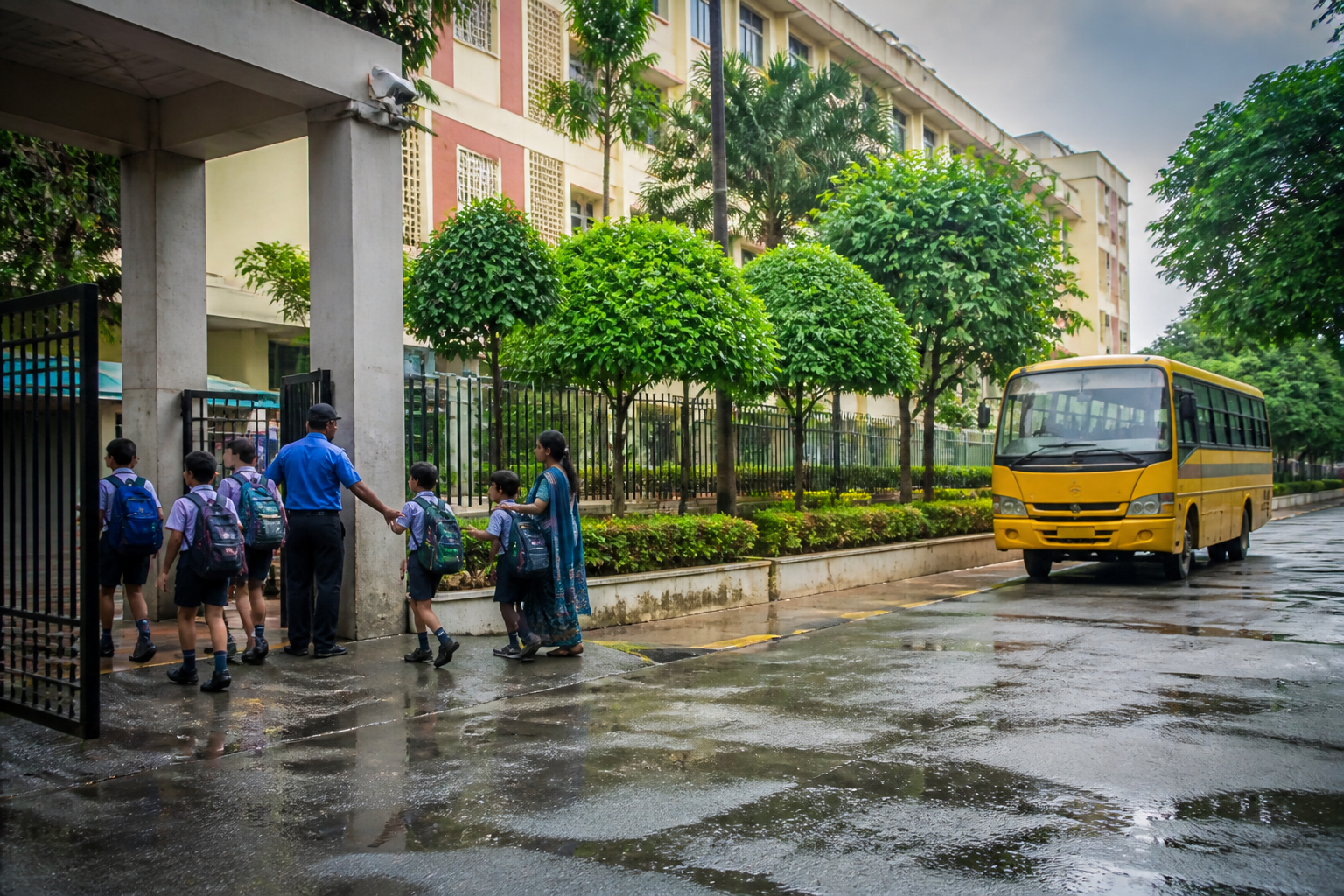
The latest school-safety disclosures in Kolkata show that protecting children is no longer being presented as a matter of gates, guards and surveillance cameras alone. After a snakebite incident at The Heritage School and growing parent concerns about campus safety, two schools have described systems covering physical security, emergency medicine, transport, maintenance, child protection and emotional support. Together, their responses point to a wider shift: school safety is becoming an operating system for the entire campus, not a single security function.
The Newtown School sent parents a detailed circular last Wednesday. The document covered physical security, health and wellness, emotional and pastoral support, transport, campus operations and maintenance. The Heritage School separately invited parents of students from Kindergarten to Class XII to explain the measures taken after a child suffered a snakebite and to answer questions about safety on campus.
The immediate triggers were different, but the institutional response was similar. Both schools treated safety as a matter requiring disclosure, explanation and continuing engagement with parents. This is significant because the everyday risks faced by children in a school are distributed across several systems: entry and exit points, corridors, buses, washrooms, outdoor areas, medical response, pest control, trees and vegetation, and the behaviour of adults responsible for supervision.
The Newtown School’s circular listed more than 850 CCTV cameras covering entrances and exits, corridors and common areas, staircases, outdoor areas and sports zones. It also identified 82 housekeeping and maintenance personnel across its campuses. These figures suggest that surveillance and physical upkeep are being managed at a substantial operational scale, but they also underline a basic limitation: equipment and staffing only improve safety when they are actively monitored, maintained and linked to a response process.
Sunil Agarwal, founder-director of The Newtown School, said CCTV footage had to be retrieved almost every alternate day to resolve issues or clarify parents’ doubts. The statement offers a glimpse into how surveillance operates in practice. Cameras are not only a deterrent or a record of serious incidents; they are also becoming part of routine dispute resolution between schools and families. That creates an ongoing demand for storage, retrieval, review and responsible handling of footage.
The school’s approach also places communication at the centre of safety management. Principal Satabdi Bhattacharjee wrote that parents wanted to know who was looking after their children, whom children could approach when something did not feel right, how concerns were addressed and how the school prepared for situations that might arise. The circular was intended to give parents greater visibility of these arrangements.
This emphasis matters because safety is partly an institutional trust problem. Parents may not be able to directly observe what happens inside a campus during the school day. They therefore rely on the school to explain its procedures, identify responsible adults and demonstrate that complaints or emergencies will not disappear into an opaque administrative process. A safety circular does not remove risk, but it can make the chain of responsibility more visible.
The Newtown School’s emergency provisions extend beyond an infirmary. The school said it had an ambulance on campus, priority admission arrangements at hospitals and a system for keeping parents informed at every step. Its buses were described as having GPS tracking, with live vehicle locations available through a parents’ app. Each bus also had CCTV cameras, a first-aid kit, a fire extinguisher and an emergency exit.
These details show how school safety now extends beyond the classroom and even beyond the school boundary. Transport creates a moving safety environment in which supervision, route visibility and emergency response must work together. A bus may be operated separately from the classroom, but for parents it remains part of the same duty of care. The use of GPS and onboard equipment addresses visibility and preparedness, while the effectiveness of those systems depends on how quickly staff can respond when a problem is detected.
The school also identified policies on child protection and the Protection of Children from Sexual Offences Act, anti-bullying, social media, transport, and health and infirmary operations. Its stated safety framework therefore includes both physical hazards and risks linked to behaviour, communication and digital spaces. Emotional support, approachable adults, parent engagement and digital and cyber-safety awareness were listed among the measures aimed at students’ mental and emotional well-being.
That wider definition is important because a school can appear physically secure while children remain unable or unwilling to report problems. The presence of trusted adults and clear reporting channels is therefore as much a part of the safety infrastructure as cameras or emergency equipment. The Newtown circular described channels through which students and parents could raise concerns, although the supplied account does not specify how those channels are structured or how complaints are escalated.
The Heritage School’s response began with a different kind of campus risk. After a child suffered a snakebite, the school briefed parents on inspections and safety checks, tree pruning and the clearing of bushes. It also conducted a wildlife-safety and emergency-awareness session for students from Class III onwards.
An official from the state’s Wild Animal Rescue and Transit Facility Centre, who had inspected The Heritage School and Mitra Institution, said tree branches should not touch window openings because snakes could potentially move through gaps during the monsoon. This connects the incident to a broader maintenance question. Vegetation, building openings and seasonal conditions can interact to create risks that are not addressed by conventional access control.
The Heritage School’s meeting also moved beyond the incident that prompted it. Parents raised concerns about buses and washrooms, and school authorities sought to address those doubts. That expansion of the conversation is revealing. A serious incident often becomes a route through which families ask about less visible parts of campus management. The public meaning of a safety meeting is therefore not limited to the original event; it can expose the range of issues parents believe must be monitored.
Principal Seema Sapru described the meeting as a confidence-building exercise intended to inform parents about measures taken by the school. The school’s response, like Newtown’s circular, treated reassurance as something that must be supported by operational details. Inspections, pruning, clearing, awareness sessions and discussions about buses and washrooms translate the broad idea of safety into specific sites and procedures.
The two accounts also reveal the institutional complexity of school safety. A school may control its campus, employ maintenance staff and establish internal policies, but emergency medical care involves hospitals, wildlife risks may require specialist agencies, and transport requires coordination between the school, bus operators, drivers, attendants and parents. Safety is consequently distributed across institutions with different responsibilities and capabilities.
The Newtown School’s statement that no environment involving children can be entirely free from unforeseen events or risk is a central qualification. Its document described safety as an ongoing process rather than an absolute condition. This distinction is important for public discussion. A long list of safeguards should not be treated as proof that a campus is completely secure. It is better understood as evidence of how an institution identifies, manages and communicates risk.
The supplied account does not establish whether the two schools follow a common citywide safety standard, how frequently all listed systems are independently audited, or whether parents have access to performance records beyond the disclosures described. It also does not provide comparative information about safety arrangements across Kolkata’s schools. Those gaps limit what can be concluded about the wider school system.
What can be established is that parents are asking for greater visibility into the systems that shape children’s daily experience. Schools are responding with more detailed communication and a broader vocabulary of safety. Security cameras and gates remain part of that framework, but they sit alongside housekeeping, vegetation management, transport monitoring, medical readiness, child-protection policies, emotional support and channels for reporting concerns.
The larger urban question is how institutions that serve children manage risks across built spaces, public systems and human relationships. A campus is not safe merely because it is enclosed. Its safety depends on how buildings are maintained, how people move through them, how emergencies are handled, how information travels and how quickly concerns reach someone responsible.
For Kolkata’s schools, the next test is not simply whether safety measures exist. It is whether those measures remain visible, maintained and usable when an incident occurs. The two schools’ recent disclosures show a movement towards greater transparency, while also confirming that school safety remains a continuing process involving parents, school staff, maintenance teams, transport systems, medical institutions and specialist authorities.
