


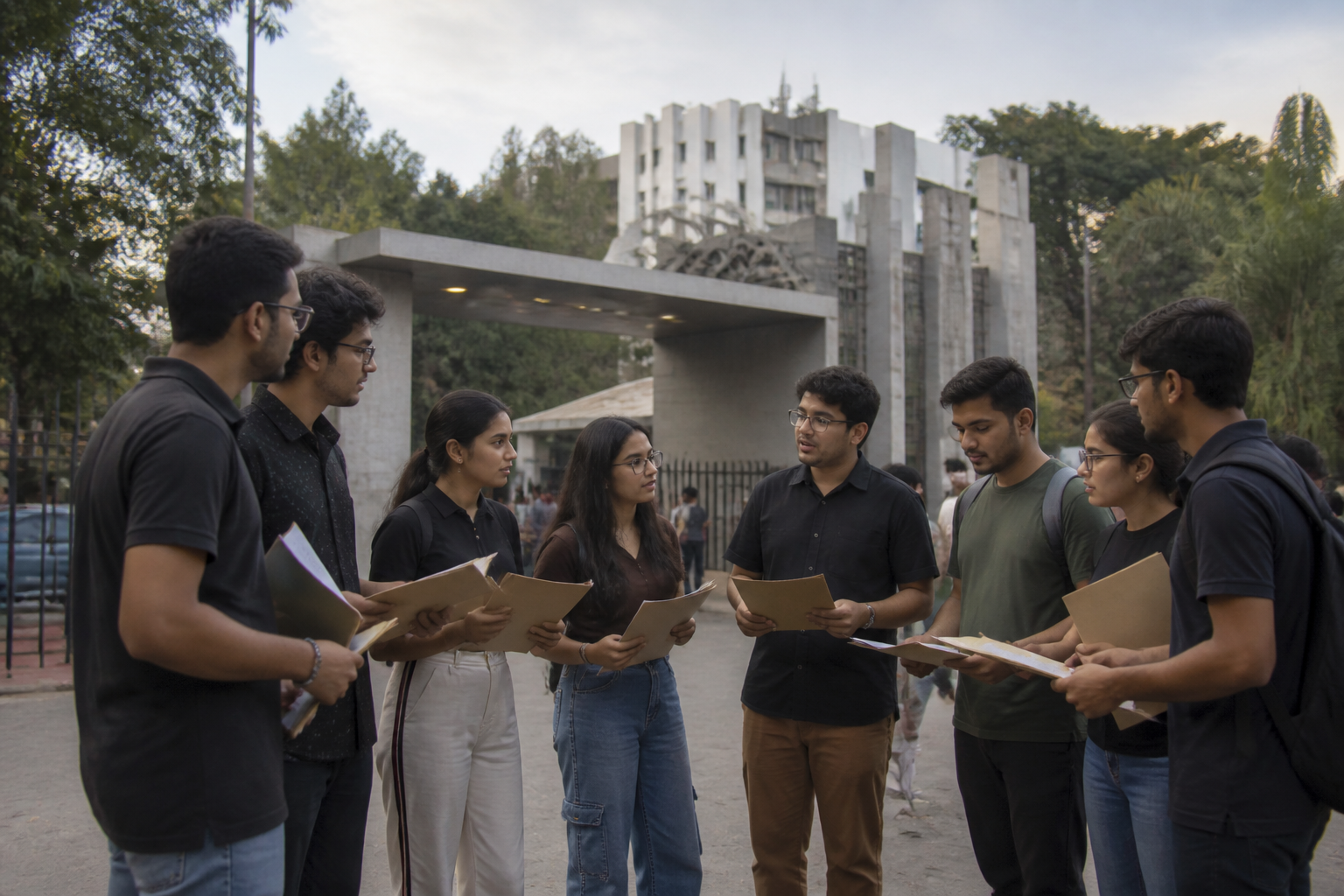
The 18-point charter submitted by protesting students at IIT Bombay is more than a list of immediate concessions sought after the death of second-year BTech student Sahil Wakode. It is a detailed challenge to how a major public technical institution handles academic discipline, mental-health support, medical emergencies, student representation and administrative accountability.
The demands were presented during a three-hour late-night meeting at the institute’s main gate on Sunday, after three days of protests on the Powai campus. Times of India reported that IIT Bombay director Shireesh Kedare signed the charter during the meeting, which students recorded live. An institute official, however, said discussions would continue and that “due process will be followed”. That distinction is central: the document records what students are seeking, but it does not by itself establish that every demand has been accepted or will be implemented.
The immediate trigger was Wakode’s death by suicide. The incident followed an examination-related episode involving Professor Suryanarayana Doolla, who was identified by the students as the professor and invigilator involved. Wakode’s father filed a complaint, an FIR was registered against Doolla, and Mumbai Police transferred the case to the Crime Branch. The IIT Bombay Faculty Forum has expressed solidarity with Doolla, saying he was following institute-approved academic procedures.
This places the institute at the intersection of three processes that do not automatically resolve one another: a police investigation, an institutional inquiry and a student-led demand for accountability. The students have sought the immediate suspension of Doolla and the removal of any other stakeholder found guilty after an investigation. They have also demanded an independent panel comprising professors, student representatives, external members and members recommended by students. The panel would examine the circumstances surrounding Wakode’s death, including the emergency and hospital response.
The proposed timelines show the students’ concern that an inquiry should not become an open-ended administrative exercise. They have sought an interim report by September 30, public conclusions by October 15 and an implementation plan before September 26. They have also demanded weekly progress updates. The charter proposes that the director, Dean AP and Dean SA should resign if specified demands are not implemented within a month.
That demand is significant because it shifts accountability from a general institutional assurance to named office-bearers and measurable deadlines. It also reflects a broader problem in large residential campuses: students often interact with several administrative offices, but responsibility for a failure can become dispersed across academic, hostel, medical and student-affairs structures. The students’ charter attempts to create a chain between a decision, the official responsible for it and the consequence of non-implementation.
The demands relating to the disciplinary action committee, or DAC, reveal how students perceive the risks of handling academic misconduct in isolation. They have asked that a student’s mentor or student companion and a student buddy chosen by the student be informed immediately when a student is caught committing malpractice. They have also called for interactions concerning the case to be documented and conducted with these persons’ knowledge.
The proposal does not seek to remove the disciplinary process. Instead, it seeks to add visibility and support around it. In the account presented by the protesting students, an academic allegation can have consequences extending beyond the examination room, particularly when the student is already vulnerable or isolated. Their demand for documentation and the presence of trusted persons is therefore connected to procedural safeguards, not only to the outcome of an individual case.
The charter also asks IIT Bombay to create a formal code of conduct for professors, including a complaints process, an escalation mechanism and a defined timeline for evaluating cases. Students have further sought a public apology over what they described as the defamation of Wakode through details in an institute LinkedIn post. These demands indicate that communication is being treated as part of institutional accountability. For the students, how an institution describes a deceased student can affect dignity, trust and the credibility of subsequent proceedings.
Mental-health capacity is another major part of the document. Students have demanded at least one counsellor for every 250 students, independent audits of the Student Wellness Centre and at least one counsellor in every hostel. They have also sought a psychiatrist on call around the clock at IIT Bombay Hospital, better-qualified emergency and night-shift doctors, regular mental-health training for hospital staff and a mechanism to address student concerns about the hospital.
The specific ratio requested by students is important because it converts a broad demand for “better counselling” into a staffing benchmark. The source report does not establish IIT Bombay’s current counsellor-to-student ratio, waiting times or the number of hostel-based counsellors. Those gaps matter because the effectiveness of a wellness system cannot be assessed only through the existence of a centre or helpline. Access, response time, continuity of care and emergency coordination are also institutional questions, although the charter itself does not provide data on current performance.
The proposed sensitisation workshops every two months for professors and staff who directly interact with students, along with inclusion in onboarding, similarly focuses on repeated institutional practice rather than a one-time response. The demand suggests that students see the problem as partly embedded in routine interactions between authority figures and students. Whether the institute accepts this framework, and how it defines compliance, will determine whether the demand becomes a training programme or remains an assurance.
The students have also sought at least 20 hours a week from the Dean SA office for one-on-one interactions, written responses to concerns within 48 hours and weekly publication of available interaction slots. These are administrative-access demands. Their underlying purpose is to make student affairs more predictable and less dependent on informal access to senior officials.
Representation is the charter’s most direct challenge to institutional decision-making. Students have asked for voting power for student representatives on academic and non-academic committees concerning students, equal student representation and no administrative veto over the student voice. They have also called for the reconsideration of decisions affecting student culture that were imposed without consultation.
The request raises a difficult governance question. Student representation can improve the visibility of lived experience in decisions about hostels, welfare, discipline and campus culture. At the same time, institutions must define the powers, responsibilities and limits of such representation. The charter provides a clear demand for voting rights, but the supplied report does not detail which committees would be covered, how representatives would be selected or how conflicts between student and administrative responsibilities would be resolved.
The demands concerning hostel wings point to another dimension of campus life: informal support networks. Students want the administration to help bring hostel wings back together and ensure that wingmates remain together in subsequent years, with adjacent rooms. This is an acknowledgement that residential arrangements are not merely logistical. For students living away from home, peer networks can be an important part of daily support, although the report does not establish how hostel reorganisation affected specific students or groups.
The proposed open concerns portal and a standing task force on student well-being extend the charter from individual grievance redressal to institutional monitoring. The portal would display student concerns and administrative responses to the student community. The task force would include students, faculty, mental-health professionals and external experts, study student distress, recommend preventive measures and publish a semester-wise report for IIT Bombay residents.
Transparency is built into both proposals. A visible response system could make it easier to track whether complaints have been received and answered. A recurring well-being report could create an institutional record instead of leaving each crisis to be handled as an isolated event. But the report does not specify who would audit the portal, what information would be withheld for privacy reasons or whether the task force’s recommendations would be binding.
The demand for no disciplinary, hostel, financial or legal action against protesting students adds another layer. Students have sought a written assurance against direct or indirect penalties. This is connected to the credibility of the proposed grievance systems: students are more likely to use formal channels if they believe protest or criticism will not affect their academic or residential position. The institute’s response to this demand will be watched alongside its response to the substantive welfare and accountability measures.
The scheduled meeting of the Board of Governors and the expected open house with students are the next institutional tests. Students have asked for the open house to be held before September 22, while the charter seeks a written response within 24 hours and an implementation plan before September 26. These deadlines create a short timetable for an institution that must respond while the police investigation and the FIR against Doolla remain active.
The evidence currently establishes that students have submitted a detailed charter, that the director signed it during a recorded meeting according to the report, and that an institute official said due process would continue. It does not establish that all 18 demands have been accepted, that the proposed inquiry has been constituted, or that the requested deadlines will be met. Those are the developments that will determine whether the charter becomes an administrative reform programme or remains a protest document.
The larger urban issue is the governance of large residential institutions. IIT Bombay is a campus, but it is also a dense, semi-autonomous living and service environment with housing, healthcare, education, disciplinary systems and public accountability operating together. The students’ demands show that failures in one part of that system can quickly become questions about the whole institution. The immediate focus will remain on the investigation into Wakode’s death and the institute’s response. The longer test will be whether student welfare becomes a measurable governance responsibility rather than a crisis-time commitment.
