


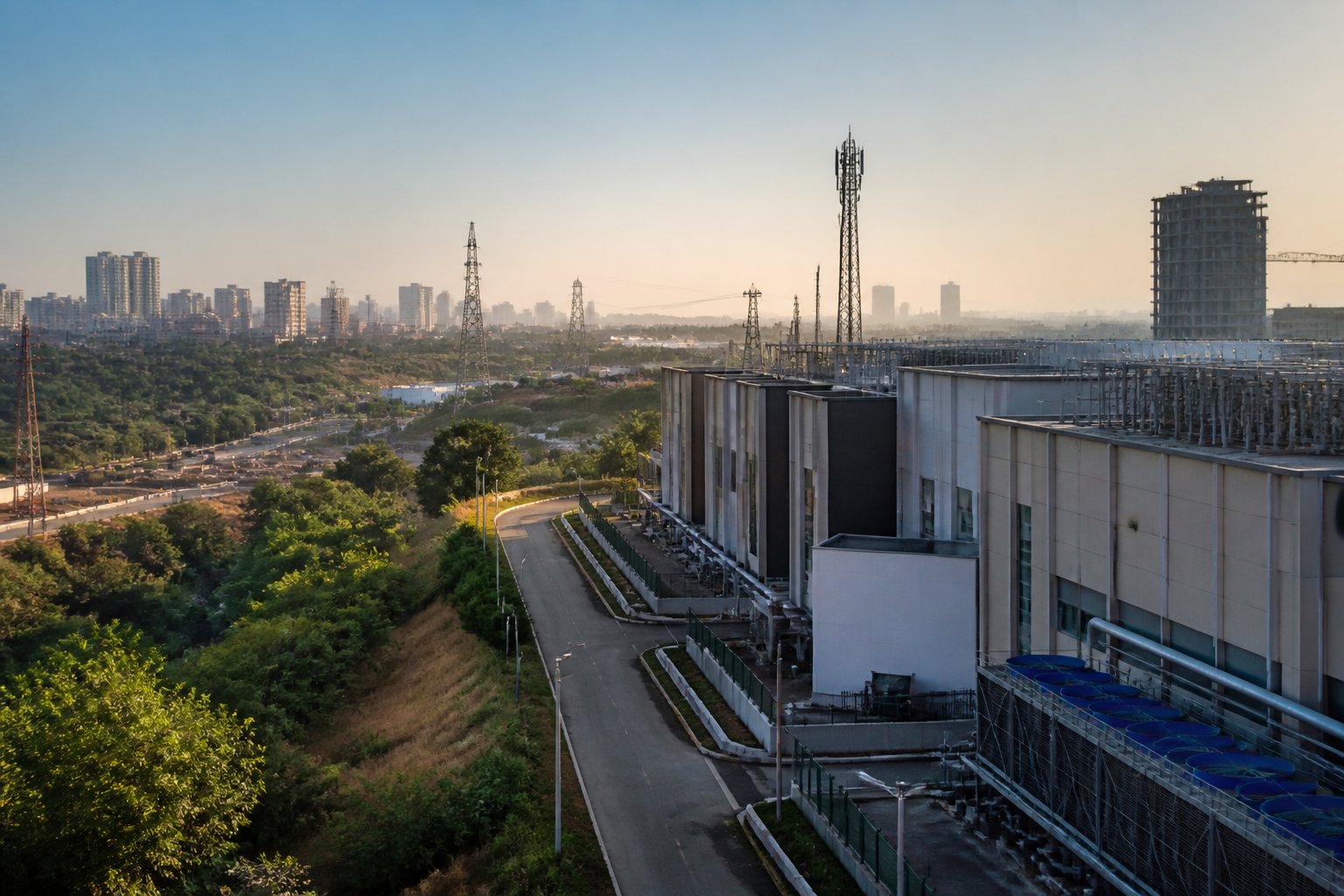
Mumbai and Pune are emerging as a connected data centre corridor as cloud adoption, artificial intelligence and business digitisation drive a rapid expansion of India’s digital infrastructure. A Cushman & Wakefield report cited by Loksatta estimates that the two metropolitan regions will more than double their data centre capacity by 2030, placing new pressure on the physical systems that support the digital economy.
The scale of the shift is visible in the current numbers. Mumbai had 890 megawatts of operational data centre capacity in the first half of the year, while Pune had 133 megawatts. Together, the two markets accounted for 1,023 megawatts of operating capacity, more than half of India’s total data centre capacity of 1,789 megawatts during the same period.
The report also identifies a substantial pipeline. Mumbai is expected to add another 1,726 megawatts of capacity, while Pune is expected to receive 258 megawatts of new supply. If these additions are delivered, the two markets would add nearly 2,000 megawatts to their existing base. The figures indicate that the corridor is not simply responding to present demand; it is being positioned for a much larger digital infrastructure requirement.
The more important urban question is where this capacity will be located and how metropolitan infrastructure will accommodate it. Data centres are often discussed as technology assets, but their operation depends on land, reliable electricity, communications infrastructure and physical connectivity. The report specifically identifies digital infrastructure, energy availability and broad connectivity as factors supporting Mumbai’s attractiveness. For Pune, it points to business expansion by global companies and comparatively lower space costs than other metropolitan markets.
That distinction between the two cities is significant. Mumbai’s lead is built around an existing concentration of infrastructure and connectivity. Pune’s growth is linked more directly to the availability and cost of space, as well as the expansion of global businesses. Together, these factors suggest a metropolitan market with different but complementary advantages rather than two identical locations competing on the same terms.
## What the Mumbai-Pune data centre corridor reveals
India had 147 data centres operated by 33 service providers during the first half of the year, according to the report. National operational capacity stood at 1,789 megawatts after an addition of 178 megawatts during the six-month period. These figures show both the concentration and the speed of expansion in the sector.
The national pipeline is considerably larger than the capacity already operating. The report estimates that another 3,860 megawatts of data centre capacity will be supplied by 2030. Of this, 509 megawatts is under construction and 3,351 megawatts is at the planning stage. The difference between these stages matters because planned capacity is not the same as commissioned capacity. It represents an intention or development pipeline, while construction and operation indicate progressively higher levels of execution.
Mumbai’s planned addition of 1,726 megawatts represents the largest identified increase among the two markets. Pune’s additional 258 megawatts is smaller in absolute terms but substantial compared with its current operating base of 133 megawatts. On the figures cited in the report, Pune’s planned supply is almost twice its existing capacity. That makes the city’s expansion particularly important even though Mumbai remains the dominant market.
The report does not provide a project-wise list, construction timetable, land-use map or detailed assessment of electricity and water requirements. It therefore cannot establish how the proposed capacity will be distributed across the Mumbai and Pune metropolitan regions, which local authorities will oversee individual projects, or whether all planned facilities will reach operation by 2030. Those gaps are central to understanding the eventual urban consequences of the expansion.
## Infrastructure is the real operating base
The data centre sector is commonly associated with cloud services and artificial intelligence, but the report’s location factors underline its dependence on conventional urban systems. A facility requires a site, power connections, communications links and access for construction and operations. In Mumbai, the combination of digital infrastructure, energy availability and connectivity is cited as a reason for continued preference by companies. In Pune, lower space costs and business expansion are identified as important drivers.
This makes data centre growth relevant to infrastructure planning even when the facilities themselves are not visible in everyday city life. Unlike a metro station or a road, a data centre does not primarily attract daily public users. Its urban footprint is expressed through land consumption, power demand, construction activity and the network infrastructure required to connect it to businesses and digital services.
The available evidence does not quantify the electricity demand of the proposed facilities or identify the sources of their power. It also does not state whether new transmission infrastructure will be required, whether existing substations have adequate capacity, or how the two metropolitan regions will coordinate utility planning. These are not minor technical details. They will determine whether the proposed pipeline can be delivered on schedule and at the scale projected.
The same applies to land. Pune’s lower space costs are an identified advantage, but the report does not specify the kinds of sites being considered or how data centre development will interact with existing industrial, commercial and residential growth. In Mumbai, where land availability is more constrained than in many competing locations, the size of the proposed pipeline raises questions about the spatial form of future facilities and the infrastructure corridors that will support them.
## A corridor with different urban roles
Calling Mumbai and Pune a data centre corridor captures their combined market strength, but the available figures also show an uneven relationship. Mumbai currently has 890 megawatts of operational capacity, more than six times Pune’s 133 megawatts. Mumbai’s future addition is also considerably larger. Pune, however, has a much larger planned addition relative to its existing base.
This difference could shape how the two cities participate in the digital economy. Mumbai is already the established concentration, while Pune is the faster-growing secondary market identified by the report. The source does not establish whether companies are deliberately distributing capacity between the cities for resilience, cost management or operational reasons. It only identifies the market factors that are drawing companies to each location.
The corridor therefore should not be understood only as a technology-sector growth story. It is also a test of whether metropolitan planning can connect private infrastructure investment with public systems. The report provides evidence of demand and supply intentions, but not of a joint planning framework between the cities or the authorities responsible for land, power, roads and communications.
That institutional gap is important because the two cities belong to a wider regional economy but have separate administrative structures and distinct development pressures. A large expansion in one location can affect land values, construction demand, utility planning and connectivity requirements beyond the individual site. The supplied report does not assess these effects, but its capacity figures show why they merit attention.
## What remains to be established
The report confirms that Mumbai and Pune occupy a leading position in India’s data centre market and that both have significant additional capacity in the pipeline. It also shows that the national sector is expanding quickly, with 178 megawatts added during the first half of the year and another 3,860 megawatts expected nationally by 2030.
What remains uncertain is the execution of the pipeline. Of the national additions, only 509 megawatts is under construction, while 3,351 megawatts remains at the planning stage. The supplied material does not provide completion dates, investment values, project approvals or information on how many planned facilities have secured land and power connections.
For Mumbai and Pune, the next useful evidence will therefore be project-level information: the location of proposed facilities, their construction status, utility requirements and the agencies responsible for approvals and connections. Until those details become available, the figures should be read as a strong signal of market direction rather than a completed transformation.
The central fact is nevertheless clear. Mumbai and Pune are becoming the most important connected data centre markets highlighted in the report, with Mumbai providing the larger operating base and Pune showing a substantial expansion relative to its current capacity. Whether that growth becomes a coordinated urban infrastructure transition will depend on how the planned capacity moves from market projections to approved, powered and operational facilities.
