


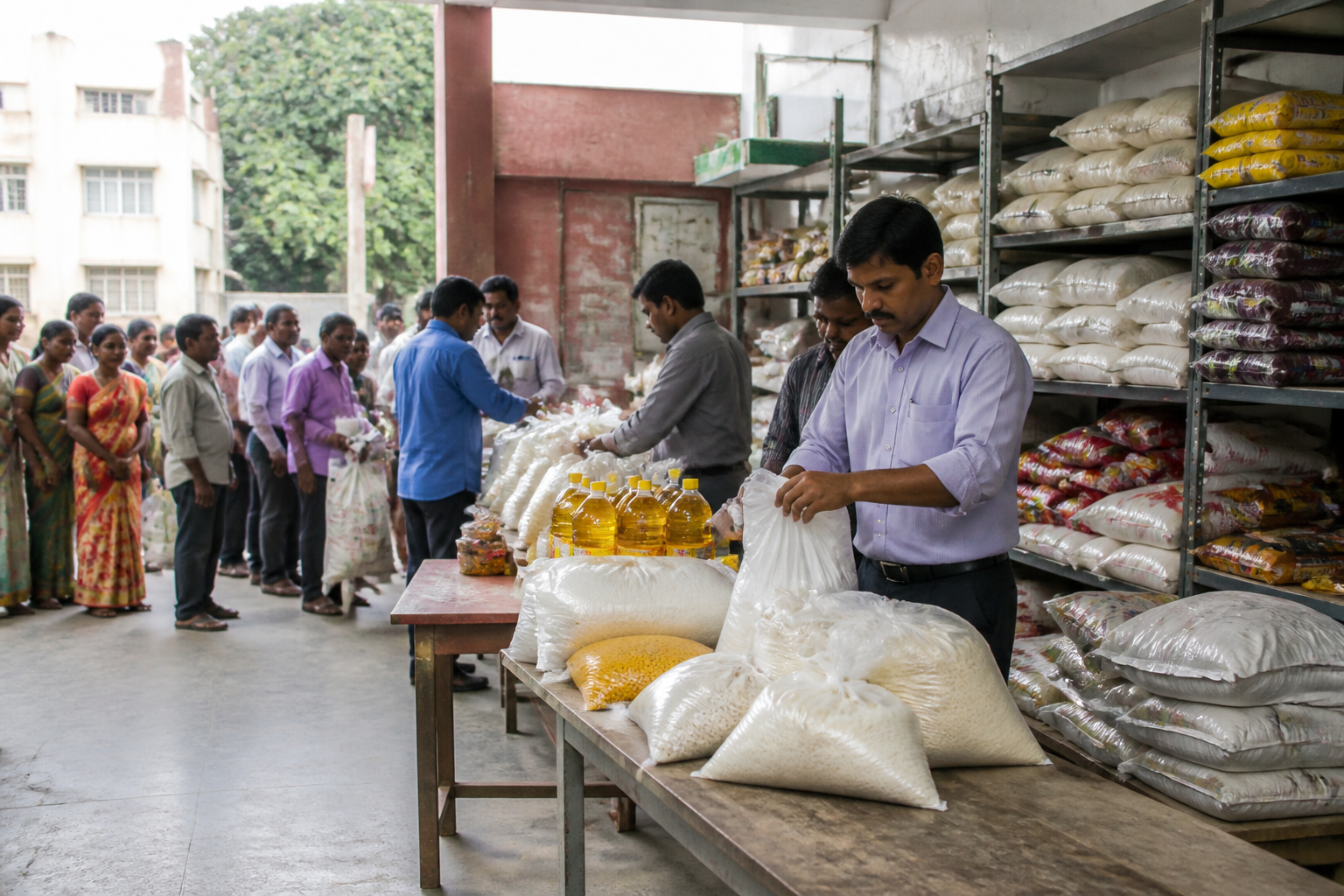
The Karnataka government’s decision to scrap the Indira food kits tender is more than a change in the contents of a welfare package. It has reopened a central administrative question: whether the state should directly procure and distribute essential food items to poor households, or allow beneficiaries greater choice through vouchers while reducing the government’s role in supply and distribution.
Food and civil supplies minister Rizwan Arshad told The Times of India that the government had cancelled the tender and was working on a revised version of the scheme. The new programme is expected to be introduced within 45 days, after which fresh tenders will be called. Until then, the government is expected to continue providing 5kg of rice to Below Poverty Line families under Anna Bhagya, in addition to the 5kg supplied through the National Food Security Act or the Pradhan Mantri Garib Kalyan Yojana.
The immediate decision follows concerns raised by the finance department over procurement and quality. Those objections are significant because the proposed scheme was designed as a large, state-managed distribution system rather than a simple cash transfer. The government would have had to define the contents of every kit, procure multiple commodities, maintain quality standards, move supplies across the state and ensure that the intended quantities reached beneficiaries.
The original proposal was introduced by the previous Siddaramaiah government as a more nutritious alternative to providing an additional 5kg of rice under the guarantee scheme. A standard kit for families of three to four members was to include 1kg each of tur dal, moong dal, sugar and salt, along with one litre of cooking oil. Families of one or two members were to receive half-kilogram packs. The estimated cost was Rs 6,119 crore.
That composition reveals the policy choice at the heart of the programme. Rice is relatively uniform as a welfare commodity, while pulses, sugar, salt and cooking oil create a more complex procurement and distribution chain. Each item has different sourcing, storage and quality requirements. A scheme that seeks to provide a variety of foodgrains therefore carries a wider administrative burden than one based primarily on a single staple.
The food and civil supplies department’s own survey was cited as the reason for retaining the idea of food kits in some form. According to Arshad, women surveyed by the department preferred a variety of quality foodgrains. The minister said the new team was working on the composition of the kits and on strengthening the supply chain.
The government is therefore not abandoning the objective of diversification altogether. Instead, it is revisiting how that objective should be delivered. This distinction matters. The change announced so far is not a confirmed replacement scheme, but a decision to cancel the current tender and redesign the programme. The final contents, procurement model, beneficiary process and financial structure remain to be established.
## The procurement problem behind the welfare promise
The finance department reportedly suggested that the government consider issuing e-vouchers instead. Under that approach, beneficiaries could buy foodgrains themselves, while the state would avoid managing the full supply and distribution process. Such a model would shift some operational responsibility from the government to households and participating sellers.
The supplied report does not establish whether e-vouchers will form part of the final scheme. It only identifies them as an option raised by the finance department. That distinction is important because the two systems would measure success differently. A direct kit would be assessed through procurement prices, delivery volumes, quality inspections, warehouse management and last-mile distribution. An e-voucher system would require reliable beneficiary authentication, participating outlets, digital access and a mechanism to ensure that the promised value can actually be used to buy acceptable food items.
The state-level guarantees committee has also pointed towards a decentralised procurement model. Earlier in the month, its president HM Revanna said the government would float supply tenders at the district level instead of issuing a single pan-state tender. He said this would help prevent pilferage and misappropriation.
District-level tendering could bring procurement closer to local distribution networks, but it would also create a need for consistent specifications and monitoring across districts. The available information does not say how many district tenders would be issued, what quality-control system would apply or how the government would compare prices and performance between districts. Those details will determine whether decentralisation improves accountability or simply creates multiple procurement systems to supervise.
The cancellation of the tender means that these questions remain unresolved rather than settled. A fresh tender can address concerns in the original process only if the revised scheme clearly defines quantities, quality benchmarks, delivery responsibilities and penalties for non-compliance. The government’s stated 45-day timeline provides a near-term administrative milestone, but no detailed implementation framework has yet been disclosed in the supplied material.
## What the numbers establish
The proposed programme carried an estimated cost of Rs 6,119 crore. That figure places procurement design at the centre of fiscal planning, particularly because the scheme would involve several commodities and different pack sizes. The exact number of intended beneficiary households, the annual or periodic cost of the revised scheme, and the cost per kit have not been provided.
The proposed food basket included four separate 1kg food items and one litre of cooking oil for larger households. Smaller households were to receive half-kilogram packs. This indicates an attempt to match distribution to household size, but the source does not specify how household size would be verified, how changes in family composition would be recorded or whether the pack sizes would remain the same in the revised model.
The rice support that is expected to continue provides a separate baseline. BPL families are expected to receive 5kg under Anna Bhagya, in addition to another 5kg under the National Food Security Act or the Pradhan Mantri Garib Kalyan Yojana. The supplied report does not clarify whether these two allocations are delivered through the same channel or how the proposed food kits would have been integrated with them.
That separation is administratively relevant. A beneficiary may receive rice through an existing public distribution arrangement and other commodities through a new kit or voucher system. If the channels are different, the government would need to coordinate beneficiary records, delivery schedules and grievance mechanisms. No such operational details have been announced in the material available for this report.
## The urban distribution question
Although the proposal covers Karnataka, its implementation would be experienced locally through ration shops, district offices, warehouses, transport routes and household-level access points. The practical success of the scheme would therefore depend on the public distribution network’s ability to move from a rice-focused entitlement to a broader basket of goods.
In cities, the choice between kits and vouchers could affect how beneficiaries access the programme. A pre-packed kit may provide certainty about what is supplied but limited choice about brands or quantities. A voucher could offer greater flexibility, but only if participating outlets are accessible and adequately stocked. The source material does not provide evidence on how either model would work in Bengaluru or other urban centres.
The reference to women’s preferences also brings a ground-level dimension into the policy debate. The department’s survey reportedly found a demand for variety and quality rather than only an additional rice allocation. That finding suggests that the design of welfare cannot be judged solely by the number of kilograms distributed. The type of food, its quality and the household’s ability to use it are also part of delivery effectiveness.
At the same time, the survey’s sample size, methodology and geographic coverage have not been disclosed in the supplied report. The finding can therefore explain the government’s stated policy direction, but it cannot independently establish how widely those preferences are held across Karnataka.
The larger issue is whether the state can build a procurement system that is both financially controlled and responsive to household needs. Direct distribution gives the government more control over the contents of the benefit, but exposes it to procurement, storage, quality and leakage risks. Vouchers can reduce some of those responsibilities, but place greater reliance on retail networks and beneficiary access. A district-based tender model occupies a third position, retaining physical distribution while attempting to make procurement more local and accountable.
Karnataka’s next decision will show which of these administrative priorities it chooses to emphasise. The government has confirmed the cancellation of the current tender and promised a redesigned scheme within 45 days. It has not yet confirmed the final kit composition, whether e-vouchers will be adopted, how district-level procurement will operate or what the revised cost will be.
For now, the evidence establishes a pause and redesign rather than a final policy reversal. Rice support under the existing arrangements is expected to continue, while the broader food-kit proposal moves back into procurement and supply-chain planning. The key developments to monitor are the revised scheme, the fresh tender documents and the government’s explanation of how it will address quality, pilferage, beneficiary choice and fiscal control.
