


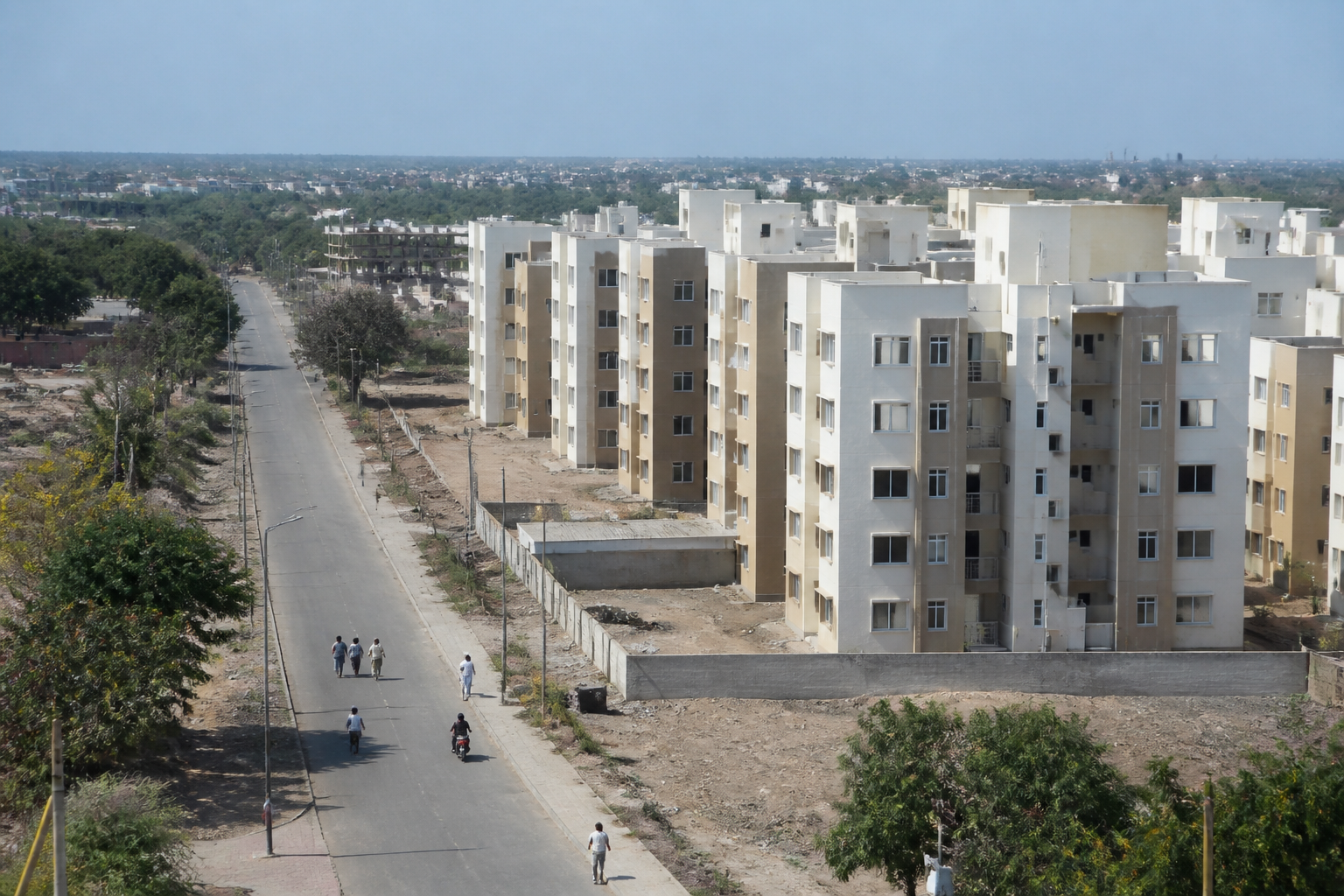
Solapur’s Ray Nagar housing project was conceived as a large-scale solution for unorganised and powerloom workers under the Pradhan Mantri Awas Yojana (Urban). Yet the project’s reported occupancy figures expose a central problem in urban housing delivery: a home cannot become a neighbourhood unless residents can also reach work, schools, healthcare, markets and public transport.
According to a report by Loksatta – Mumbai, about 14,000 beneficiaries have taken possession of homes in the first completed phase of Ray Nagar at Kumbhari, but only an estimated 600 to 650 families are currently living in the housing complex. The project has 30,000 homes planned across roughly 350 acres, with 15,000 homes completed in the first phase. The gap between possession and occupation has prompted the Maharashtra Housing and Area Development Authority (MHADA), the Ray Nagar Federation and the district administration to plan employment and transport interventions within and around the settlement.
The figures indicate that the project’s immediate challenge is no longer only construction or allotment. It is whether households can afford to live in the homes they have received. The report says residents have access to water, electricity, broad roads, a water purification plant and anganwadis. However, the complex is located approximately 12 to 20 kilometres from Solapur city, and residents reportedly lack regular municipal bus services, functioning healthcare facilities, markets and primary and secondary schools in the settlement.
For workers whose livelihoods remain in the city, the distance has a direct financial consequence. One beneficiary quoted in the report said daily earnings of about Rs 350 to Rs 400 could not support a commuting cost of Rs 200 to Rs 250 by rickshaw. The statement captures the difference between formal housing access and practical housing affordability. A subsidised or allotted house may reduce the cost of acquiring a dwelling, but it does not necessarily reduce the cost of living there.
Ray Nagar’s history also shows how the physical completion of a project can precede the creation of an urban ecosystem. The state and central governments decided to build 30,000 homes for unorganised and powerloom workers at Kumbhari. MHADA was appointed the special planning authority for the area, while the Ray Nagar Federation was responsible for housing construction and related responsibilities. The project was launched in 2019, and representative key distribution took place in January 2024. The report says that, despite the possession process having begun roughly one and a half years earlier, the number of resident families remains limited.
This pattern is significant because large housing projects are often assessed through physical indicators: homes completed, beneficiaries identified, keys distributed and subsidies released. Ray Nagar’s reported occupancy rate adds another measure to that list. It asks whether the settlement is functioning as a place of everyday life. In this case, the report suggests that the answer remains uncertain because the infrastructure needed to support daily routines has not kept pace with the housing stock.
The employment question is particularly important. The intended residents include unorganised and powerloom workers, for whom proximity to work and low-cost travel are likely to influence household decisions. If employment remains concentrated in Solapur city while homes are located at Kumbhari, residents must choose between moving into the new settlement and absorbing a substantial commuting cost, or remaining closer to their existing livelihoods. The reported occupancy figures suggest that many households have chosen the second option, even after accepting possession of their homes.
In response, MHADA is preparing a plan to create local employment opportunities. The report says the state government has approved changes in the use of 30 to 40 plots originally designated for various purposes. These plots are expected to be made available for service industries and non-polluting small businesses, including textile-related work, beedi production, pickle, papad and masala production, garment activity and incense-stick manufacturing. MHADA is expected to handle the permissions required for these uses, with implementation scheduled to begin shortly, according to the report.
The proposed approach follows a walk-to-work model: if employment is available within or near the housing complex, the need for expensive daily travel could decline. But the proposal also illustrates how land-use planning decisions made after occupation problems emerge can become a corrective to the original project design. The available material does not establish when these enterprises will begin operating, how many jobs they will create or whether they will match the skills and incomes of the intended residents. Those details will determine whether the plan changes occupancy in practice.
The district administration is also reported to be working on transport, roads and schools. A review meeting on Ray Nagar was held four days before the report, according to the Ray Nagar Federation’s secretary, Yusuf Sheikh, identified in the report as “Major”. Instructions were reportedly issued to introduce new municipal buses, complete the Kumbhari-to-Ray Nagar road urgently and start Marathi, Telugu and Urdu-medium schools from the next academic year. Additional funds for the new road have also reportedly been provided.
These measures point to the multiple institutions involved in making the settlement viable. MHADA is responsible for planning and approvals, the federation has responsibilities connected with the housing project, the district administration is coordinating interventions, the municipal corporation is relevant to bus services and the district council is expected to be involved in schools. The project’s outcome therefore depends not only on the number of houses built but also on coordination across housing, transport, education, local economic development and municipal services.
The Ray Nagar case also raises a broader question about the location of affordable housing. Land on the urban edge may make it possible to assemble a large site and build thousands of units, but distance from established employment and services can impose recurring costs on low-income households. Those costs may not appear in the construction budget or the beneficiary-allocation process. They emerge later through transport fares, travel time, school access, healthcare trips and the loss of working hours.
The report does not establish that every planned facility is absent. It records the presence of several basic utilities and amenities, including water, electricity, roads, a water purification plant and anganwadis. The problem is that these facilities have not been sufficient to persuade most beneficiaries to relocate. This distinction matters. A settlement can have essential physical infrastructure and still remain socially and economically incomplete if residents cannot access work and public services at an affordable cost.
Ray Nagar’s reported figures make that gap visible. Of 15,000 homes completed in the first phase, approximately 14,000 beneficiaries have taken possession, but only 600 to 650 families are estimated to be living there. The project therefore has a large difference between formal delivery and actual use. The figures do not, by themselves, explain every household’s decision, and the source material does not provide a detailed survey of beneficiaries. But they show that key distribution is not a sufficient indicator of housing success.
The next stage will test whether the proposed interventions can convert possession into occupancy. The relevant milestones include the approval and operation of local industries, the availability of municipal bus services, completion of the connecting road, and the start of schools and other essential services. Until those measures are implemented and residents can sustain their livelihoods near the settlement, Ray Nagar will continue to demonstrate the limits of treating housing as a standalone asset rather than as part of a functioning urban system.
