


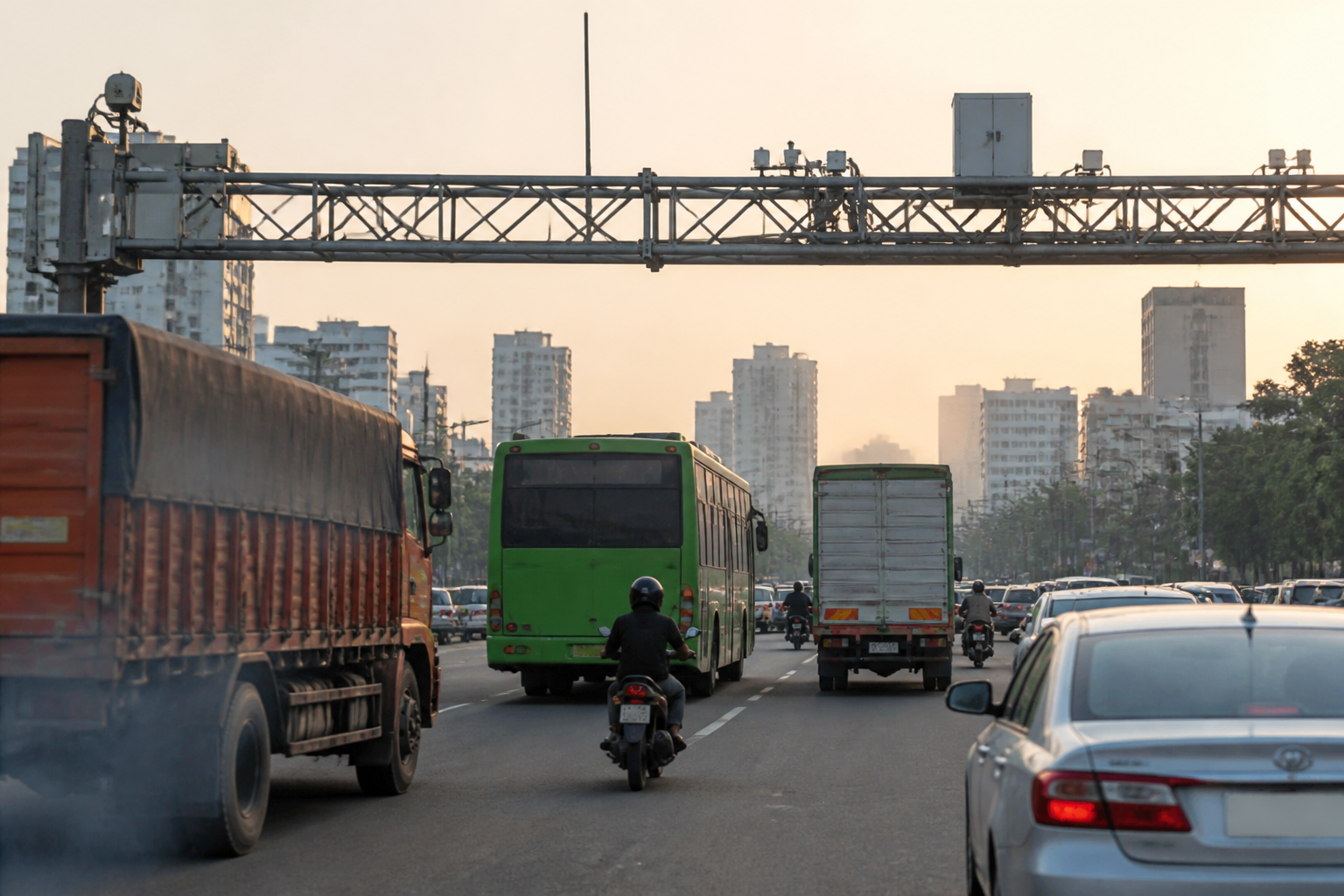
India’s next vehicle-emission regime is still being drafted, but the economic stakes are already becoming visible. Road Transport and Highways Secretary V Umashankar said on September 3 that consultations on Bharat Stage 7, or BS7, were nearing completion and that a draft could be issued in a couple of months. Industry estimates cited by The Hindu BusinessLine place the potential annual opportunity for auto-component manufacturers at close to ₹10,000 crore.
The figure is not a confirmed market size. It is an estimate based on the expected increase in emissions-control content across combustion vehicles, including catalysts, filters, sensors, electronic controls, fluid-dosing systems and exhaust-treatment assemblies. The eventual value will depend on decisions that have not yet been made public, including the emission limits, testing procedures, vehicles covered and implementation timetable.
That uncertainty is central to understanding the BS7 opportunity. The transition is not simply a matter of making one existing component more expensive or adding a new filter to every vehicle. It could alter the technical and compliance architecture of India’s vehicle market, with the largest per-vehicle increases expected in heavy commercial vehicles and diesel-powered passenger vehicles. At the same time, the final treatment of two-wheelers could significantly change the overall value of the market.
The estimated content increase varies sharply by vehicle category. Heavy trucks and buses could require an additional ₹75,000 to ₹1 lakh per vehicle, according to industry experts cited in the report. Medium commercial vehicles could see ₹30,000-40,000 of extra content, while light commercial vehicles could add ₹15,000-20,000. Diesel cars and sport utility vehicles could require ₹12,000-16,000 in additional systems, largely through more sophisticated selective catalytic reduction after-treatment and nitrogen-oxide monitoring.
The expected increase is lower for petrol, compressed natural gas and hybrid passenger vehicles, at approximately ₹3,000-4,000 per vehicle. These vehicles could nevertheless require additional particulate filters and sensors. Two-wheelers are estimated to see only ₹750-1,130 of extra content per vehicle, but annual volumes exceeding two crore units mean that the segment could still account for a substantial part of the overall opportunity.
This difference between unit value and market scale is one of the most important features of the proposed transition. Heavy vehicles offer suppliers the greatest incremental revenue per unit because their emission-control systems are more complex. Two-wheelers offer a different commercial proposition: low additional content per vehicle multiplied by a very large installed and annual sales base. The final balance between these segments will depend partly on whether and how the government applies more demanding monitoring and real-driving requirements to motorcycles and scooters.
The component opportunity is also expected to be concentrated in a few technical areas. Exhaust and after-treatment systems could account for about 40-45 per cent of the estimated opportunity, or ₹3,000-4,500 crore annually. Sensors and monitoring controls could represent another 25-30 per cent, equivalent to ₹2,000-3,000 crore. Fluid-dosing systems are estimated at 15-20 per cent, or ₹1,200-2,000 crore, while precision engine and valve hardware could contribute 10-15 per cent, or ₹800-1,500 crore.
These estimates indicate that BS7 would reward capabilities beyond conventional mechanical manufacturing. The value would increasingly sit in systems that monitor emissions, manage dosing, process data and maintain compliance under operating conditions. That would make electronic controls and sensing technologies as important to the transition as exhaust hardware itself.
The companies positioned to benefit will therefore vary by application. Sharda Motor Industries and Tenneco Clean Air India are identified as direct beneficiaries in exhaust and after-treatment assemblies. Eberspächer and Cummins have exposure to heavy-duty applications. Bosch, Uno Minda, Continental and Sensata are associated with sensors and monitoring systems, while Bosch and Cummins also participate in dosing systems. These are not uniform beneficiaries: their potential exposure will depend on the final technical rules and on the vehicle categories in which they supply components.
Diesel vehicles are especially important to the calculation because many already use particulate filters and selective catalytic reduction systems. The next regulatory step could raise the complexity and value of those systems rather than introduce an entirely new compliance category. Diesel-heavy portfolios at Mahindra and Tata Motors, along with diesel offerings from Hyundai, Kia and Toyota, are consequently described in the report as higher-value applications for suppliers.
That does not mean the transition is limited to diesel. Petrol, CNG and hybrid vehicles could also require additional sensing and particulate-control equipment. The estimates instead show how the starting technology of each powertrain affects the likely incremental cost of compliance. Vehicles with more extensive existing after-treatment systems have a higher base from which the next regulatory upgrade can add content.
The treatment of two-wheelers remains a particularly important unresolved issue. The Society of Indian Automobile Manufacturers, supported by the Japan Automobile Manufacturers Association, wants two-wheelers kept out of initial real-driving emissions testing. The industry’s argument is based on the physical burden of current portable emissions measurement systems, or PEMS. The equipment can include gas cylinders, power packs and heavy analysers weighing more than 100 kg.
A load of that size can be accommodated by a four-wheeler but could substantially affect the operating load of a lightweight motorcycle. Industry representatives argue that placing the equipment on a commuter motorcycle could produce readings that do not reflect normal use. The issue is therefore both technical and regulatory: the government must determine how to measure real-world emissions without allowing the testing method itself to distort the result.
The decision matters because real-driving emissions and onboard monitoring could determine whether the two-wheeler market participates fully in the next wave of component demand. If requirements are deferred, a sizeable share of the possible sensor, monitoring and control revenue could arrive later. If they are included from the outset, manufacturers and suppliers would face a broader compliance shift across one of India’s largest vehicle segments.
BS7 is also being developed alongside other changes in the vehicle regulatory framework. The regime is expected to overlap with tighter Corporate Average Fuel Economy III requirements and India’s move to Worldwide Harmonised Light-Duty Vehicles testing from April 2027. These parallel programmes could create additional compliance work for vehicle manufacturers, although the supplied material does not establish how the requirements will ultimately interact.
The government’s approach is expected to draw from Europe’s Euro 7 regime, but the precise Indian framework remains undecided. Emission limits, monitoring requirements, the vehicles covered and implementation dates have yet to be clarified in the material available. That makes the ₹10,000-crore estimate directional rather than definitive. It describes the scale of a possible market created by stricter standards, not an allocation already approved by the government.
The institutional process now moves from consultation towards drafting. The statement by the road transport secretary provides the clearest timetable in the supplied material: a draft is expected in a couple of months from September 3, after consultations are completed. The draft should provide the basis for assessing which vehicle categories face new obligations, how testing will be conducted and when manufacturers must comply.
Until those details are published, the main conclusion is that BS7 is likely to shift value within India’s vehicle supply chain towards after-treatment, sensing, dosing and electronic-control systems. Heavy trucks and buses could generate the greatest value per vehicle, while two-wheelers could determine the scale of the opportunity through their volumes. Diesel passenger vehicles remain important because of their existing emissions-control architecture.
What remains uncertain is more consequential than the headline estimate. The final rules will determine whether the projected annual opportunity approaches the indicated range, how quickly it materialises and which suppliers capture it. The next significant milestone is the release of the government’s BS7 draft and the accompanying decisions on real-driving emissions, onboard monitoring, two-wheeler coverage and implementation dates.
