


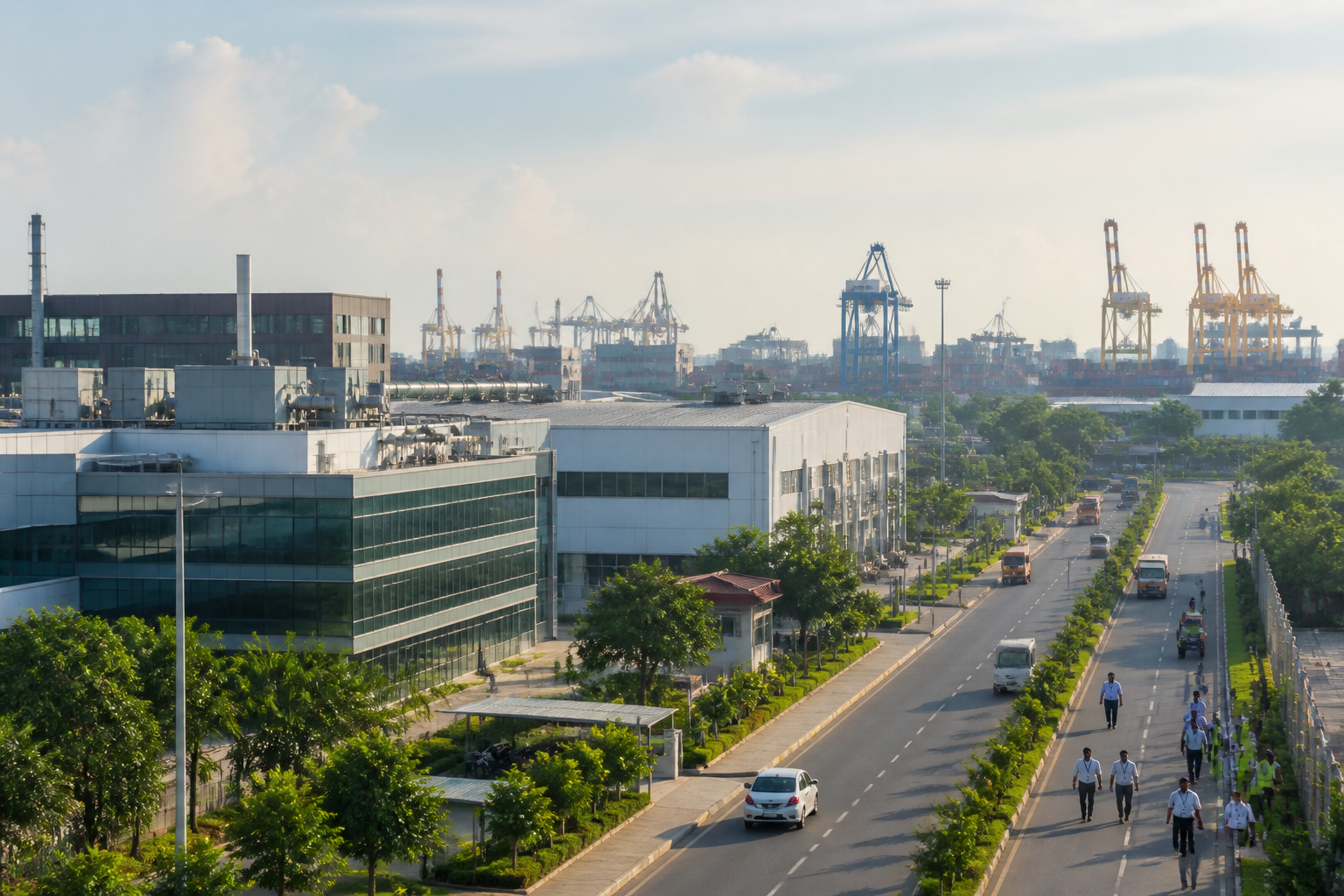
Tamil Nadu’s French investment story is becoming less about individual factories and more about the evolution of Chennai as an integrated industrial, research and logistics ecosystem. Around 150 French companies operate in the state, spanning automotive manufacturing, construction materials, banking, textiles, healthcare, renewable energy, project engineering and technology. Their expanding presence is also exposing the infrastructure, skills and institutional conditions that determine whether Chennai can move from being a manufacturing centre to a deeper innovation hub.
The assessment comes from Étienne Rolland-Piègue, consul general of France in Puducherry and Chennai, in an interview with The Times of India. He identified Chennai’s potential as an innovation ecosystem for industrial and deep-tech applications, while pointing to the city’s manufacturing capacity, research institutions and regional connectivity as factors attracting French companies.
The significance of this relationship lies in the range of activities now being located in Tamil Nadu. French companies are not present only as suppliers or assembly units. According to Rolland-Piègue, their operations include global research and development centres, regional headquarters and local production facilities. This combination gives the investment relationship a wider urban footprint: it affects industrial land, transport links, technical employment, research partnerships and the supporting network of suppliers.
Automotive manufacturing remains the most visible layer. Renault, Stellantis, Valeo and Michelin are among the French companies operating in the sector, which also includes a large ecosystem of component manufacturers. Saint-Gobain represents the construction-materials industry, while BNP Paribas has a presence in Chennai’s financial and corporate-services economy. The interview also identifies textiles, healthcare, renewable energy and project engineering as areas of French interest.
This sectoral spread matters because cities gain more durable economic value when investment creates linkages between factories, research institutions, services and smaller suppliers. The material supplied does not quantify employment, investment value or land use, so it does not establish the overall economic scale of French companies in Tamil Nadu. It does, however, show that the relationship is increasingly distributed across different parts of the urban economy rather than concentrated in one industrial segment.
Chennai’s appeal, as described by the French consul general, rests on three connected advantages: a skilled workforce, an innovation ecosystem and regional connectivity. Institutions such as IIT Madras and its Research Park are cited as important parts of that ecosystem. The city’s location and links to Southeast Asia and the wider Asia-Pacific region are also presented as advantages for companies seeking to combine production, research and regional operations.
These factors reveal how competition between industrial cities has changed. Access to land and labour remains important, but companies making higher-value products and technologies also require institutions capable of supporting research, specialised skills and collaboration. The presence of IIT Madras and its Research Park does not automatically guarantee commercial innovation, but it provides a platform through which companies can connect industrial operations with scientific and technical capabilities.
A recent example cited in the interview is CMA CGM’s opening of an R&D hub in Chennai to develop digital and artificial-intelligence solutions for the group’s shipping activities worldwide. The example is important because it places Chennai within a global corporate technology network rather than limiting its role to local production. It also links the city’s manufacturing and port-oriented economic identity with software, data and logistics innovation.
The city’s future industrial position will partly depend on whether such facilities remain isolated corporate enclaves or connect with local companies, universities and talent. The supplied evidence confirms the establishment and purpose of the CMA CGM hub, but it does not provide details about its workforce, investment, research partnerships or measurable economic impact. Those details will be necessary to assess how deeply the new R&D activity is embedded in Chennai’s wider innovation system.
The India-European Union free trade agreement is another factor that could alter the operating environment for companies in Tamil Nadu. Rolland-Piègue said the automotive industry is likely to be affected, including the network of auto-component suppliers that supports vehicle production. He described the agreement as having a role in developing more diversified and resilient supply chains, while acknowledging that companies’ responses will shape the resulting industrial landscape.
For Chennai, the supply-chain question is particularly relevant because automotive production is not a single-industry activity. Vehicle manufacturers depend on component suppliers, engineering firms, logistics providers and specialised workers. Changes in tariffs or market access could influence where companies source parts, how they organise production and whether local suppliers are able to participate in more complex value chains. The interview does not specify the final tariff structure for automotive products or identify which companies may alter their operations, so the precise consequences remain unsettled.
Electrification is identified as a leading opportunity for Tamil Nadu. The transition to electric vehicles could create demand for new technologies, components and forms of industrial collaboration. Rolland-Piègue also highlighted the importance of intellectual property in this sector, suggesting that future cooperation may involve joint innovation rather than only conventional manufacturing investment.
This is where the relationship between industrial policy and urban infrastructure becomes visible. Electric-vehicle manufacturing requires more than vehicle assembly. It depends on component ecosystems, engineering capabilities, energy systems, logistics and access to technical talent. The source material establishes electrification as a priority sector but does not provide information on charging infrastructure, battery manufacturing, electricity demand or specific EV projects in Tamil Nadu. These are important areas for future scrutiny because they will determine whether the transition creates a broad industrial base or remains limited to selected companies.
The India-France Year of Innovation 2026 is expected to support this wider innovation agenda. Tamil Nadu was among the states most represented during Bharat Innovates 2026 in Nice, France, in June, according to the interview. The stated focus includes innovation in electrification and other sectors such as energy transition and aerospace.
The reference to innovation diplomacy is significant because state-level investment is increasingly shaped by relationships among governments, universities and companies. Tamil Nadu-based firms also have operations and collaborations in France. The Murugappa Group has an industrial presence there, while several information-technology companies from the state operate in France. Chennai-based Zifo was cited as an example of a company collaborating with French scientific firms in the health sector on research and operations.
These links suggest a two-way commercial relationship rather than a simple inflow of foreign capital. French companies are using Tamil Nadu for production, research and regional operations, while Tamil Nadu-based companies are accessing French industrial and scientific networks. The source does not provide figures for the value of these cross-border activities, but it identifies the institutional and corporate connections through which knowledge and business activity can move in both directions.
The interview also discusses French agricultural and wine exporters, who are watching the India-EU FTA for possible tariff reductions. According to the consul general, tariffs on premium wines could decline from the current 150% to as low as 20%, while tariffs on mid-range wines could be reduced to 30%. The reductions would be gradual over seven years, and the stated changes would apply only to premium wines under the terms described in the interview.
This part of the agreement illustrates that trade policy does not operate uniformly across India’s urban markets. Alcoholic-beverage commercialisation varies between states through different registration systems, fees, taxes and distribution arrangements. Even if tariffs fall, companies will still have to navigate state-level market structures. The interview therefore presents the FTA not as a single national switch but as a policy change whose effects will depend on how products move through India’s fragmented regulatory and commercial systems.
For Chennai, the more consequential question is whether the city can support the full range of activity that modern manufacturing and innovation require. The French presence already covers factories, research centres, financial services, construction materials, logistics technology and corporate operations. Each function depends on different parts of the urban system, from industrial connectivity and port access to higher education, housing and specialised labour markets.
The evidence supplied does not establish whether Chennai currently has sufficient housing, public transport, social infrastructure or affordable commercial space for this expansion. Nor does it quantify congestion, land costs, workforce shortages or infrastructure constraints. Those gaps matter because investment attraction is only one part of urban competitiveness. Retaining companies and enabling them to move into higher-value activity depends on the city’s ability to make industrial, residential, research and transport systems work together.
Tamil Nadu’s French investment relationship therefore offers a useful measure of Chennai’s transition. The city has attracted companies that manufacture vehicles and components, produce construction materials, operate banks, develop shipping technologies and collaborate in scientific research. The next phase will depend on whether these activities become more connected through local suppliers, research institutions and skilled employment.
The supplied evidence confirms strong interest from French companies and identifies manufacturing, innovation, electrification, energy transition and aerospace as areas of opportunity. It does not yet show the scale of new commitments, the number of jobs created or the infrastructure investments required. Those details, along with the final implementation of the India-EU FTA, will determine whether Tamil Nadu’s French investment story becomes a deeper transformation of Chennai’s industrial economy or remains a collection of successful but separate corporate operations.
