


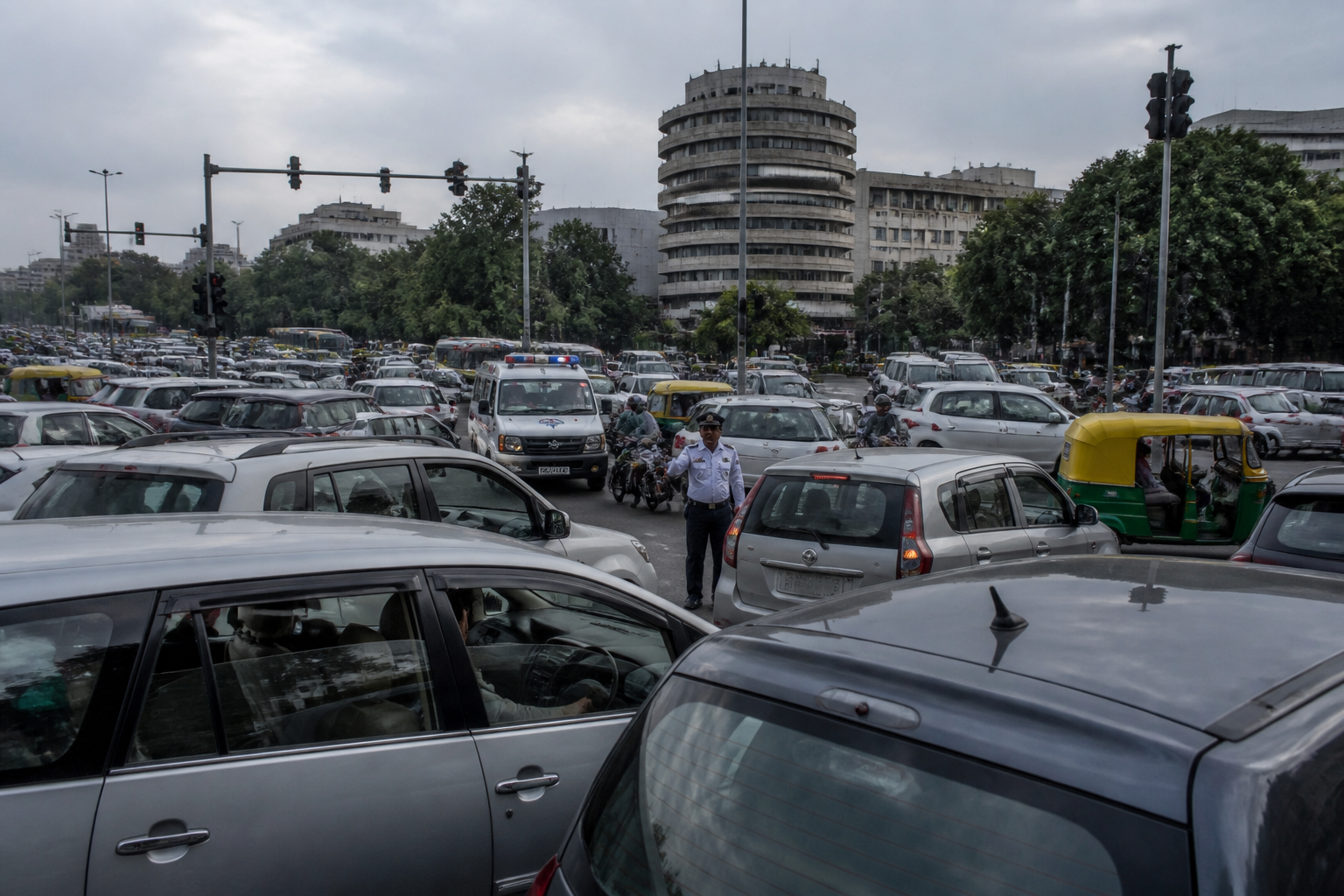
ITO’s recurring traffic queues are not simply the result of poor signal management. The junction has become a concentrated expression of a larger problem in Delhi’s road network: several major traffic movements are competing for limited space, while the infrastructure and signal system struggle to discharge vehicles as quickly as they arrive. For commuters, the result is a wait that can stretch beyond 10 minutes at one signal and a peak-hour journey that becomes unpredictable.
The scale of the problem is significant. Delhi Traffic Police and Municipal Corporation of Delhi estimates place daily traffic at ITO at around 4 lakh to 4.5 lakh vehicles. Some recent studies cited in the report put peak congestion volumes at 6 lakh to 7 lakh. The intersection connects central, east and northeast Delhi with Noida and Ghaziabad, making it more than a local junction. It is a critical transfer point between several parts of the National Capital Region and a key route for commuters, buses, emergency vehicles and traffic headed towards New Delhi Railway Station.
That strategic role is also what makes ITO difficult to manage. The junction is fed by IP Marg, Laxmi Nagar, DDU Marg-Minto Road, W Point, Mathura Road, Tilak Marg and Sikandra Road. These are not minor access roads that can easily be held back while another approach is cleared. Several are important arterial routes, and two or three major movements can become heavily loaded at the same time.
A traffic police source explained the operational dilemma: traffic personnel can normally prioritise the most congested arm of an intersection and accept some delay on other approaches. At ITO, however, giving one direction more green time quickly creates a queue elsewhere. The signal operator is therefore not solving congestion so much as distributing it across competing approaches.
The imbalance between incoming and outgoing traffic makes the constraint clearer. In the morning, the Laxmi Nagar side can feed five to six lanes towards the junction, while only around three lanes can be discharged. In the evening, nearly 12 lanes converge from the W Point side, but only about two and a half lanes can be cleared in one cycle. When vehicles cannot exit the junction within the available green phase, queues begin to occupy space needed by other movements.
This is a classic saturation problem, but at ITO it is intensified by the number and importance of the roads meeting at one point. A queue on one approach can block turning movements, reduce the usable width of another approach and prevent vehicles from clearing the intersection. Once that happens, the next signal cycle begins with less available road space than the previous one. The system loses capacity even before the traffic volume rises further.
Manual traffic management remains necessary because conditions change quickly. Traffic personnel are deployed during peak hours and adjust signals to respond to queues, emergency movements and sudden disruptions. An ambulance from a nearby hospital or college may require officers to intervene. A bus stopping abruptly, a breakdown, an accident, a diversion, a VIP movement or a sudden traffic surge can change the balance within minutes.
But manual intervention cannot create additional road capacity. It can decide which queue moves first, but it cannot make all the competing movements move together. This distinction matters because the public experience of ITO’s congestion is often framed as a signal-timing problem. Longer green phases or more aggressive manual regulation may offer temporary relief to one arm, but they can transfer the delay to another approach or cause a larger queue to form downstream.
The report also identifies a coordination problem beyond the main ITO signal. Even after the junction turns green, vehicles can remain stuck at a pedestrian signal ahead. At night, the red phase at that signal stays longer, leaving the queue in front unable to move and creating a backlog behind it. This means that the effective capacity of the route is determined not only by the ITO stop line but by the next point at which traffic is held.
Signal synchronisation could improve the movement of vehicles between successive junctions, but it is not a complete answer when the corridor is already saturated. S Velmurugan, a road safety and traffic engineering expert and senior adviser at the National Council of Applied Economic Research, said traffic volume at ITO had risen from around three lakh passenger car units in 2001 to what he estimated would be closer to five lakh today. He said every signal has a capacity and that manual management and longer green times were not sustainable at the junction.
Velmurugan also noted that automated synchronised signals could respond to queues but would still have limits. His assessment was that ITO had crossed its optimal capacity and was effectively saturated. He suggested that a flyover along the ITO corridor may be required to separate traffic movements and add road capacity.
That suggestion returns the discussion to a planning question Delhi has been asking for more than two decades: should the junction be redesigned to separate movements, or should authorities continue trying to manage all of them at grade? Plans to span ITO with flyovers date back to 2003. The Public Works Department subsequently proposed schemes in 2005 and 2008-09, although the Delhi Urban Arts Commission raised objections. In 2012, authorities proposed three cloverleaf flyovers intended to make the junction signal-free.
The continued commissioning of studies shows that identifying ITO as a bottleneck has not been the same as delivering a solution. In April, the PWD decided to undertake a feasibility study covering around 156 km of key roads, intersections and junctions, including ITO. The study may provide a fresh assessment, but the history of earlier proposals indicates that the institutional challenge is not simply diagnosing congestion. It is reconciling capacity expansion with urban design, land requirements, construction impacts, cost and the competing functions of the corridor.
The immediate response is therefore focused partly on diversion. Traffic officials have sought faster repair of the road connecting the WHO building to Hans Bhawan. They estimate that the route could reduce the load on the ITO signal by 10% to 20%. That figure is important because even a modest reduction in demand can help a saturated junction function more reliably. When traffic is close to capacity, however, the benefit depends on whether motorists can actually use the alternative route and whether the receiving roads can absorb the diverted movement.
ITO’s congestion also demonstrates why adding road space at one location does not automatically resolve a network-wide problem. If an alternative road ends at another constrained junction, the queue may simply move. If a flyover separates one movement but leaves pedestrian crossings, bus stops, turning traffic and downstream signals uncoordinated, the corridor may gain capacity in one direction while retaining a bottleneck elsewhere. The supplied evidence does not establish which solution the current feasibility study will recommend, but it does show that the problem extends beyond a single signal cycle.
A similar pattern is visible at Chirag Dilli, where ongoing Metro work has increased pressure on a junction connecting the Outer Ring Road with Saket, Greater Kailash, Panchsheel Park and Lajpat Nagar. The junction also feeds traffic towards AIIMS, IIT Delhi and several Metro stations. Around 60,000 vehicles pass through it during peak hours, with pressure shifting between approaches during the day. Queues can extend roughly half a kilometre beyond the foot overbridge.
At Chirag Dilli, the Nehru Place side appears to move slowest because it comes last in the signal sequence, even when its traffic volume is not necessarily the highest. Limited or confusing signage, inadequate lane markings and poor road discipline add to the pressure. The comparison suggests that congestion is produced by an interaction between traffic volume, signal sequencing, road geometry, construction activity and user behaviour rather than by vehicle numbers alone.
For Delhi’s transport agencies, the institutional task is consequently divided across several responsibilities. Traffic police manage signals and road operations. The PWD is responsible for feasibility studies and road infrastructure proposals. The MCD is part of the wider civic system that monitors traffic and road conditions. Other agencies influence pedestrian crossings, public transport operations, construction diversions and emergency access. At a junction such as ITO, the effectiveness of any intervention depends on coordination across these functions.
The evidence also points to a measurement gap. Traffic counts are presented in different forms: daily vehicle estimates, peak congestion volumes and passenger car units. These measures are useful for different purposes, but they do not by themselves explain how long each movement is delayed, how much traffic is turning, how many buses stop within the junction influence area or how pedestrian phases affect throughput. A durable redesign would require those movements to be assessed together rather than treating the signal as an isolated object.
The central urban question is whether Delhi should continue treating major intersections as places where traffic can be manually balanced, or whether some have crossed a threshold where their functions must be physically separated. ITO’s history suggests that the junction has been operating under increasing pressure for years. The gap between earlier proposals and present conditions has allowed temporary measures to become part of the routine management system.
What the available evidence confirms is that ITO’s delays are rooted in a capacity mismatch: traffic arrives through more lanes and more important approaches than the junction can clear in one cycle. Manual regulation, signal changes and synchronisation may manage queues, but they cannot permanently overcome that mismatch. The next milestone is the PWD feasibility study covering ITO and other bottlenecks, along with the proposed repair of the WHO building-Hans Bhawan connection. Whether those measures reduce congestion will depend on how quickly they are implemented and whether they address the full corridor rather than only the signal at its centre.
