


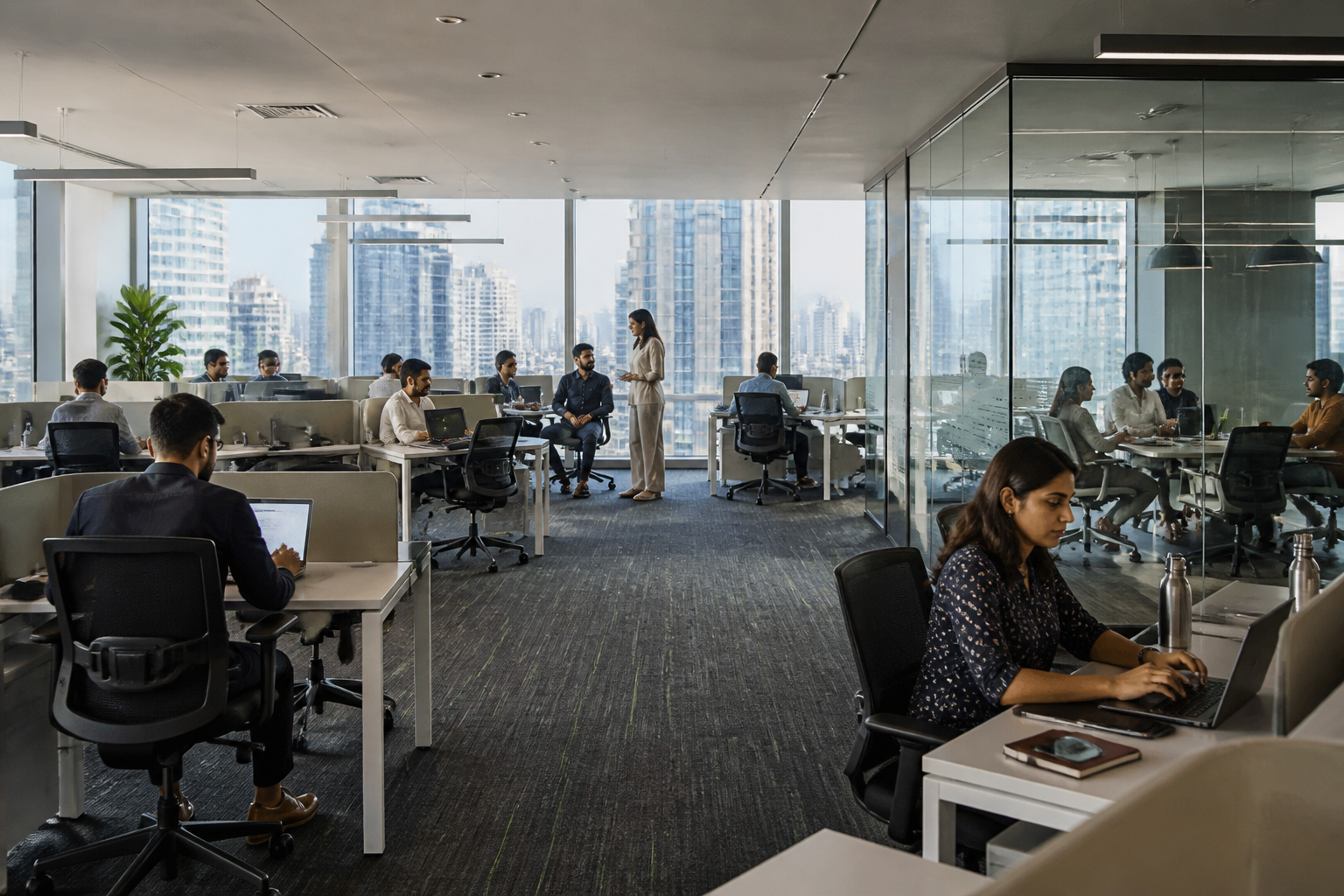
Subheadline: Rising flexible-office leasing suggests that multinational companies are expanding in India while seeking more adaptable workplace formats.
Standfirst: Mumbai and Pune are seeing sharply different but significant growth in flexible-office leasing as multinational companies and global capability centres expand their presence in India. According to a Cushman & Wakefield report cited by Loksatta, flexible-office operators leased 25,820 seats in Mumbai and 20,900 in Pune during the first half of 2026. Mumbai’s figure was 130 per cent higher than in the corresponding period of 2025, while Pune recorded 27 per cent growth. Across eight major cities, operators leased 191,306 seats, up 68 per cent year on year. The data points to a shift in how companies approach office space: instead of committing immediately to fully independent premises, some are using managed, flexible workplaces that can accommodate changing requirements. This analysis examines what the reported numbers reveal about India’s office-market structure, the growing role of global capability centres and the changing relationship between corporate expansion and urban real estate.
The reported growth in flexible-office leasing is not simply a story about coworking brands adding desks. It reflects a change in the way multinational companies are occupying urban commercial space. In Mumbai and Pune, companies continue to invest and maintain a presence, but the format of that presence is changing. The office is increasingly being treated as a service that can be adjusted, rather than only as a long-term, independently operated corporate asset.
That distinction matters for cities. Conventional office expansion generally involves a company identifying a site, signing a long lease, designing a workplace and managing its operations. Flexible offices place many of those functions with an operator. Companies can lease managed space, use existing facilities and adjust the number of seats according to their requirements. The Loksatta report describes this as a preference for effective, flexible and managed office facilities.
The data cited in the report shows the scale of the shift. During January to June 2026, flexible-office operators leased 191,306 seats across eight metropolitan markets. That was 68 per cent higher than the number leased in the first half of the previous year. Flexible offices accounted for 20 per cent of total office-space transactions in the markets covered by the report.
The figure is significant because it places flexible offices within the mainstream office market rather than treating them as a narrow alternative for freelancers, start-ups or small businesses. A fifth of office-space transactions being associated with flexible offices indicates that the format is becoming part of the institutional real-estate landscape. The supplied report, however, does not establish whether every leased seat represents a new employee, a relocation from conventional premises or a temporary expansion of an existing workplace. That distinction remains important when assessing the overall growth of office employment.
Mumbai recorded the sharpest increase among the two western Indian markets highlighted in the report. Operators leased 25,820 seats in the city during the first half of 2026, compared with 11,226 seats in the same period of 2025. The increase was reported at 130 per cent. Pune recorded 20,900 leased seats, up from 16,352 a year earlier, representing growth of 27 per cent.
The two figures describe different market positions. Mumbai’s growth was faster, suggesting a substantial increase in flexible-office activity over the comparison period. Pune’s market was smaller in absolute terms than Mumbai’s but still recorded more than 20,000 leased seats in six months. Together, the two cities accounted for 46,720 seats in the first half of 2026, although the supplied material does not provide their combined share of the national total.
The comparison also shows why seat numbers should be read alongside the structure of each city’s office market. Mumbai is a major corporate and financial centre with high-value commercial districts and a constrained geography. Pune combines information technology, engineering, manufacturing and services activity with a large metropolitan employment base. Flexible offices can serve different requirements in each market, but the supplied report does not provide a breakdown by business district, building type, rental level or company size.
The strongest signal in the report concerns global capability centres, or GCCs. GCCs accounted for 44 per cent of flexible-office leasing in the first half of 2026, up from 37 per cent in the corresponding period of the previous year. These centres are established by global companies to perform functions such as technology, business services and other corporate operations, although the supplied material does not provide a detailed breakdown of their activities in this period.
The rise in the GCC share links office demand with India’s position in global corporate operations. The report says that global companies are increasingly choosing India for GCC investment, and that this is reflected in demand for office space. Flexible offices offer such companies a way to establish or expand operations without waiting for a fully independent workplace to be built and managed.
This does not mean that GCCs are replacing conventional offices. The available data only shows their share of flexible-office demand. It does not establish their share of all office leasing, the duration of their agreements or the extent to which companies eventually move into independent premises. Still, the increase from 37 per cent to 44 per cent indicates that GCC-related demand has become more prominent within the flexible-office segment.
Bengaluru remained the leading city by the number of flexible-office seats leased. Operators leased 57,487 seats there during the first half of 2026, compared with 43,616 in the first half of 2025. The increase was reported at 31.8 per cent, and Bengaluru accounted for 30 per cent of the total transactions across the eight cities.
Hyderabad recorded 40,451 seats, up from 14,936, an increase of 170 per cent. Delhi recorded 21,970 seats, compared with 8,693 a year earlier, representing growth of 152 per cent. Chennai recorded 16,297 seats, up 3.6 per cent from 15,731. Kolkata reached 3,454 seats from 2,334, a 48 per cent increase. Ahmedabad recorded the highest percentage increase, at 570 per cent, with 4,927 seats compared with 735 in the previous year.
These figures show that the flexible-office trend is broad-based but uneven. Bengaluru retained the largest absolute market, while Ahmedabad recorded the fastest percentage growth from a much smaller base. Hyderabad and Delhi also registered steep increases. The variation suggests that flexible-office demand is being shaped by the particular office economies of individual metropolitan areas rather than by a uniform national pattern.
The data also highlights the difference between percentage growth and market scale. A large percentage increase in a smaller market does not necessarily represent more activity than a moderate increase in a larger one. Bengaluru’s 57,487 seats remained well above Ahmedabad’s 4,927, despite Ahmedabad recording the higher growth rate. Mumbai’s 25,820 seats also exceeded Pune’s 20,900, even though the two cities serve related regional corporate networks.
For commercial real-estate owners, the growing role of flexible operators may alter how office buildings are planned and leased. Buildings may need to accommodate managed-office operators alongside conventional corporate tenants. However, the supplied report does not provide information on rents, vacancy levels, building completions, lease durations or the financial performance of flexible-office companies. It therefore supports an assessment of demand, but not a conclusion about profitability or future supply.
For employers, flexible offices can reduce the time and operational effort required to establish a workplace. The model can also support phased expansion, particularly when a company is testing a market or scaling a GCC. At the same time, the source material does not indicate whether companies are choosing flexible offices because of cost, speed, workforce uncertainty, location, amenities or other factors. Those motivations should not be assumed from the seat-leasing figures alone.
For urban planners and municipal authorities, the growth of flexible offices raises questions about how employment districts are used. More office seats can affect transport demand, parking, building services and the daily movement of workers. Yet the supplied report does not quantify commuting patterns, occupancy rates, traffic impacts or the distribution of flexible offices within each city. The urban consequences are therefore relevant but not measured in the available evidence.
The reported numbers confirm three developments. Flexible offices have become a sizeable component of office-space transactions across eight major Indian cities. GCCs are taking a larger share of that segment. And Mumbai and Pune are participating in the shift, with Mumbai recording particularly rapid growth and Pune maintaining a substantial volume of activity.
What remains uncertain is whether these seats represent a lasting change in corporate real-estate strategy or one phase in a company’s expansion cycle. The next useful evidence would include lease tenure, occupancy, conversion from flexible to independent offices, the location of new facilities and the relationship between flexible-office demand and overall office absorption. Until that information is available, the clearest conclusion is that multinational expansion is increasingly being expressed through adaptable workplace formats, making flexible offices an important part of the evolving urban commercial landscape.
