


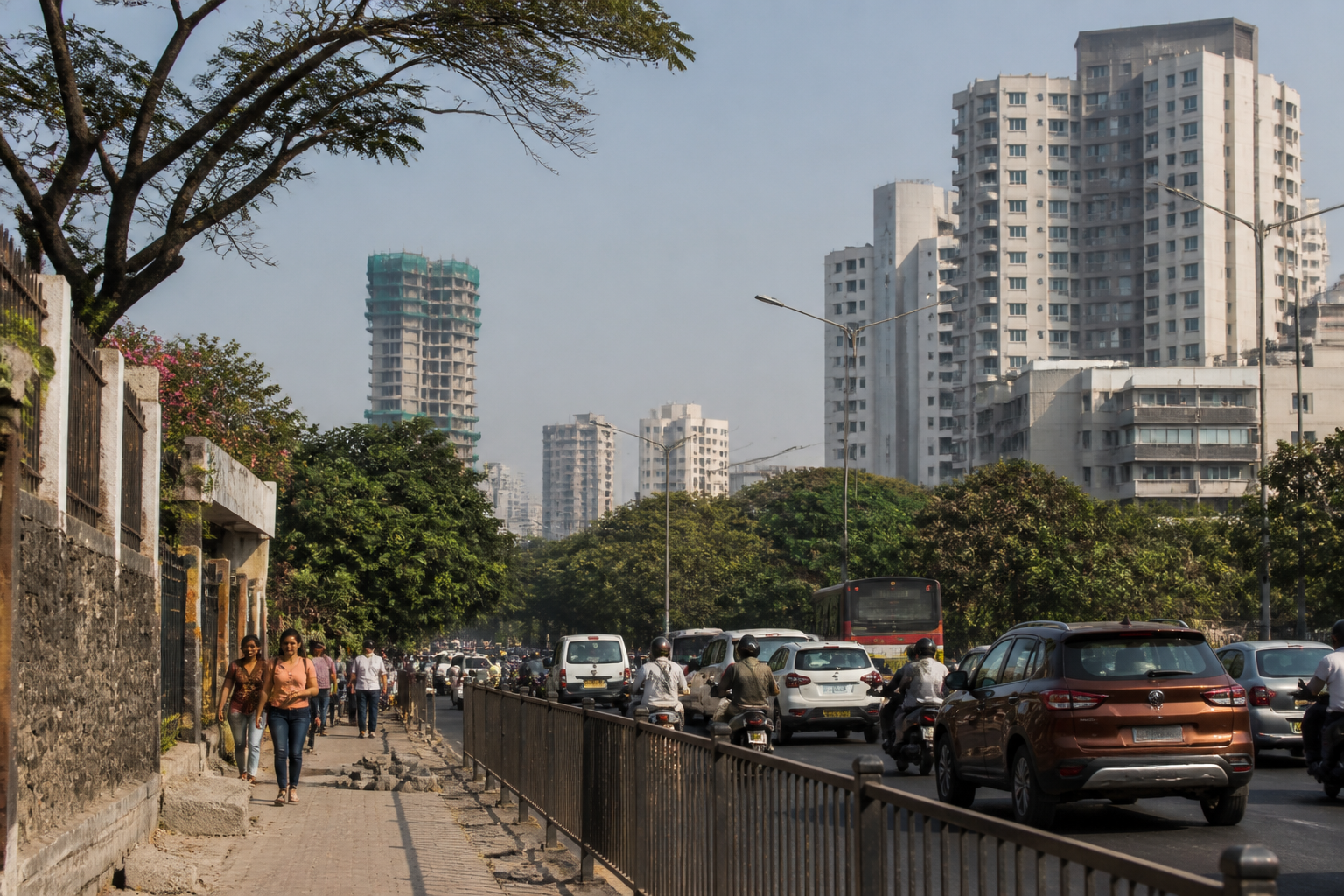
Pune’s debate over higher floor space index (FSI) has moved beyond the question of how much the city can build. It now concerns whether the municipal system can support the additional buildings, residents, vehicles and service demand that new construction may bring.
Former Member of Parliament Vandana Chavan has asked the Pune Municipal Corporation commissioner not to approve new construction without first assessing the civic body’s capacity to provide infrastructure. Her intervention follows PMC Commissioner Naval Kishor Ram’s statement that construction covering 6.50 crore square feet could take place within the municipal limits over the next four years.
The figures, presented in the supplied report, bring two different aspects of Pune’s urban expansion into the same policy discussion. The commissioner’s statement points to the scale of construction expected as the city expands in all directions. Chavan’s memorandum questions whether the city’s roads, public transport, drainage, waste systems, electricity supply, schools, health facilities and open spaces can absorb that growth.
The issue is rooted in the way development potential is distributed. The state’s Unified Development Control and Promotion Regulations, or UDCPR, have enabled construction approvals across Maharashtra. Chavan argues that the rules are permitting substantial additional development without adequate consideration of local infrastructure capacity and local needs. Her concern is not simply that more buildings are being constructed, but that the supporting systems may not be expanded at the same pace.
That distinction is central to Pune’s FSI debate. FSI determines the amount of built-up floor area that can be developed on a plot relative to its size. Higher FSI can allow taller or denser buildings, particularly in areas where planning rules seek to concentrate development. But the supplied report does not provide a citywide assessment of how much additional road capacity, drainage capacity, water supply, public transport or public space would be required for the projected construction.
Instead, it records a political and administrative disagreement over whether such an assessment is taking place. Chavan said that buildings ranging from five, seven and nine floors to structures of 15 to 20 floors are emerging in some parts of Pune under the UDCPR framework. She also referred to increased FSI along metro routes, arguing that connecting roads and other supporting infrastructure have not yet been strengthened sufficiently.
The metro-linked FSI question illustrates the planning challenge. Higher development potential near mass-transit corridors is generally intended to place more residents and activities near public transport. In the material available for this report, however, there is no detailed account of how the increased FSI is being applied along Pune’s metro routes, which locations have received it, or whether development approvals are tied to measurable improvements in pedestrian access, roads and feeder connectivity.
That missing information is important because transport capacity is not determined by a metro line alone. Residents must be able to reach stations, and buildings must connect to surrounding streets without overwhelming local junctions. Chavan’s memorandum specifically links rising urbanisation with traffic congestion, inadequate footpaths, road deterioration and encroachments. These conditions suggest that the infrastructure question extends from major projects to the everyday public realm around new development.
The commissioner’s comments describe a city facing rising population and vehicle numbers. According to the supplied report, he said roads are becoming insufficient and that projects such as the Ring Road and the High Capacity Mass Transit Route, or HCMTR, are needed. He also said special efforts were being made for these projects. The report does not include project budgets, completion schedules, land-acquisition details or capacity estimates for either initiative, so their ability to offset future construction demand cannot be assessed from the available material.
Chavan’s proposed response is an infrastructure audit before permitting large projects or granting increased FSI in areas with inadequate services. She called for audits of public transport, drainage, solid waste management, electricity, schools, healthcare facilities and open spaces. The proposal shifts the focus from a broad citywide construction forecast to a location-specific test: whether each area has the systems needed to support additional built density.
Such a test would require more than counting permitted floor area. It would need to connect building approvals with the capacity of roads, stormwater and sewage networks, waste collection, power distribution and public facilities. The supplied report does not say whether PMC currently publishes this information in a consolidated form, or whether such a framework has been formally proposed by the municipal administration.
The governance question is therefore as significant as the construction question. The UDCPR provides a common regulatory framework, while the municipal corporation is responsible for many of the services affected by development. When construction rules and municipal infrastructure planning operate on different timelines, the number of approved buildings can increase before supporting services are expanded. The report identifies this risk but does not establish how responsibilities are currently divided in individual approval decisions.
There is also a question of public benefit. Chavan asked whether the advantage of higher FSI is being realised in the interest of citizens or primarily for builders. The statement is an attributed political argument, not an independently demonstrated finding in the supplied material. Still, it identifies the distributional issue at the centre of the debate: additional development rights can create value for landowners and developers, while the cost of accommodating new demand may fall on public agencies and existing residents if infrastructure investment does not keep pace.
Pune’s projected 6.50 crore square feet of construction over four years is the only quantified forward-looking figure cited in the report. It provides a measure of expected development activity, but not of the population, employment, traffic or service demand that this floor area would generate. Without those additional estimates, the infrastructure burden cannot be calculated. Nor does the report specify how much of the construction would be residential, commercial or mixed-use.
This limits what can be concluded from the announcement. The material supports the existence of a serious policy concern and a demand for capacity-based approvals. It does not prove that all new construction is inadequately serviced, that higher FSI has caused the city’s existing problems, or that a formal moratorium has been ordered. It also does not establish whether PMC has accepted, rejected or begun acting on Chavan’s requests.
The next stage of the debate would depend on public evidence from the municipal corporation and other responsible agencies. That evidence would need to clarify the projected construction pipeline, the locations affected, the infrastructure capacity available in those locations and the status of planned transport and utility improvements. It would also need to show how the UDCPR framework is being applied where roads, drainage, public transport and civic amenities are already under pressure.
Pune’s FSI discussion consequently exposes a wider urban-planning test. The question is not whether the city should grow, but whether regulatory permission to build is being matched by a documented ability to serve what is built. The supplied report confirms the scale of the concern and the competing official and political positions. It leaves unresolved whether Pune has a formal, transparent mechanism to link development intensity with infrastructure capacity—the issue that should now be monitored through PMC decisions, audits and project updates.
