


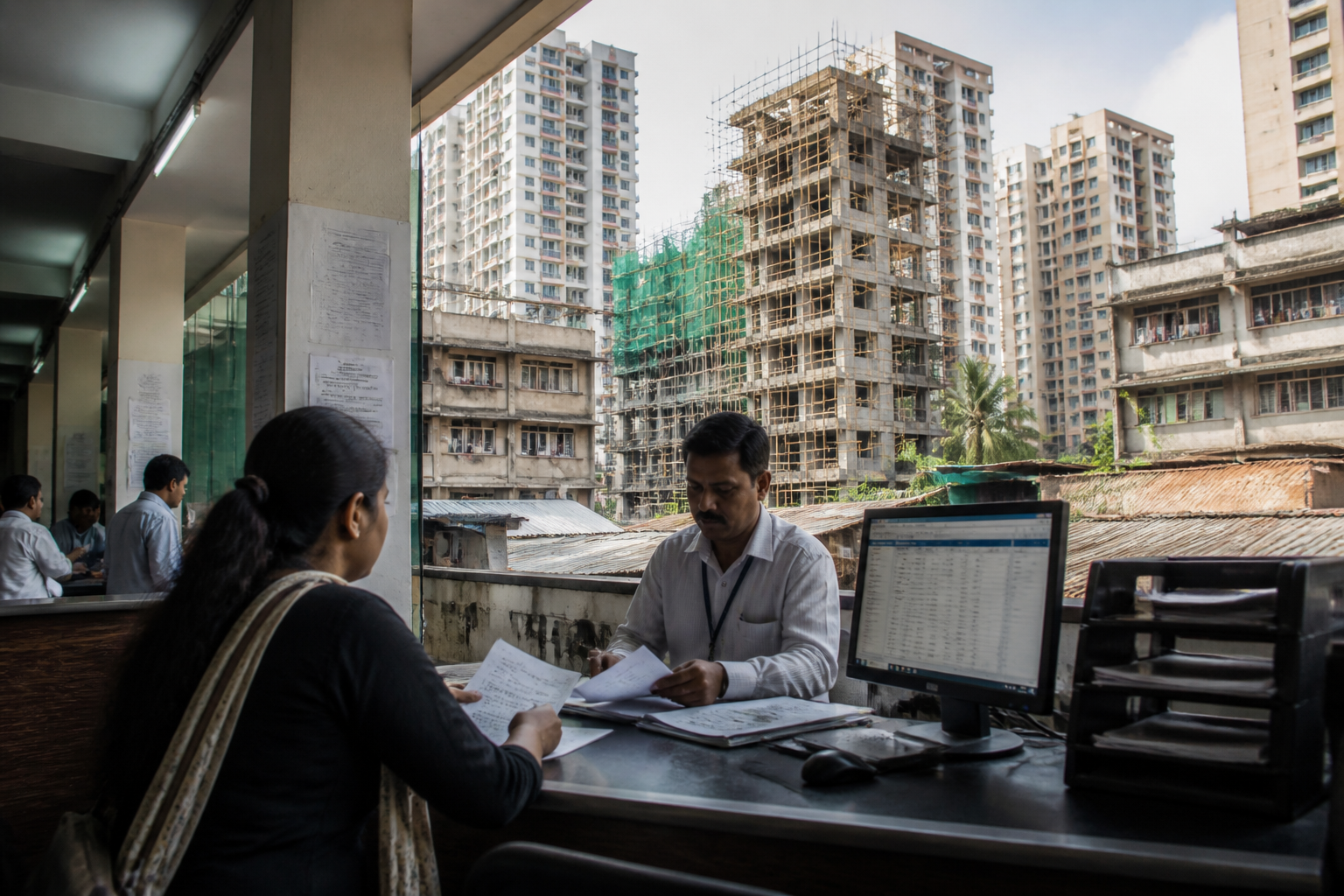
Vasai-Virar’s online building records have become the latest test of whether municipal transparency can protect homebuyers in a city where the town-planning department has already faced scrutiny over alleged construction irregularities. According to a report by Loksatta – Vasai-Virar, the Vasai-Virar City Municipal Corporation’s website has not updated information on construction commencement certificates, or CCs, and occupancy certificates, or OCs, for about a year.
The gap is not merely a website-maintenance problem. CCs and OCs are among the documents that help establish whether a building has received permission to proceed with construction and whether it has been approved for occupation. When these records are incomplete or outdated, buyers, residents and other stakeholders have fewer readily available ways to assess the regulatory status of a project.
The report says the last CC listed on the municipal portal was uploaded on July 21, 2025, while the last OC was uploaded on July 26, 2025. The information was published on September 3, 2026, meaning that the reported gap extends for more than a year. The portal reportedly showed 2,387 CC records from November 2010 to July 2025 and 2,076 OC records from January 2011 to July 26, 2025. No newer certificates were visible in the online records examined by the publication.
These figures matter because municipal portals are increasingly treated as the first point of reference for citizens trying to understand development approvals. A prospective homebuyer may use the portal to check whether a project has received the relevant permissions before committing savings to a property. The absence of current records does not, by itself, prove that a building is unauthorised. It does, however, make it harder for an individual to distinguish between a project whose information has not been uploaded and one whose approvals may not exist.
That distinction is central to the public-interest issue. A digital record is useful only when it is complete, current and sufficiently clear for a non-specialist to interpret. An outdated list can create two opposite risks. Buyers may assume that an unlisted or incompletely documented project lacks approval even when the municipal file exists offline. Alternatively, they may be unable to identify a compliance problem before purchasing because the relevant certificate has not been made available online.
The concern is particularly significant in Vasai-Virar because the town-planning department has previously been placed under scrutiny following investigations into alleged construction-related wrongdoing. Loksatta reported that the Enforcement Directorate took action in May 2025 against Y. S. Reddy, then deputy director of the town-planning department. The report also said that then municipal commissioner Anilkumar Pawar suspended Reddy after the action and that subsequent proceedings involved action against Pawar as well. Architects, chartered accountants and developers were also questioned during the investigation, according to the report.
The available account does not establish a direct connection between the investigation and the failure to update the website. Nor does the delay demonstrate that unauthorised construction was deliberately protected. Citizens quoted in the report have raised that concern, but it remains an allegation rather than an established finding. The defensible conclusion is narrower: after a major controversy involving the regulation of construction, the continued absence of updated approval records leaves the administration with a serious credibility and accountability problem.
The municipal response, as reported by Loksatta, points to an administrative process that is still being reorganised. Town-planning deputy director Manish Bhishnurkar said the information would be obtained and updated on the website. He also said the department would seek access to the system so that certificates could be uploaded directly from within the department. Municipal town-planning officials reportedly said they had asked the information technology department to appoint a dedicated engineer for online CC and OC updates.
That response identifies two operational weaknesses. The first is ownership: if the department that issues or maintains approval records does not have direct control over publishing them, uploading can depend on coordination with another unit. The second is capacity: without a designated technical resource, even a policy requiring disclosure may not result in consistent updates. In both cases, the problem is not simply whether a document exists, but whether responsibility for publishing it is clearly assigned and monitored.
For homebuyers, the practical difficulty is that construction permissions are not always easy to interpret even when they are available. A certificate may need to be matched with the project name, building number, location, developer and relevant dates. The portal therefore needs more than a collection of scanned documents or isolated entries. It needs a reliable search and verification system that allows citizens to connect a particular building or project with its approval history.
The report does not provide details of the portal’s technical design, the frequency with which the corporation is required to update it, or whether a complete offline register is available for public inspection. It also does not establish how many certificates were issued after July 2025, whether those certificates were held up at the approval stage or merely not uploaded, or how many projects and buildings are affected. Those unanswered questions are important because the public significance of the delay depends partly on the scale of the missing information.
They also determine how the municipal administration should explain the gap. A transparent clarification would distinguish between certificates that were not issued, certificates that were issued but not digitised, and certificates that were uploaded but are no longer accessible because of a technical or database problem. Without that distinction, citizens are left to infer the status of a project from the absence of an online entry, a method that can produce confusion and disputes.
The issue reflects a wider governance principle: digitisation does not automatically create transparency. A municipal website can improve accountability only when its records are updated through a defined workflow, verified by the responsible department and supported by an audit trail. The public should be able to see when a record was added or revised, which authority issued it and whether a later certificate changes the status of an earlier approval.
For a city experiencing sustained construction activity, this administrative infrastructure is as important as physical infrastructure. Roads, water networks and buildings are visible urban assets, but the permissions governing them are part of the city’s institutional infrastructure. When that information is inaccessible, oversight becomes more difficult for buyers, residents, journalists and civil-society groups. It can also increase the burden on municipal staff because citizens must rely on individual visits, informal channels or repeated applications to obtain information that should be routinely available.
The Vasai-Virar case also shows why housing regulation cannot be treated as a matter affecting only developers and planning officials. A commencement certificate relates to the authority to proceed with construction, while an occupancy certificate is associated with a building’s approved readiness for occupation. For a buyer, these documents form part of the chain of evidence used to assess a property. For a resident, they relate to whether the occupied building has passed through the required municipal process. For the city, they help connect physical growth with regulatory records.
The evidence currently available confirms a prolonged gap in the online publication of CC and OC information, a history of scrutiny involving the town-planning department, and a municipal undertaking to restore or improve updates. It does not confirm that all projects without recent online entries are unauthorised, nor does it prove that the delay was intentional. Those distinctions should remain clear while the corporation addresses the administrative failure.
The next measure of transparency will be whether the municipal website publishes the missing records, identifies the date and scope of the backlog, and clarifies who is responsible for future updates. The corporation’s stated plan to obtain departmental access and seek a dedicated engineer provides an administrative direction, but the effectiveness of that plan will depend on implementation. Until the records become current and verifiable, homebuyers in Vasai-Virar will continue to face an avoidable information gap when assessing the legality and status of construction projects.
