


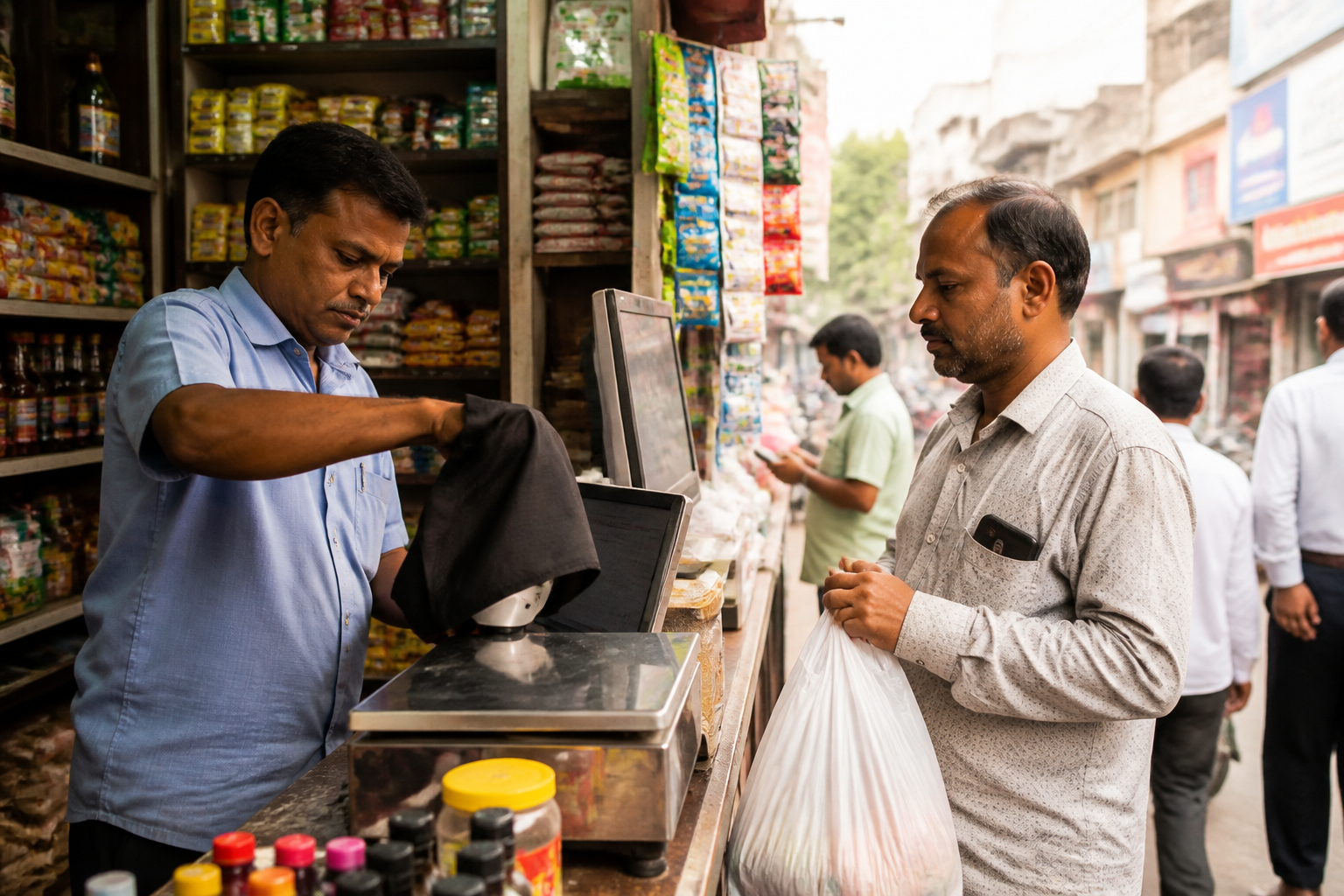
Nagpur’s No UPI Day protest disrupted digital payments at several shops, leaving cashless customers searching for ATMs or arranging money before completing routine purchases. The campaign, called by the Nagpur Chamber of Commerce, opposed a proposed 0.4% Merchant Discount Rate (MDR) on selected person-to-merchant UPI transactions above Rs2,000.
The protest received a mixed response across the city. Some traders covered their UPI QR scanners with black cloth and accepted only cash, while others continued to take digital payments. As a result, customers faced different payment conditions depending on the establishment they visited.
The disruption was particularly inconvenient for consumers who no longer routinely carry cash. Vishwas Kulkarni, who visited a grocery store in Narendra Nagar, said he learnt about the protest only when he reached the shop. He said the store had covered its UPI QR code and would accept only cash. Kulkarni added that he had stopped carrying cash after adopting UPI and that his ATM card had lapsed because of non-use.
The Nagpur Chamber of Commerce described the campaign as a success and said traders were not opposed to UPI or digital payments. Its objection was to the proposed additional transaction cost. Chamber president Pradeep Jajoo said a 0.4% MDR on eligible transactions above Rs2,000 would increase the cost of doing business. He said that even if the charge was not directly recovered from consumers, the additional cost could eventually affect prices.
Former Chamber president CA Kailash Jogani said traders recognised the role of UPI in everyday transactions. He said the concern was about adding another cost to a payment system that had made digital transactions simple and accessible. The Chamber appealed to the government to reconsider and withdraw the proposal and urged it to resolve the issue through dialogue with the trading community.
For consumers, the protest demonstrated how quickly UPI has become integrated into ordinary urban commerce. Customers who expected to pay digitally discovered the restriction only at the point of purchase, exposing the consequences of a payment interruption without necessarily affecting every shop in the same way. The episode also highlighted the continuing importance of cash and functioning ATM access for people using increasingly cashless routines.
The Chamber reiterated that the campaign was intended to draw attention to traders’ concerns over transaction costs and not to oppose digital payments. Its next step is to seek a government response through dialogue on the proposed MDR.
