


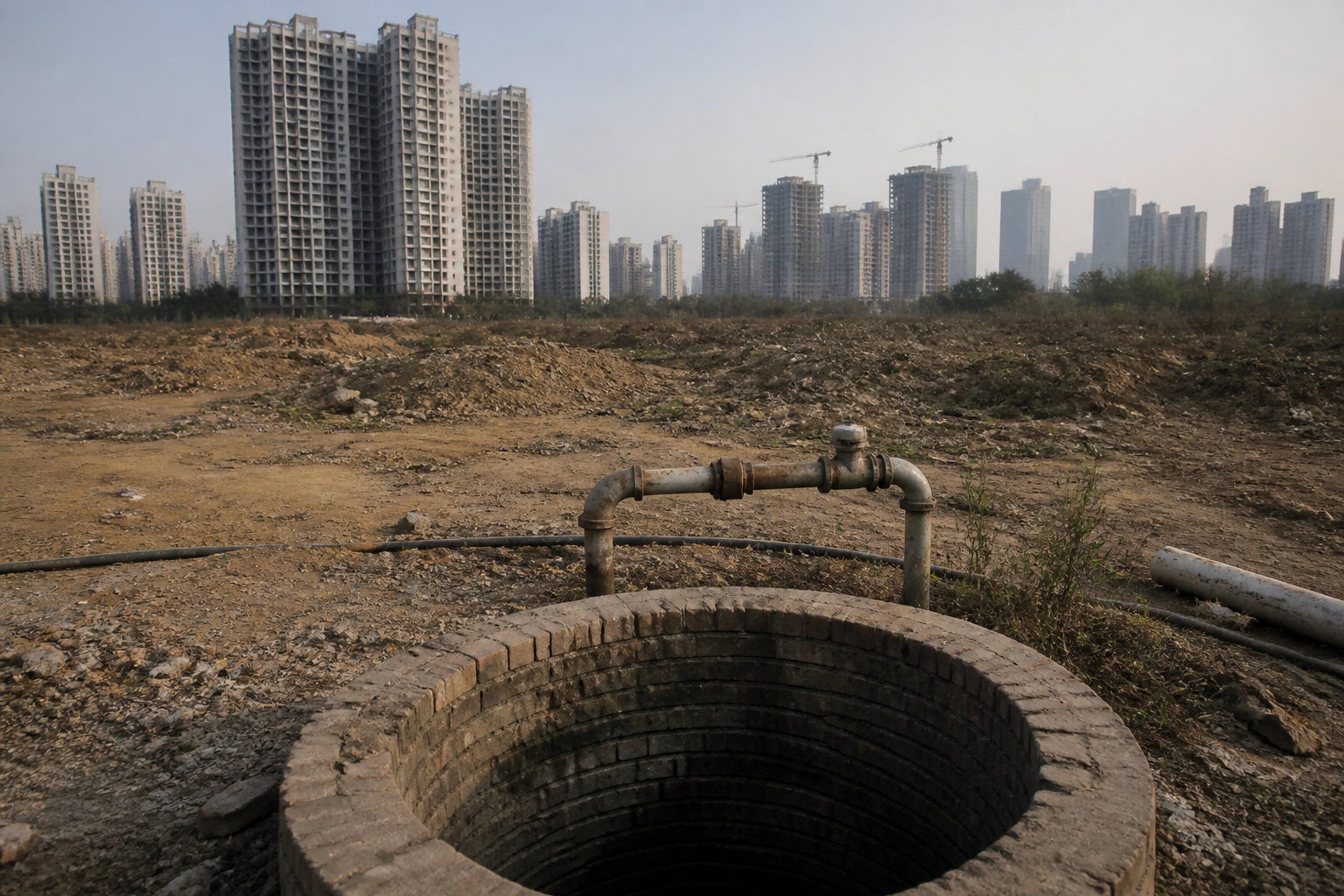
The Punjab and Haryana High Court has directed government agencies to examine Gurugram’s worsening groundwater crisis after recording that water levels have fallen by nearly 40 metres in several areas and that annual extraction is twice the available groundwater resource.
A bench comprising Chief Justice Ashwani Kumar Mishra and Justice Rohit Kapoor issued the directions in its October 1 order on a group of petitions concerning groundwater-related issues. The court warned of “disastrous consequences” for future generations if depletion continues unchecked and said the present generation is a trustee of natural resources for those to come.
The court cited an affidavit filed by the Central Ground Water Board before the National Green Tribunal, which stated that the annual extractable groundwater resource is twice the available resource. It also recorded admissions by the Haryana Water Resources Authority in Panchkula that groundwater levels in Gurugram have dropped by nearly 40 metres in several areas.
Describing the situation as “rather grim”, the bench directed the authorities to examine the issue in detail and formulate measures to halt further depletion. The court has asked the chief executive officer of the Gurugram Metropolitan Development Authority, P C Meena, to convene a high-level meeting on October 5.
The meeting will include the Gurugram deputy commissioner, the Haryana Shehri Vikas Pradhikaran administrator, the Gurugram municipal commissioner and senior officials from the Haryana Water Resources Authority, Haryana Pond Authority, Central Ground Water Board and Central Ground Water Authority. Representatives of TERI, local resident welfare associations, DLF City and REDCO have also been invited.
The Central Ground Water Authority has been directed to provide exact data on registered and unregistered borewells operating across Gurugram. The court has also urged the panel to examine whether groundwater extraction can be immediately prohibited in areas already served by piped water supplied by GMDA.
The direction places borewell mapping and the relationship between piped-water access and groundwater extraction at the centre of the immediate administrative response. It also brings government agencies, major private developments, resident groups and research institutions into the same review process.
The court order arose during hearings in Sunil Singh v. Ministry of Environment and Forests, along with related petitions filed by the Qutab Enclave Residents Welfare Association and others. Meena has been directed to submit an affidavit by October 8 detailing the decisions and outcomes of the October 5 meeting.
