


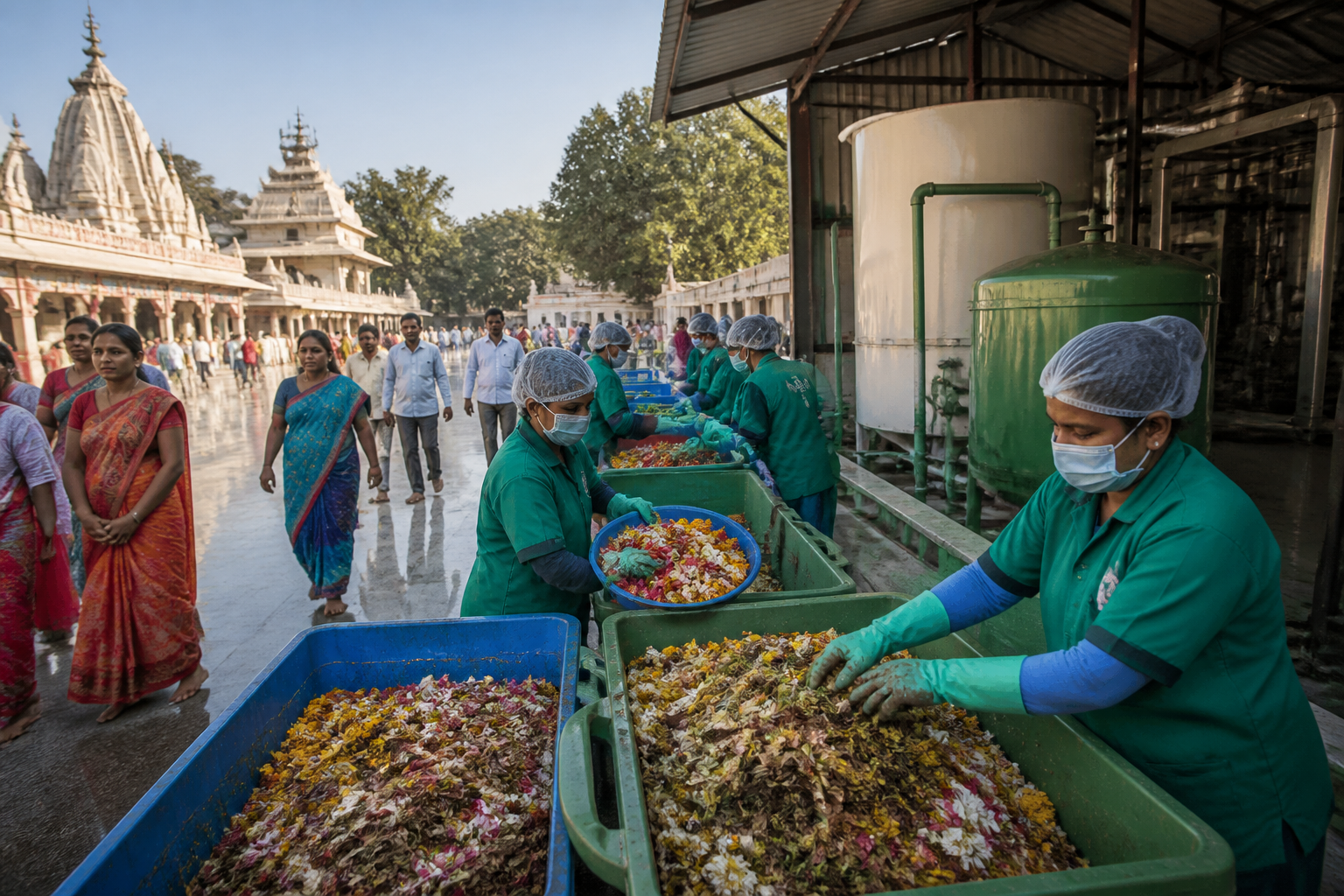
ITC’s expansion of its Green Temples initiative from three pilot sites to more than 2,300 places of worship across seven States points to a larger shift in how India’s waste systems are being designed: away from treating waste as a municipal disposal problem and towards managing it close to where it is generated. The programme covers temples in Uttar Pradesh, Uttarakhand, Maharashtra, Andhra Pradesh, Karnataka, Tamil Nadu and Telangana, and combines source segregation with the recovery of floral offerings, organic waste and plastics.
The immediate significance of the initiative lies in the nature of the spaces it targets. Places of worship are high-footfall community institutions, but they are also complex waste-generating environments. Floral offerings, food-related organic waste, packaging, plastic items and biodegradable materials can enter the same stream unless devotees, temple staff, vendors and waste workers have clearly defined systems for separating them. The Green Temples model attempts to use the institutional authority and daily routines of temples to make segregation part of normal operations.
According to the information reported by Deccan Chronicle, the programme uses a hub-and-spoke structure. A lead temple anchors shared systems for segregation, processing and resource recovery for surrounding places of worship. This arrangement is important because waste infrastructure is often unevenly distributed. A cluster-based system can allow smaller institutions to connect to processing capacity without each facility having to create a complete standalone operation. The material supplied does not establish how each location is funded, staffed or monitored, but it identifies institutional partnerships as the mechanism through which the model is being replicated.
The programme’s central proposition is that organic and biodegradable waste should be processed near its source wherever practical. Floral offerings are directed into appropriate processing streams, while plastics are sent into formal recycling chains. At locations with biogas and composting facilities, organic waste is converted into biogas and compost. Participating temples are reported to manage more than 90% of collected material through closed-loop systems. The article also reports that biogas units installed at some temples generate the equivalent of around eight to 20 LPG cylinders a month, while compost creates an additional value stream.
These figures show the potential of decentralised processing, but they also underline the difference between installing equipment and operating a waste system. A biogas unit or composting facility can process only what arrives in a reasonably segregated and suitable form. The initiative therefore places behavioural change and institutional capacity-building alongside physical infrastructure. Temple executives and district officials are trained to operate and sustain the systems. Devotees, staff and local vendors are encouraged to segregate waste and reduce its generation at source, including through alternatives such as banana leaves.
This operational layer is where many waste-management programmes succeed or fail. Collection, transport and disposal are visible parts of the system, but the quality of the final outcome is determined much earlier, at the point where waste is discarded. Once wet organic waste, dry recyclables and other materials are mixed, recovery becomes more difficult and more expensive. The Green Temples initiative is built around preventing that loss of value at the source. Its reported outcomes should therefore be read not only as a corporate sustainability intervention but also as an experiment in organising citizens and institutions around a common waste protocol.
The initiative is linked by ITC to the priorities of the Swachh Bharat Mission in 2026, including source segregation, scientific waste management, citizen participation and resource recovery. It is also associated with the Government’s Swachhata Hi Seva 2026 campaign, whose stated theme is “Swachhata Mein Sahbhag; Swachh Bharat, Viksit Bharat”. These policy priorities place participation alongside infrastructure. That is a significant administrative requirement: municipalities and other public agencies must work with institutions that generate waste, rather than relying only on downstream landfill or transport arrangements.
The broader numbers provided by the company show the scale of its community waste-management work. During FY 2025-26, its Mission Sunehra Kal intervention operated across 35 districts in 14 States, reached more than 7.13 lakh additional households and cumulatively covered 8.23 million households. The programme’s waste-collector well-being initiative had covered 23,000 waste collectors. During the same financial year, more than 6.87 lakh metric tonnes of waste was collected, including around 4.23 lakh metric tonnes of wet waste that was composted and 1.65 lakh metric tonnes of dry waste that was recycled. ITC reported that approximately 86% of the waste was managed instead of going to landfills.
The figures also reveal why wet and dry waste need different institutional pathways. Wet waste can be composted or processed through biogas systems, while dry waste requires sorting and access to formal recycling chains. A programme that collects both streams but cannot maintain separation may still move material away from a landfill without creating a genuinely circular system. The data supplied does not provide independent verification of the reported diversion rate, nor does it specify the performance of individual temple sites. Those limitations matter when assessing whether a model can be replicated across different cities, towns and institutional settings.
The governance structure described in the report is deliberately distributed. ITC says it works with Panchayats and State Mission Directors and engages with both phases of the Light House Initiative of the Department of Drinking Water and Sanitation, as orchestrated by the India Sanitation Coalition. This places the programme within a network that includes a company, local institutions, district officials, State-level mission authorities, sanitation bodies, waste collectors and citizens. Such coordination is essential because waste does not fit neatly within one administrative boundary. Collection may be local, processing may be shared, and recycling may depend on formal chains that extend beyond the originating neighbourhood.
Places of worship can provide an especially useful setting for this kind of coordination because they already have established management structures and regular contact with large communities. That does not automatically make them effective waste hubs. The systems still require clear responsibilities, reliable collection, trained operators, equipment maintenance and arrangements for materials that cannot be processed on site. The supplied information confirms training and processing interventions, but it does not establish whether all participating temples have the same infrastructure or whether the reported 90% closed-loop management rate applies uniformly across the network.
The role of waste collectors is another important part of the system. The community programme’s reported coverage of 23,000 waste collectors indicates that the intervention is not limited to infrastructure and public messaging. Waste recovery depends on workers who collect, sort, transport and handle materials, yet their contribution is often separated from discussions about circularity. The report identifies a waste-collector well-being initiative, although it does not provide details on wages, protective equipment, employment status or health outcomes. Those questions will remain important for evaluating whether resource recovery is being achieved through a fair and durable system.
The Green Temples initiative therefore raises a wider urban question: can community institutions become dependable nodes in municipal waste networks? The answer depends less on the symbolic visibility of a temple or the presence of a processing unit than on whether segregation is maintained every day, whether recovered materials have a reliable destination and whether public agencies can sustain oversight after the initial intervention. The model’s reported expansion suggests institutional acceptance, but scale alone does not demonstrate uniform performance.
What the available evidence confirms is that the initiative has expanded substantially, uses a decentralised hub-and-spoke structure, and links temple waste to composting, biogas production and formal recycling. It also shows that the company’s wider programme operates across households, districts and States and includes waste collectors as a defined stakeholder group. What remains less clear is how results vary between sites, how municipal systems integrate with the temple network and whether the reported resource-recovery rates can be independently assessed. Those will be the key measures of whether Green Temples becomes a durable urban waste-management model rather than a collection of isolated facilities.
