


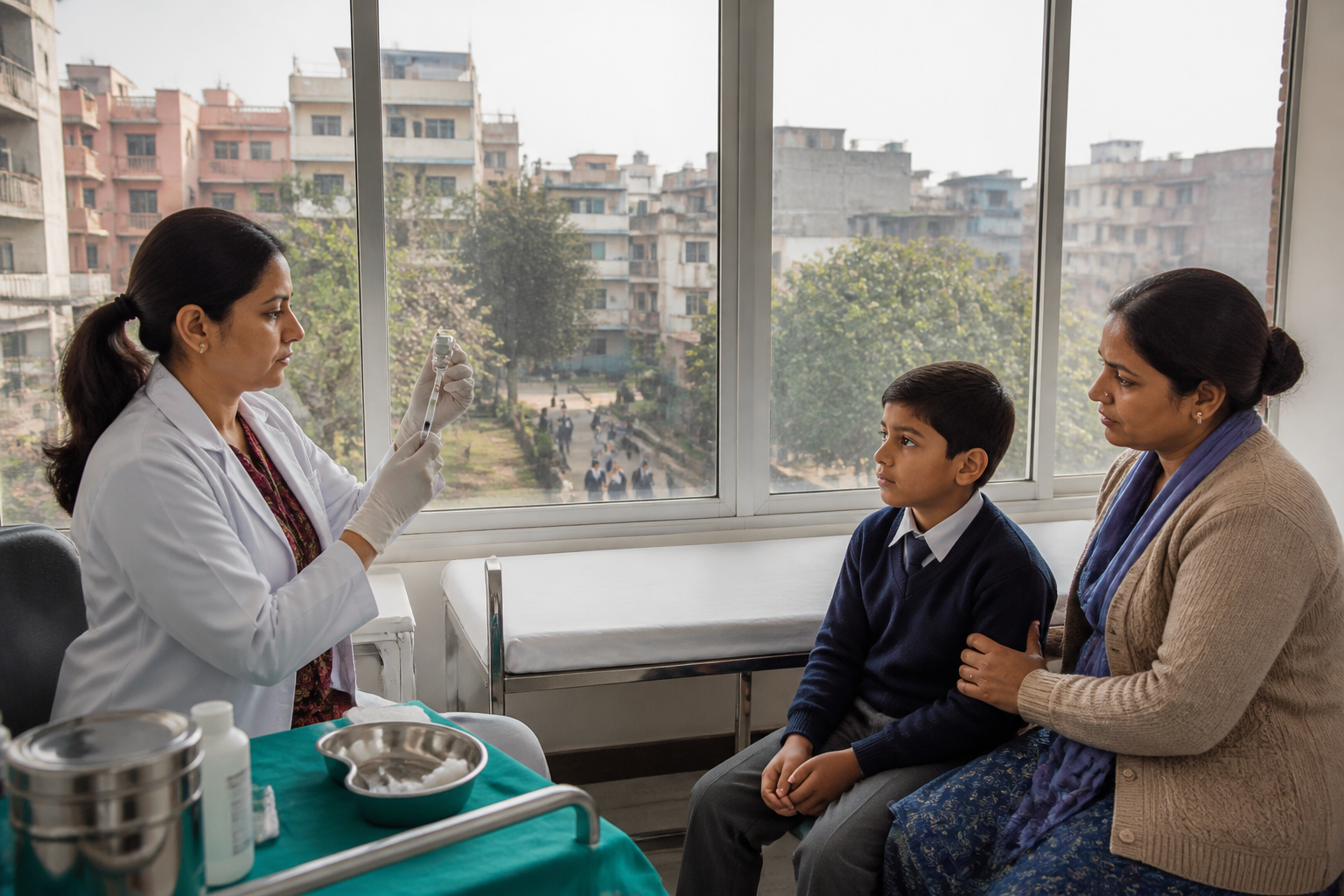
A Delhi study on preventive rabies vaccination in children has opened a policy question that extends beyond the vaccine schedule itself: how should cities protect children from animal-bite exposures that may never be recognised, reported or treated? Researchers found that a single-visit, two-site intradermal pre-exposure regimen produced protective antibody levels in 91% of 48 children within 28 days. The finding is preliminary, but it focuses attention on the gap between the formal design of public-health programmes and the way children actually experience urban risks.
The study, titled “Immunogenicity of Single-Visit, Two-Site Intradermal Preexposure Rabies Prophylaxis in Children: A Prospective Interventional Study”, was conducted between 2024 and 2025 by doctors from Maulana Azad Medical College and Associated Hospitals in New Delhi, the Postgraduate Institute of Child Health in Noida, the ICMR-National Institute of Virology in Pune and the state-level Viral Research and Diagnostic Laboratory at MAMC. Its institutional spread is important: the work links paediatrics, microbiology and rabies laboratory expertise rather than treating vaccination as an isolated clinical intervention.
The central result is not that the one-visit regimen has replaced existing practice. The researchers explicitly said that larger, controlled trials are required before any policy shift. Instead, the study provides an early indication that a simplified approach may generate a useful immune response in children. Protective antibody levels were recorded in 91% of participants within 28 days of vaccination. The sample was small, and the findings therefore establish a possibility for further investigation rather than a basis for immediate universal adoption.
The study also identified a limitation that could shape how such a programme would work in practice. Antibody levels declined close to six months after the initial shot. However, all children who received a booster developed a protective response within seven days. According to the researchers, if a vaccinated child is exposed years later, the child may require two booster doses on days 0 and 3 and would not require rabies immunoglobulin. That potential reduction in post-exposure treatment is one reason the researchers believe a preventive approach could be considered for children who may not identify or report minor animal bites.
This is where the urban dimension becomes clear. A city’s exposure to animal bites is not managed only inside hospitals. It is also shaped by neighbourhood environments, school routes, play spaces, informal settlements, household supervision and the ability of families to recognise a minor injury as medically significant. The source material does not provide citywide figures on unreported bites, but the researchers cite earlier work by doctors from MAMC and GTB Hospital that highlighted gaps in dog-bite awareness, reporting and vaccination. The implication is institutional rather than merely clinical: a treatment system cannot respond to an exposure that the system never records.
India does not currently have a policy for mandatory rabies vaccination among children comparable to the policies described in the report for rotavirus or polio. Private practitioners do offer a day-zero, day-seven and day-28 vaccination schedule. That existing arrangement places much of the responsibility on families to recognise the value of pre-exposure vaccination, pay for it where necessary and complete a multi-visit schedule. The Delhi findings raise the possibility that a simpler regimen could make delivery easier through schools and community programmes, although the study does not establish how such programmes would be financed, administered or monitored.
A school-based model would also change the administrative chain involved. Vaccination would need coordination among health departments, schools, parents, clinicians and laboratories. The study itself does not propose an implementation framework, identify a funding source or estimate the number of children who could be covered. Those omissions are not defects in a small interventional study, but they show why clinical evidence alone cannot produce a public-health policy. A schedule that appears easier at the point of administration still requires systems for consent, records, follow-up, booster access and response after a later exposure.
The numbers in the study illustrate both its promise and its limits. Forty-eight children participated, 91% developed protective antibody levels within 28 days, antibody levels fell close to six months, and all children given a booster responded within seven days. These results offer a signal for larger research, but they do not establish effectiveness across a broader population or demonstrate that every child would respond in the same way. The authors’ call for larger, controlled trials is therefore central to interpreting the result, not a minor qualification.
The possible advantage described by the researchers is operational as well as medical. A child with prior pre-exposure vaccination could potentially receive two booster doses after exposure and avoid rabies immunoglobulin. Whether that would reduce delays, costs or pressure on treatment facilities is not measured in the study and cannot be assumed from its findings. It does, however, point to a question for health administrators: whether preventing vulnerability in advance could be easier to organise than relying entirely on rapid, accurate reporting after a bite.
That question is particularly relevant to urban public-health systems because their effectiveness depends on routine contact with residents. Schools and community programmes can reach children who may not visit private practitioners, while local health facilities can provide a route for counselling, documentation and follow-up. But reach alone would not guarantee protection. The evidence supplied here does not say which delivery channel is most effective, how often boosters should be given in a public programme or how officials would measure missed exposures. Those issues remain unresolved.
The study therefore should be read as evidence of a policy possibility, not as a final recommendation. It adds support to the argument for investigating simpler preventive vaccination schedules, especially for children who may not recognise or report minor animal bites. At the same time, its small sample, the decline in antibody levels near six months and the absence of a demonstrated programme model limit what can be concluded now.
The larger urban question is whether public-health systems are designed around the risks that institutions can count or the risks that residents actually experience. A policy based only on reported bites may miss children whose exposures are unnoticed. A preventive programme could address that gap, but only after larger trials establish the regimen’s reliability and public authorities determine how schools, communities and health facilities would share responsibility. For now, the Delhi study confirms a promising research direction while leaving the policy decision open.
