


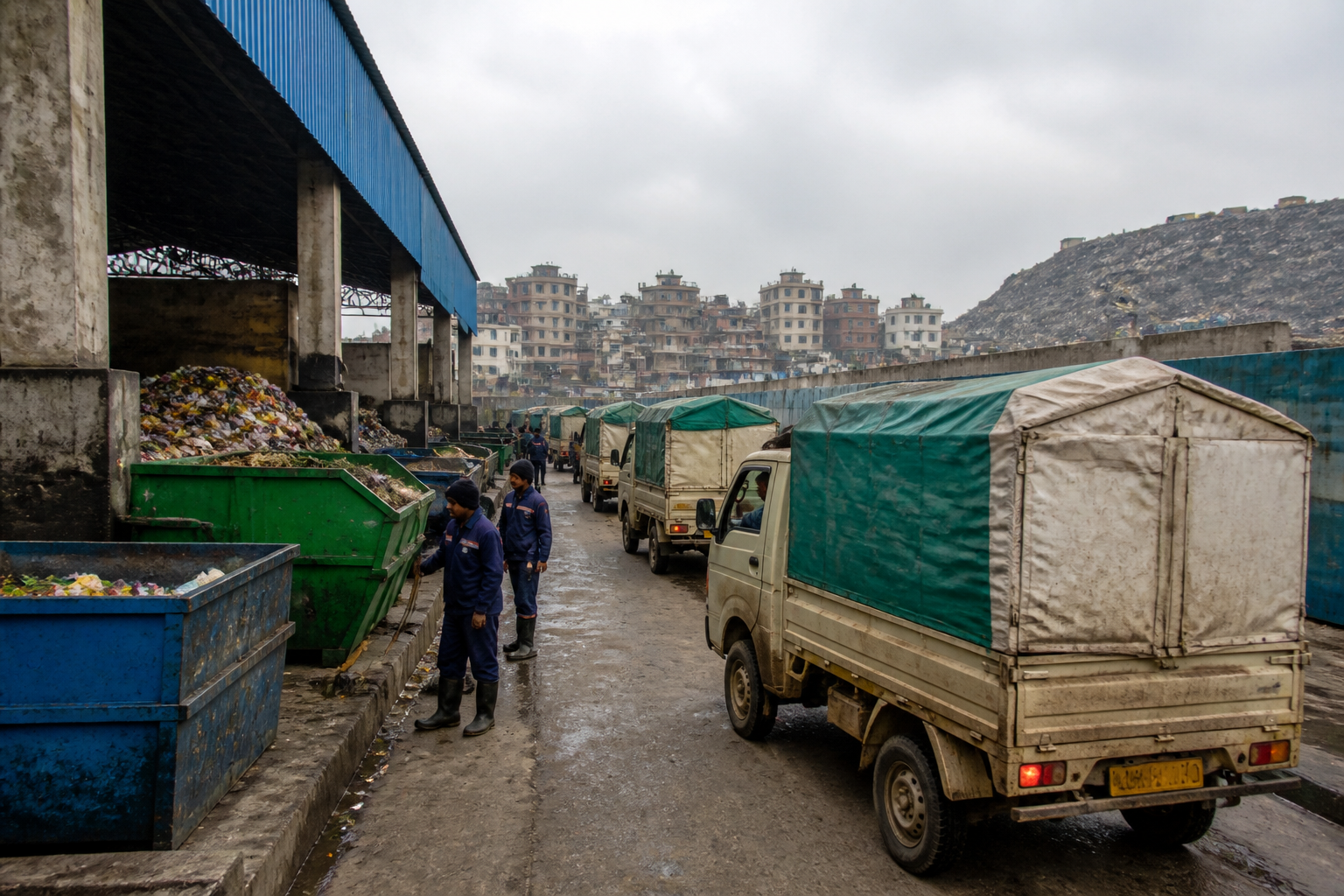
Delhi’s latest waste-management plan is built around a major expansion of processing capacity, tighter monitoring and a promised shift towards source segregation. But the discussion at the Municipal Corporation of Delhi’s Special Committee meeting also revealed the harder problem: the city’s waste system can fail even when households are asked to do the right thing, if collection, transport and processing do not preserve that separation.
The MCD generates approximately 13,500 tonnes of waste every day, according to figures presented by Chief Engineer Ajay Aggarwal. About 40% of this is wet waste, but the corporation currently processes only 60% of it. The gap is being addressed through five decentralised fresh-waste processing plants with a combined capacity of 6,000 tonnes. MCD officials said the plants are expected to open by December or mid-January, with the stated objective of preventing fresh waste from reaching landfills after January.
That timeline places the burden of the city’s waste transition on both infrastructure delivery and daily operating discipline. A plant can add capacity, but it cannot by itself ensure that wet, dry, domestic hazardous and sanitary waste remain separated from the household to the processing facility. The committee meeting showed that the MCD’s immediate challenge is not only how much waste Delhi produces, but how consistently the civic system handles it at every stage.
Aggarwal said the corporation had identified 823 Garbage Vulnerable Points, or GVPs, across Delhi and eliminated 230 of them. A 15-day drive scheduled from October 2 to October 17 aims to clean, beautify and eliminate another 300 to 400 such points. These figures indicate that visible dumping remains a substantial operational issue, even as the corporation works on larger processing and landfill-remediation projects.
The proposed changes also include an increase in tipper capacity from 1.75 cubic metres to 2.25 cubic metres. MCD officials said the change would raise the volume of waste collected by 30%. Fixed Compactor Transfer Stations are also being expanded, with the number in the South-Central zone expected to rise from 17 to 50. Together, these measures address the movement of waste through the city, but they also increase the importance of monitoring whether waste is being transported in separate streams or mixed before it reaches transfer and processing points.
This was the central concern raised by councillors. Manisha Ashish Punia, councillor from Subhash Mohalla, said households may segregate waste, but the separation breaks down during collection and transport when different categories are mixed together. Her point identifies a structural weakness in the chain: source segregation is not a household-only responsibility. It depends on collection vehicles, workers, transfer stations and processing facilities following the same system.
The concern also has a resource dimension. Punia said her zone operated with only five to six tippers despite the volume of waste it handled. The report does not establish the total fleet required across Delhi or explain how vehicles are distributed between wards. It does, however, show why a citywide rule can produce uneven results when local collection capacity differs sharply between areas.
Kalkaji councillor Yogita Singh questioned the feasibility of four-way segregation at source, asking how many households in Delhi and across India realistically have enough space for four separate bins. She said residents were willing to segregate wet waste but resisted waste-processing or composting points outside their homes because of odour. This brings the policy challenge inside the housing system: even a technically sound segregation model must fit the physical conditions of homes and neighbourhoods.
The disagreement over local processing points reflects a recurring tension in decentralised waste management. Bringing processing closer to where waste is generated can reduce transportation requirements and keep fresh waste away from landfills. But residents are unlikely to accept facilities that create odour or appear poorly maintained. The supplied report does not provide performance data for existing neighbourhood processing points, so it cannot establish whether the problem is primarily technology, maintenance, siting or enforcement. The committee discussion nevertheless shows that public acceptance is part of operational capacity.
MCD’s plan also relies on enforcement. Rohini C councillor Dharamveer Sharma called for the penalty for open dumping to rise from Rs 500 to Rs 10,000. The demand suggests that councillors view the existing penalty as insufficient to deter dumping. Whether a higher penalty changes behaviour would depend on inspection, evidence collection, enforcement consistency and the ability of the corporation to identify offenders. The committee report records the proposal but does not state that the increase has been approved.
Bulk Waste Generators were another enforcement concern. Punia called for physical inspections of these premises. Such inspections matter because large institutions, commercial establishments and other bulk generators can account for substantial waste volumes, while their compliance requirements differ from those of individual households. The report does not provide the number of bulk generators, inspection frequency or violation data. It does establish that councillors are seeking a more direct compliance mechanism rather than relying only on general public messaging.
The MCD is simultaneously dealing with the city’s accumulated waste burden. Aggarwal said around 200 to 220 lakh tonnes of the 280 lakh tonnes of legacy waste at Okhla, Bhalswa and Ghazipur had been cleared. He said Okhla and Bhalswa would be cleared completely within three months, while Ghazipur is scheduled to be removed by December 2027. These are substantial claims, but the supplied report does not specify the measurement method, the destination of processed material or the remaining quantity at each landfill.
The timelines therefore need to be understood as implementation milestones rather than completed outcomes. Clearing legacy waste is not the same as ending the conditions that created it. If fresh waste continues to arrive because collection and processing systems remain incomplete, landfill remediation can become a moving target. MCD’s stated plan to prevent fresh waste from reaching landfills after January is consequently linked to whether the five new plants open on schedule and operate at their planned capacity.
The corporation is also targeting waste streams beyond household refuse. Aggarwal said MCD was working to divert 1,500 tonnes of cattle waste generated along the Yamuna to curb river pollution. An agreement with the National Dairy Development Board provides for 600 tonnes of capacity across three plants, while the total dung-processing capacity is expected to reach nearly 1,400 tonnes per day within the next year. The figures indicate an effort to treat cattle waste as a separate urban utility and pollution-management issue rather than allowing it to enter ordinary waste channels.
MCD officials also referred to a recent visit to Indore and said Delhi was adopting elements of Indore’s 2016–17 sanitation model. The approach cited at the meeting includes 100% door-to-door collection, corporation-owned tippers, Material Recovery Facilities and biomethanation plants. These components are institutionally important because they place responsibility for collection assets and processing infrastructure within a more integrated municipal system. However, the report does not provide a comparison of Delhi and Indore’s coverage, staffing, financing or performance, so it cannot establish how directly the model can be transferred.
The policy framework extends to Reduce-Reuse-Recycle centres in every ward. Aggarwal said these centres were being established under Supreme Court orders and central guidelines, allowing citizens to donate clothes, shoes, utensils and books. Their role is different from that of waste-processing plants: they aim to prevent reusable goods from entering the waste stream in the first place. Their effectiveness will depend on ward-level accessibility, collection arrangements and whether residents understand where and how to use them.
Taken together, the MCD’s proposals describe a system with several interlocking layers: household segregation, door-to-door collection, larger tippers, transfer stations, material recovery, decentralised processing, landfill remediation, cattle-waste treatment and ward-level reuse centres. The risk is that failure at any one link can weaken the rest. If households segregate but vehicles mix waste, the effort is lost. If plants are built but feedstock arrives contaminated, processing becomes more difficult. If landfill waste is cleared but fresh waste continues to be dumped, the visible problem returns.
The evidence presented at the meeting confirms that Delhi is attempting a substantial expansion of its waste-management infrastructure. It also confirms that the implementation gap remains unresolved. MCD has identified targets for processing capacity, vulnerable-point removal, landfill clearance and cattle-waste diversion, while councillors have highlighted constraints involving bin space, odour, vehicle shortages, mixed collection and enforcement. The next decisive milestones are the commissioning of the five fresh-waste plants, the October cleanup drive, the promised landfill timelines and the corporation’s ability to maintain segregation through collection and transport.
