


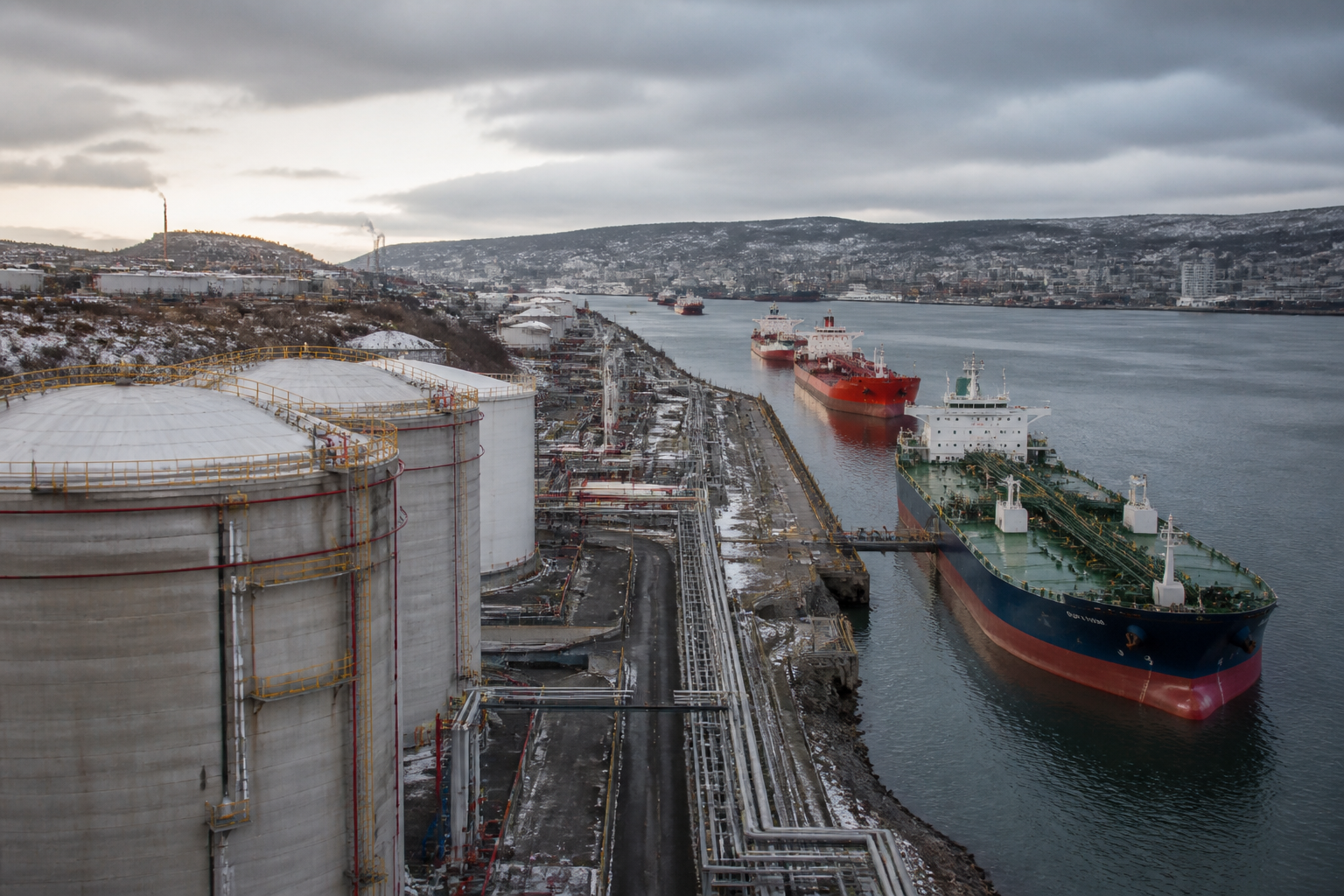
The global oil market is entering winter with a sharply reduced safety cushion after more than 1 billion barrels were removed from commercial stockpiles during recent supply disruptions. The immediate concern is not only the total volume of crude held in storage, but how much can actually be delivered quickly if another disruption hits. That distinction exposes a wider vulnerability for cities: transport systems, logistics networks and energy-intensive urban economies depend on a supply chain whose emergency flexibility is becoming increasingly limited.
Saudi Aramco chief executive Amin Nasser said at the Energy Intelligence Forum in London that less than 6 billion barrels of commercial inventories remain globally, with 10% or less practically available. His assessment, reported by Reuters and carried by The Times of India, separates nominal inventory from usable inventory. Oil may be counted as stored even when it is tied up in pipelines, held in tank bottoms or reserved for government emergencies. For traders and consumers, the relevant question is how many barrels can reach the market within the time available during a supply shock.
That distinction matters because the global oil system is designed around buffers. Storage allows producers, governments and traders to absorb temporary interruptions without an immediate collapse in supply. When those buffers are drawn down, the market becomes more dependent on uninterrupted production and transport. A disruption that might previously have been managed through inventories can then create a faster and more severe response in prices and availability.
The scale of current demand makes the remaining flexibility particularly important. Global oil consumption is running at about 102 million barrels a day, according to the International Energy Agency. Against that level of daily use, even a large inventory figure can provide limited practical cover if only a small share is accessible. The reported 10% availability estimate therefore points to a market with a substantial volume of oil on paper but a much smaller pool of immediately deployable supply.
The depletion has been driven by the use of stored oil during supply disruptions linked to the wars in the Middle East and Ukraine. Nasser said more than 1 billion barrels had been released, mainly from commercial inventories, since the latest Middle East crisis began. Commercial stocks have therefore performed the role they are meant to perform: compensating for disrupted flows. But the consequence is that the mechanism used to stabilise the market has itself been weakened.
For cities, this is not an abstract commodity-market problem. Urban areas concentrate daily oil demand through road transport, delivery fleets, construction activity, aviation links and industrial supply chains. The supplied report does not quantify the impact on any particular city or country, and it does not establish that a new shortage has occurred. It does, however, describe a condition in which a future interruption could transmit more quickly through the systems that connect urban residents to jobs, goods and services.
Chevron chief executive Mike Wirth said the loss of these buffers had made the oil market more fragile and increased the price floor for crude. The statement links inventory conditions to the market’s ability to absorb volatility. A higher price floor does not by itself establish a specific future price or consumer impact, but it indicates that rebuilding stocks may require producers to place additional oil into storage while still meeting everyday demand.
That rebuilding challenge is central. Stocks can be replenished only if enough supply is available after current consumption and other commitments have been met. The article reports that doing so could take years. This creates a difficult sequence: the same barrels needed to restore resilience are also needed to serve current demand. Until inventories recover, the system remains more exposed to disruptions in production, shipping or access to key export routes.
The market is also becoming more dependent on supplies that continue to flow, particularly seaborne exports from the Middle East. Vitol chief executive Russell Hardy said there were few additional inventories left in Western markets that could be drained to cover a fresh shortfall. His assessment suggests that the geographic distribution of remaining usable stocks is as important as the global total. Oil cannot stabilise a disrupted market merely by existing somewhere; it must be accessible, transportable and available at the right time.
The United States is entering this period with a reduced emergency reserve as well. Stocks in the Strategic Petroleum Reserve have fallen to their lowest level since October 1982, according to US Department of Energy data cited in the report. The reserve is intended to provide additional crude during major supply disruptions. Its depleted position therefore removes part of the emergency capacity that would normally support the market during a severe interruption.
The condition of the US reserve also shows why commercial and government inventories must be considered separately. Commercial stocks support routine market operations, while strategic reserves are designed for exceptional circumstances. Neither category is fully equivalent to immediately deliverable supply. Government reserves may be subject to release decisions and operational constraints, while commercial volumes may already be committed, inaccessible or unsuitable for the specific disruption being addressed.
The International Energy Agency is preparing to release 100 million barrels of crude and diesel to ease pressure, particularly on diesel prices. Nasser said the decision followed negotiations over how much oil could realistically be made available. The article does not establish the exact timing or composition of the release. It also remains unclear how much of it will come from barrels associated with the IEA’s record 400 million-barrel release in March that had not yet reached the market.
The proposed intervention illustrates both the value and the limits of emergency action. A release can add supply during a stressed period and may provide near-term relief. It does not automatically restore the stocks that have already been consumed. If the released oil comes from existing emergency holdings, the immediate market may gain barrels while the longer-term reserve position becomes more difficult to rebuild. The distinction between temporary relief and restored resilience is therefore important.
The reported figures also reveal why oil security is an institutional problem rather than only a production problem. The system includes producers, traders, governments, strategic reserves, pipelines, ports and shipping routes. Each part determines whether an inventory number translates into usable supply. A market can have billions of barrels in storage and still face stress if too little can be accessed quickly or moved to where demand is concentrated.
This has direct relevance for urban governance, even though the report focuses on the global market. Cities generally do not control international oil inventories, but their functioning depends on the consequences of those inventories. Public and private transport require fuel, construction projects depend on the movement of materials and equipment, and urban distribution networks rely on predictable logistics costs. The supplied evidence does not quantify these effects or identify specific municipal responses, but it establishes the external energy condition within which urban systems operate.
The current pressure also complicates the idea of resilience. Resilience is often associated with physical infrastructure such as roads, transit systems, storage facilities and power networks. Yet the reliability of those assets can depend on inputs controlled far beyond city boundaries. A well-maintained road network cannot prevent fuel-market stress from raising the cost of movement, and an efficient distribution system cannot create crude that is unavailable or inaccessible. Energy buffers are therefore part of the wider infrastructure supporting urban life.
At the same time, the report does not show that the global oil market has run out of supply or that a specific urban disruption is under way. It records warnings from industry executives, current inventory estimates, the condition of the US strategic reserve and a planned IEA intervention. The scale, timing and consequences of any future shock remain uncertain within the supplied material. The strongest established conclusion is narrower: the system has less readily available oil to absorb another major disruption than it had before the recent drawdowns.
The immediate developments to monitor are the IEA’s planned 100 million-barrel release, the proportion of crude and diesel it contains, the arrival of any previously released barrels and the pace at which commercial and strategic inventories can be rebuilt. Until those details become clearer, the global oil market will remain dependent on continuing flows at a time when the emergency cushion described by industry leaders has become materially thinner.
