


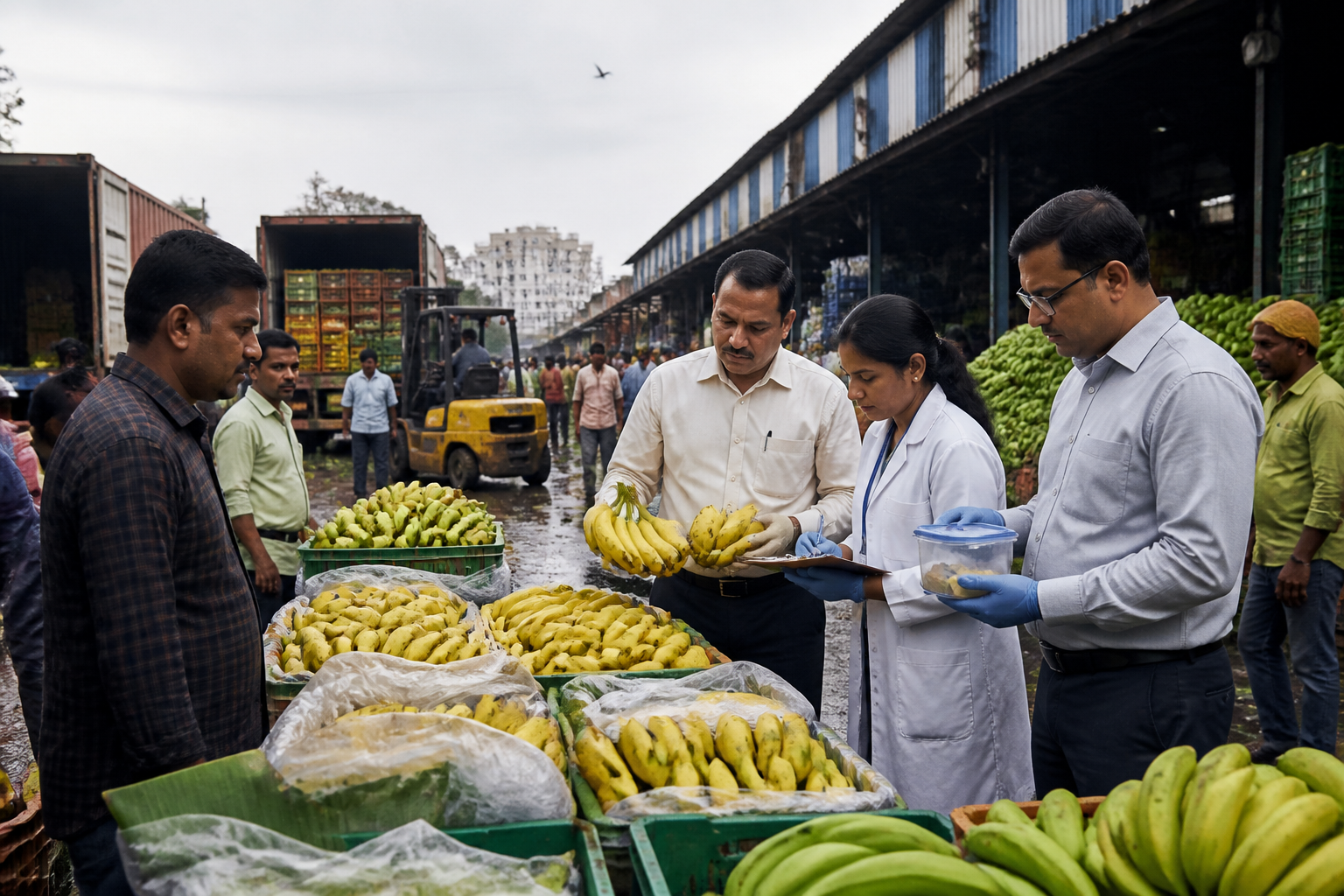
The Maharashtra FDA food safety action across Mumbai, the wider Mumbai Metropolitan Region and other parts of the state is more than a series of raids. It reveals how urban food safety depends on a chain of inspections, licences, laboratory testing, police cases, transport checks and consumer complaints—and how failures at any point in that chain can reach the public.
The FDA seized 1,394 kg of bananas at the APMC fruit market in Turbhe after finding a worker using a chemical solution to artificially ripen the fruit. It also suspended the licences of eight Mumbai establishments and cancelled or suspended the registration certificates of three others over hygiene and food-handling violations. In separate operations, prohibited food stock and vehicles worth about Rs 1.29 crore were seized in Mumbai and Palghar, while 16,730 litres of milk found to be detergent-positive were destroyed in Solapur district.
Taken together, the cases show the different layers of food regulation in an expanding urban region. APMC Turbhe is a major wholesale market through which food enters the metropolitan supply chain. Restaurants, bakeries, caterers and hospital canteens transform or serve that food. Trucks and toll naka checkpoints move prohibited products between districts. Milk processors and receiving establishments connect rural or peri-urban production to urban consumption. Each setting has a different risk profile, but all are linked by the same regulatory system.
The Turbhe seizure illustrates the difficulty of regulating practices that may be visible at the point of sale but hidden in the supply process. According to the FDA, officials found a worker at Stall No N919 in Sector 19 using BTHILEX Ethephon 39 per cent SL, described as a plant growth regulator, to ripen bananas. The solution had reportedly been prepared by mixing two caps of the chemical in five litres of water.
Officials seized 198 kg of Sundari bananas, 498 kg of Elaichi bananas and 698 kg of Khatta Meetha bananas. The total stock was valued at approximately Rs 67,814. Three statutory banana samples and a surveillance sample of the chemical mixture were sent for testing. The FDA also said the packaging of the chemical carried a suspicious manufacturer address, PIN code and contact number and did not display a registration number from the Central Insecticides Board and Registration Committee.
The distinction between permitted and prohibited ripening methods is central to the case. The FDA said ethephon may be used as a source for generating ethylene gas, but fruit must be ripened through the prescribed method. The permitted process involves ethylene gas of up to 100 parts per million in closed chambers, under the standard operating procedure issued by the Food Safety and Standards Authority of India. Directly dipping fruit in an ethephon solution is prohibited. Calcium carbide, commonly called masala, is also prohibited for artificial fruit ripening.
That distinction places responsibility not only on the retailer but also on market supervision and supply-chain documentation. The FDA said a case was registered at APMC police station under provisions of the Food Safety and Standards Act, 2006, the Bharatiya Nyaya Sanhita, 2023, and the Insecticides Act, 1968. Further proceedings under Section 42 of the Food Safety and Standards Act will follow the food analyst’s report. The next legal step therefore depends partly on laboratory evidence, not only on what inspectors observed at the premises.
The Mumbai restaurant and food-service inspections show a different but equally important regulatory challenge: routine hygiene. The FDA acted against 11 hotels, restaurants, caterers and bakeries. The reported violations included incorrect storage temperatures, uncovered food, insects and flies, weak pest control, open waste bins, poor hygiene among food handlers and missing records relating to medical examinations, training and audits.
At Chhotus Kitchen in Borivali West, frozen products were reportedly stored above the prescribed minus 18 degrees Celsius. At Tardeo Lunch Home, officials found improper refrigerator temperatures, ice accumulation, uncovered food, flies and open dustbins after an inspection linked to a complaint. At Shagun Veg Restaurant in Mumbai Central, the FDA reported similar refrigeration and hygiene issues, along with peeling plaster. At Roshan Bakery in Mazgaon, inspectors found rusted and stained baking trays, uncovered ready-to-eat food, non-food-grade packaging and old blackened oil being reused.
These findings point to a compliance problem that is administrative as much as physical. Food safety depends on equipment, cleaning and pest control, but also on records that allow regulators to establish whether a business is following a continuing system. The FDA said documents such as food and water test reports, pest-control records, audit reports and FoSTaC training records were unavailable or incomplete at several establishments. In some cases, the FSSAI licence was not prominently displayed or the registered address had not been updated.
The reported action at Satkar Caterers, located in the staff canteen of RN Cooper Municipal General Hospital in Vile Parle West, adds an institutional dimension. The FDA cited flies, cockroaches, ineffective pest control and inadequate segregation of raw and cooked food, as well as incomplete hygiene, medical examination, training and audit records. A hospital canteen is not simply another commercial kitchen: it operates inside a public health institution and serves workers, patients’ attendants and visitors. The report does not establish that any illness resulted from the violations, but the location makes compliance especially important.
The enforcement pattern also extends beyond kitchens and markets. During a special drive in Mumbai Division between September 30 and October 5, the FDA inspected three establishments and found prohibited food items at all three. Stock worth Rs 31.14 lakh was seized, three FIRs were registered and three people were arrested, according to the report. The largest seizure, valued at Rs 21.46 lakh, was made at an establishment in Bandra East. Further stock worth Rs 4.85 lakh was seized in Santacruz West and goods worth Rs 4.83 lakh in Dharavi.
In Palghar, the FDA used toll naka checks to intercept vehicles carrying prohibited products. At Charoti Toll Naka in Dahanu, officials stopped an Eicher vehicle carrying Bajirao Scented Pan Masala and Mastani 216 Premium Chewing Tobacco. The stock was valued at Rs 43.50 lakh and the vehicle at about Rs 20 lakh. At Khadinavde Toll Naka in Vasai, another Eicher truck carrying gutkha and other prohibited food items was intercepted. The stock was valued at Rs 19.80 lakh and the vehicle at about Rs 15 lakh. The two actions together involved goods and vehicles worth Rs 98.30 lakh.
This is the point at which food regulation becomes a metropolitan governance issue. Mumbai’s food system does not stop at the municipal boundary. Products move through wholesale markets, restaurants, informal channels, highways and district borders. Enforcement therefore requires coordination among the FDA, municipal authorities, police, market administrations and transport checkpoints. The cases reported by Mid-Day show that inspections are occurring at several of these nodes, but they also demonstrate how many separate interventions are required to monitor one food economy.
The Solapur milk cases show why sampling and laboratory analysis matter. In Malshiras, the FDA reported two cases involving milk that tested positive for detergent and was considered unsafe for human consumption. At Mahalaxmi Milk and Milk Products in Piliv, a sample collected on July 7 was reported unsafe in an analyst’s report dated July 24. The remaining 7,634 litres, valued at Rs 3,05,360, were destroyed. At Delivish Agro Dairy Product Pvt Ltd, also in Piliv, 9,096 litres valued at Rs 3,63,840 were destroyed after a sample was reported detergent-positive.
Together, the cases involved 16,730 litres of milk valued at Rs 6.69 lakh. The report said the milk was destroyed because it was perishable and could not be stored for a long period. FIRs were registered at Malshiras police station on October 1 against the owners and other legally responsible persons linked to the supplying and receiving establishments. The timeline—from inspection and sampling in July to laboratory findings and FIRs in October—shows the procedural gap between identifying a possible violation and completing enforcement action.
That gap is not necessarily evidence of administrative failure. Laboratory testing, legal review and the registration of cases follow different steps, and the supplied report does not provide enough information to assess the duration or efficiency of the full process. It does, however, show that food safety enforcement is not limited to immediate seizure. Samples, analyst reports, destruction of perishable stock and police proceedings are all part of the regulatory pathway.
For citizens, the most direct lesson is that food safety is shaped by ordinary operational details: whether refrigeration is maintained, whether food is covered, whether waste is removed, whether handlers receive training, whether chemicals are stored separately and whether records are kept. These are not abstract standards. They determine how food is stored, prepared and sold in the places where urban residents eat every day.
The FDA has appealed to consumers to report complaints about food quality or food-related malpractice through its toll-free number, 1800222365. That appeal makes complaints part of the enforcement system, as seen in the inspections at Tardeo Lunch Home and Shagun Veg Restaurant. But consumer reporting works alongside, rather than replaces, routine inspections, laboratory capacity, market surveillance and follow-up proceedings.
The evidence supplied in the report confirms a broad enforcement drive, multiple seizures and several recorded hygiene failures. It does not establish the prevalence of these violations across Mumbai’s entire food sector, nor does it provide outcome data on the laboratory samples from Turbhe or the final legal results of the cases. The developments to monitor are the FDA’s further proceedings after the banana sample analysis, the action concerning the suspected chemical registration irregularities, and the legal outcomes of the Mumbai, Palghar and Solapur cases.

