


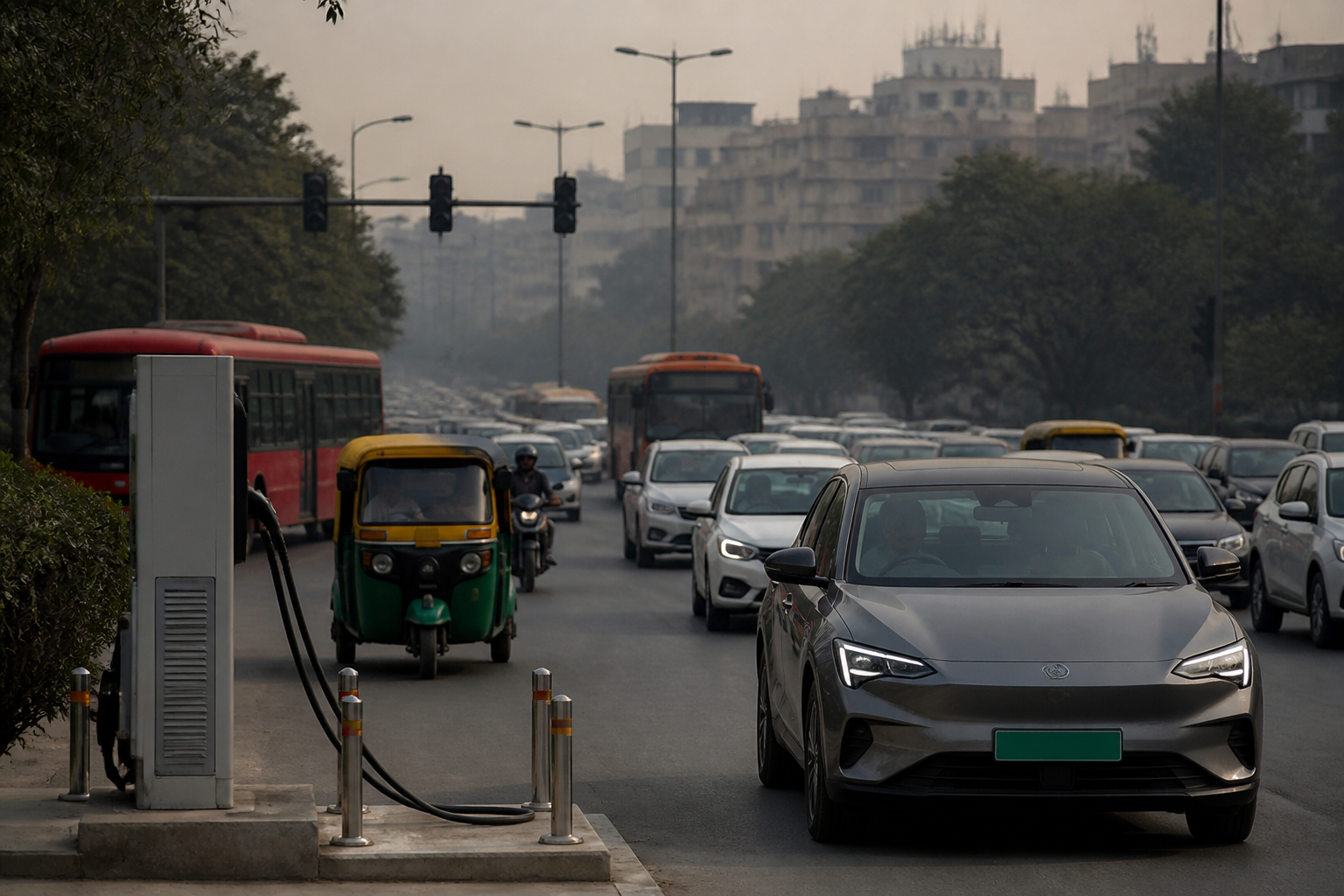
Delhi’s air pollution strategy cannot rely on electric vehicles alone, according to a comparative study by The Energy and Resources Institute (TERI), which argues that the city’s vehicle-fuel transition must be designed around different vehicle categories, usage patterns and the infrastructure already available. The study identifies electric vehicles as a strong long-term option for two-wheelers and a growing option for three-wheelers and commercial vehicles, while assigning an important transitional role to compressed natural gas.
The findings matter because transport contributes about 39 per cent of Delhi’s PM2.5 emissions, 19 per cent of PM10 emissions and 81 per cent of nitrogen oxide emissions, according to the study as reported by Jagran. These figures place vehicle technology and fuel choice at the centre of the city’s clean-air challenge. They also show why a single solution may not work equally well across private cars, taxis, buses, goods vehicles, two-wheelers and three-wheelers.
TERI assessed the availability and comparative position of infrastructure for different fuels and technologies in nine locations. Delhi emerged as the city with the strongest CNG infrastructure among the places assessed. It was also among the better-positioned cities for electric-vehicle infrastructure, alongside Bengaluru. This gives Delhi a wider base for managing a phased transition, but it also creates a policy choice: whether to replace one dominant fuel strategy with another or to use different technologies for different mobility needs.
The study’s central message is that the number of charging points alone does not establish whether an electric-vehicle network is adequate. Electric vehicles generally require more time to recharge than petrol, diesel or CNG vehicles require to refuel. As a result, two networks with the same number of stations may deliver very different levels of service. A charging network’s practical capacity depends not only on how many points are installed, but also on how long vehicles occupy them and how frequently they are used.
That distinction is important for a dense city such as Delhi, where vehicles serve both daily commuters and commercial users. A private car that remains parked for several hours may be able to charge without affecting the user’s routine. A taxi, delivery vehicle, bus or goods carrier, however, depends on turnaround time and operational availability. The study therefore points towards an infrastructure strategy based on vehicle use rather than a simple target for the number of charging stations.
For two-wheelers, TERI identifies electric vehicles as the strongest long-term alternative. This is significant for Delhi’s urban mobility system because two-wheelers are used extensively for commuting, deliveries and short-distance travel. Their operating patterns may make them more compatible with electrification than vehicles that travel long distances continuously or depend on rapid refuelling during the working day.
The transition for three-wheelers is more gradual. CNG remains strong in the current market, but the study indicates that electric three-wheelers are likely to gain ground over time. This category illustrates why fuel change is also an issue of livelihoods and operational economics. Three-wheelers are often used intensively for passenger and goods movement, so the viability of a new technology depends on more than its emissions performance. Charging access, downtime and vehicle economics must also fit the way these vehicles earn money.
Private cars are expected to shift more slowly, with CNG remaining a strong complementary option for an extended period. For commercial four-wheelers, electric vehicles may become the preferred long-term option, while CNG is expected to remain important during the transition. The distinction between private and commercial vehicles is central to the study’s approach: a technology that works for a privately owned vehicle may not immediately meet the operational requirements of a high-use commercial fleet.
The study assesses diesel as weak on both environmental and economic performance. CNG, by contrast, shows a better balance across technical, environmental and economic criteria in several vehicle categories. This does not make CNG a permanent answer to Delhi’s pollution problem, but it explains why the city’s existing CNG network remains relevant while electric mobility infrastructure and vehicle adoption expand.
Electric vehicles have a clear advantage in reducing local air pollution because they do not produce tailpipe emissions during operation. TERI’s assessment also identifies limitations in their wider environmental performance. The electricity mix used to charge vehicles, the manufacturing of batteries and dependence on raw minerals affect the overall environmental assessment. The study therefore separates the immediate local-air-quality benefit of EVs from the broader question of their complete environmental footprint.
That distinction is often lost in public discussions that treat vehicle electrification as an automatic clean-air solution. At street level, replacing a petrol or diesel vehicle with an EV can reduce pollution from the vehicle’s operation. At system level, however, the environmental result also depends on how electricity is generated, how batteries are produced and what happens across the vehicle’s wider supply chain. The evidence presented in the study supports electrification, but not as a policy detached from energy and industrial systems.
The implications extend beyond fuel policy. Delhi’s transition will require coordination between transport authorities, electricity providers, charging-network operators, vehicle manufacturers and agencies responsible for air-quality management. The availability of a strong CNG network gives policymakers an existing asset during the transition, while the growth of EVs requires investment in charging capacity that is matched to vehicle demand and operating patterns.
The study also assigns a role to compressed biogas in passenger cars, taxis, buses and light commercial vehicles. It identifies liquefied natural gas as relevant for long-distance freight transport. These recommendations reflect the different technical demands placed on urban and intercity vehicles. Short-distance urban vehicles may have more opportunities for charging or refuelling within the city, while long-distance freight requires energy density, range and operational continuity.
This vehicle-specific approach challenges the idea that Delhi can meet its transport-emissions challenge through a single technology mandate. Two-wheelers may move more rapidly towards electric power. Three-wheelers may require a period in which CNG and EVs operate alongside each other. Private cars may see a slower transition, while commercial vehicles could adopt electric technology where their routes and charging schedules make it practical. Buses, taxis and light commercial vehicles may require separate fleet-level strategies.
The numbers cited in the study underline the scale of the policy problem. Transport’s reported contribution of 39 per cent of PM2.5 and 81 per cent of nitrogen oxide emissions means that fuel choices can influence two major components of Delhi’s air-quality burden. At the same time, the 19 per cent contribution to PM10 shows that vehicle emissions are part of a wider particulate-pollution system rather than an isolated source.
The evidence does not establish that fuel switching by itself will resolve Delhi’s air pollution. It does establish that transport is too significant to be left out of the city’s clean-air planning and that different vehicle segments will not move at the same speed. It also shows that infrastructure capacity must be measured by service delivered, not merely by the number of facilities announced or installed.
Delhi’s larger urban question is therefore one of sequencing. The city has an established CNG base, a comparatively developed EV infrastructure position and a transport system with sharply different vehicle requirements. TERI’s assessment supports using these capacities together: accelerating EV adoption where it is most suitable, retaining CNG during the transition and considering CBG and LNG for categories with distinct operating needs.
What happens next will depend on how this evidence is translated into vehicle-specific policy and infrastructure planning. The study provides a comparative basis for that discussion, but the supplied material does not establish a detailed implementation timetable or targets for each category. The key issue for Delhi will be whether future clean-transport measures align technology, charging and refuelling capacity with the way the city’s vehicles actually operate.

