


India should adopt a hybrid approach to artificial intelligence, while ensuring that critical business, government, financial and healthcare applications do not become dependent on external providers, said Sunil Gupta, co-founder, managing director and chief executive of Indian data-centre and cloud company Yotta.
Speaking at ABP Group’s Infocom 2026 conference, Gupta said frontier AI models could continue to serve routine consumer needs, but organisations should use open-source models, fine-tuned with their own data and operated in secure computing environments within India for more sensitive applications.
He said the key risk was not simply technological dependence. “This is less of a technology debate; it’s more of a geopolitical debate,” Gupta said, referring to the risks faced by organisations relying on closed models that do not operate in India or remain under Indian control.
Gupta advised organisations to use frontier models where losing access would not disrupt their operations, while avoiding dependence on an external provider for critical use cases. “For all your critical use cases… make sure you are not creating a dependent scenario on anybody else,” he said.
The approach would increase the importance of domestic data centres and cloud infrastructure capable of running smaller models and AI agents. Gupta said most enterprise applications would operate on smaller models, with agents built on top of them. He added that providers such as Yotta were now offering computing capacity in India that was comparable with what was available globally.
Gupta linked the company’s decision to build a sovereign cloud to the need to prevent external control over critical systems. “Nobody should have a remote kill switch,” he said, citing the Russia-Ukraine war, the Nayara Energy episode and restrictions on GPU access in several countries as examples of disruptions or constraints affecting technology operations.
He also argued that India could become a computing hub for domestic and international users. The world’s largest computing operators, he said, had approached India over the past two years to buy computing services from the country. Gupta said India had the skills, talent and resources to serve global demand and that the country’s computing capacity could become four or five times larger within the next year.
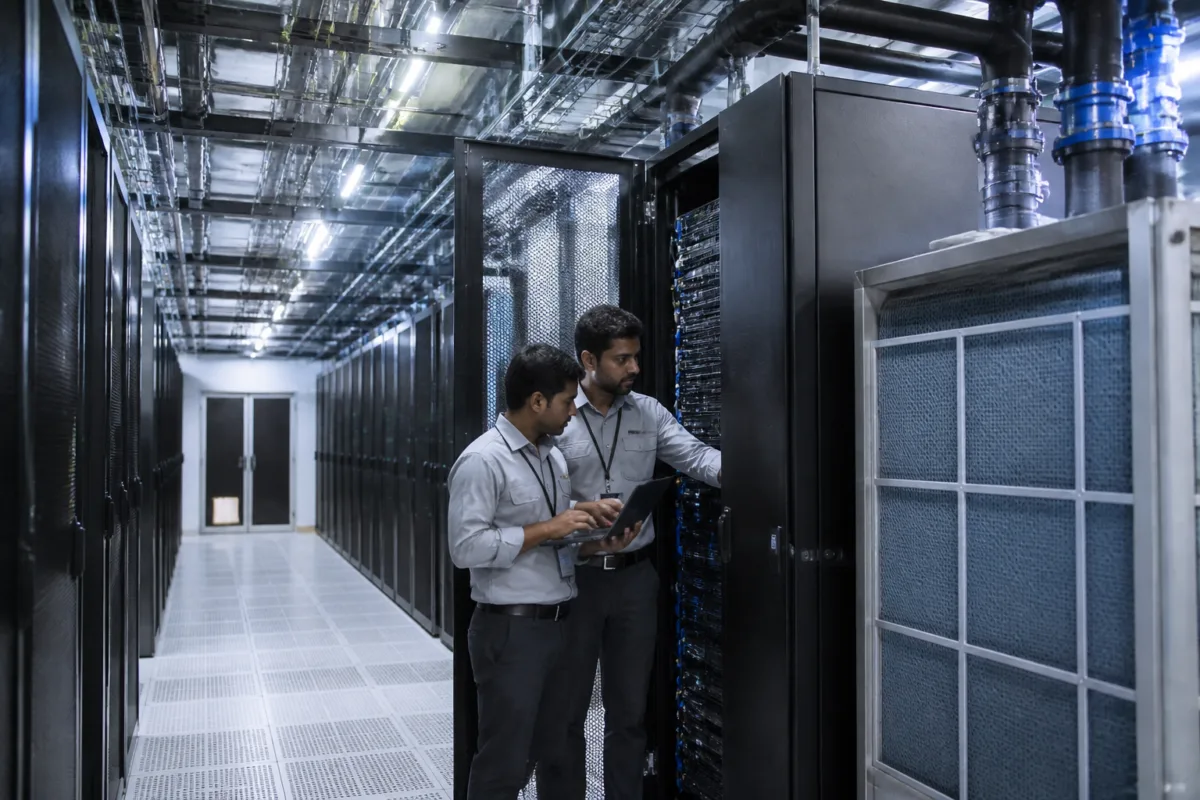
That expansion would have a direct physical-infrastructure dimension. Larger computing capacity requires data-centre facilities, high-performance equipment and secure cloud environments. Gupta acknowledged concerns about the sector’s consumption of electricity and water, but said many Indian data centres used closed-loop cooling systems and did not draw fresh water every day.
His comments place resource efficiency alongside control over data, models and computing hardware as part of the infrastructure challenge facing India’s AI expansion. The remarks did not include a capacity baseline or independently verified forecast, but they point to the competing requirements that will shape future data-centre development: reliable domestic computing, protection of critical applications and management of power and water use.

