


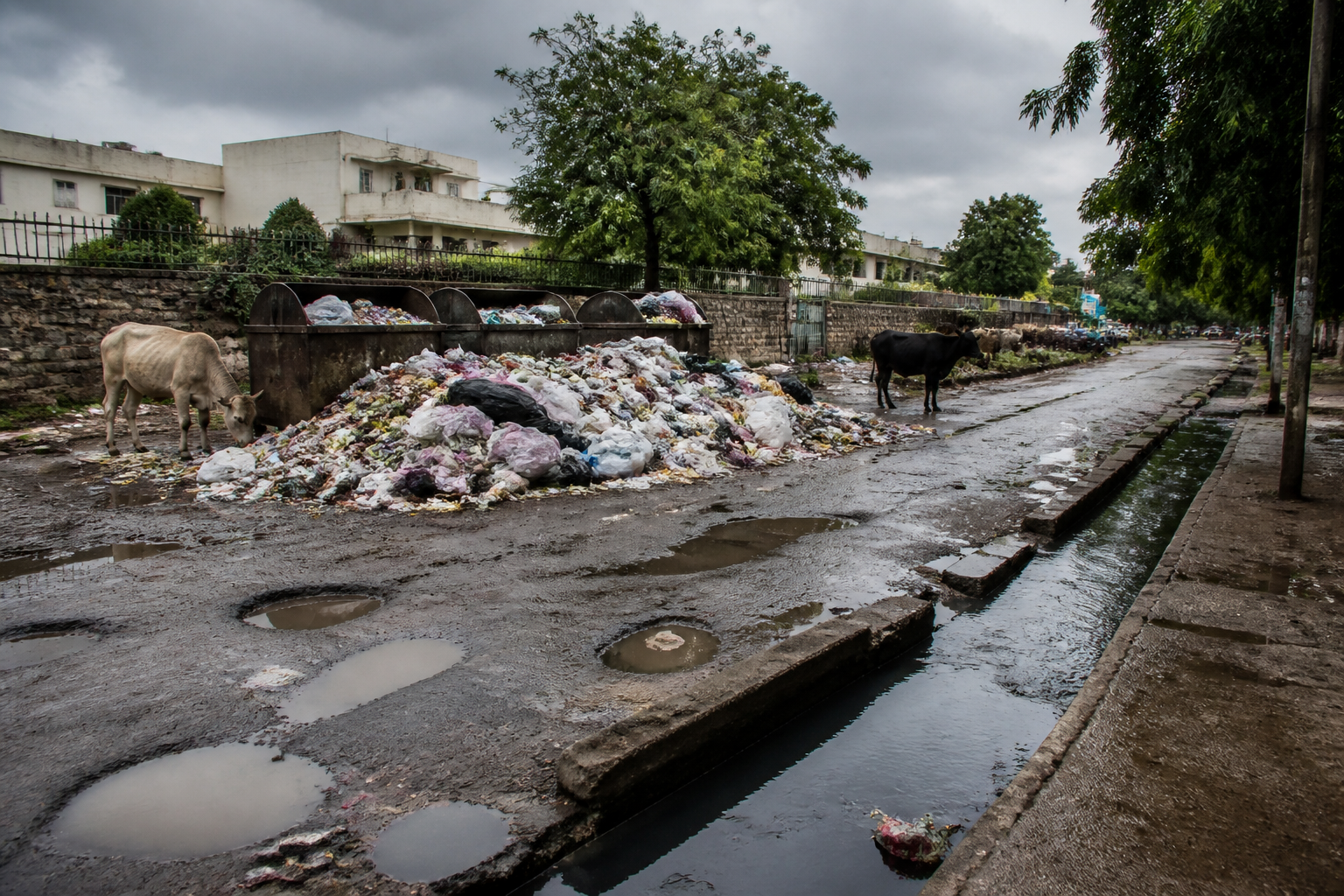
The National Green Tribunal’s direction to inspect a garbage dump outside a children’s welfare home in Sarita Vihar has brought a familiar urban failure into sharper focus: a waste facility intended to serve a neighbourhood has allegedly become a source of environmental and public-health risk for the people living and working beside it. The tribunal has asked the Delhi Pollution Control Committee to conduct a spot verification and said the Municipal Corporation of Delhi may face environmental damage compensation if violations are found.
The case is important not only because of the conditions reported outside the home, but because it shows how the location and operation of a waste collection point can shape the daily life of vulnerable residents. The welfare home has been at the site since 2000 and houses orphaned children up to six years old. Its staff told the Times of India that waste has accumulated beside the gate, an open drain is blocked, a public urinal across the road is unusable because of a lack of water, and a nearby fish and chicken market may be adding to the pollution burden.
These claims remain subject to the DPCC’s spot verification. But the reported conditions point to a wider governance question: whether municipal waste infrastructure is being managed as a controlled public service or merely as a place where waste can be temporarily deposited and moved later. The distinction matters. A secondary collection point is part of the city’s formal waste chain, but when waste spills onto roads, attracts stray animals and remains exposed, the facility’s civic purpose can be overwhelmed by its local effects.
The NGT’s intervention followed a plea by the welfare home, which alleged that garbage and solid waste were being dumped beside its gate and obstructing entry. During a September 3 hearing, the tribunal observed that the application raised a “substantial issue relating to compliance with environmental norms”. The order does not establish that the allegations are proved; that determination is expected to follow the committee’s inspection.
The reported ground conditions, however, illustrate why verification is consequential. The Times of India said its visit found a garbage dump spilling onto the road, an open drain choked with waste and stretches of road marked by potholes. Staff members said children could not use open areas inside the compound because of foul odour, mosquitoes and flies. They also reported infections, breathing difficulties and cough among children, although the supplied report does not provide medical records establishing a direct causal link between those conditions and the illnesses.
The home’s coordinator, Sangeeta Bhatia, said the children could not be confined indoors and that the smell from the dump prevented them from using the compound’s open areas. Elcy Jolly, the home’s manager and a nurse, said unhygienic conditions often led to infections among the children. These accounts provide a ground-level measure of civic failure: the impact is not limited to visual blight or inconvenience. It affects whether children can play, whether windows can be opened and whether an institution providing care can operate in a safe environment.
Residents described a similar loss of public use. One resident said a nearby park could not be used because of the dump, while another said the condition worsened during rain, when the pothole-ridden road became waterlogged. The allegations about the urinal add another layer to the problem. Where public sanitation facilities lack water or cannot be used, open defecation becomes a predictable consequence, increasing the risk of contamination around a site already burdened by exposed waste.
MCD’s response is central to understanding the administrative issue. The corporation said the site is a secondary collection point serving Sarita Vihar and that a concessionaire lifts the garbage daily. It also said construction of a fixed compactor transfer station at the site was in progress and scheduled to become operational by October 30. According to MCD, the enclosed facility would prevent waste from scattering and accumulating and restrict stray animals’ access to it.
That response suggests the corporation recognises a gap between the current arrangement and the intended future system. Daily lifting, if carried out as stated, does not necessarily prevent waste from accumulating between collection cycles, spilling onto the road or being disturbed by animals. Nor does it by itself address the blocked drain, damaged road, unusable urinal or the effects on the welfare home and neighbouring public spaces. The proposed fixed compactor transfer station is therefore not simply a construction project; it is presented as the operational mechanism through which the site is expected to become enclosed and systematic.
The case also raises the question of how responsibility is divided. MCD is responsible for the waste collection point and has referred to a concessionaire’s daily lifting schedule. DPCC, meanwhile, has been tasked by the NGT with checking compliance with environmental norms. The tribunal’s possible compensation direction introduces a legal and financial consequence if violations are established. The situation thus moves beyond routine complaint handling into a chain of municipal operations, regulatory inspection and environmental accountability.
There is a recent Delhi precedent in the supplied report. In August 2025, the NGT upheld a Rs 25 lakh fine against MCD for environmental harm caused over several decades to visually impaired students staying at a home in Raghubir Nagar. The action followed conditions around a municipal dhalao, which was subsequently closed. That earlier case does not determine the outcome in Sarita Vihar, but it shows that the tribunal has previously treated waste infrastructure near care and residential institutions as an issue capable of attracting compensation and corrective action.
The numbers in the Sarita Vihar case are limited but significant. The welfare home has operated at the location since 2000. The children living there are up to six years old. The tribunal has ordered one specific verification by DPCC, while MCD has set one operational milestone: October 30 for the proposed fixed compactor transfer station. The earlier Raghubir Nagar matter involved a Rs 25 lakh penalty. Together, these details show the progression from a long-running local condition to formal inspection and possible liability.
What remains unestablished is equally important. The supplied material does not record the DPCC’s findings, confirm whether waste was missed for particular periods, establish the exact source of the alleged health problems, or state whether the proposed facility became operational by the announced deadline. It also does not provide an engineering assessment of the road, drain or urinal. These gaps are precisely why the tribunal-directed inspection matters: it can separate observed conditions and attributed allegations from findings that may support regulatory or financial action.
The deeper urban question is whether cities can prevent essential infrastructure from transferring its burden to the most vulnerable users of public space. Waste must be collected, transferred and processed, but each stage requires controls over timing, enclosure, drainage, animal access and the relationship between civic facilities and nearby homes or institutions. When those controls fail, the city’s waste system becomes visible not as a service but as an obstruction, a health concern and a barrier to ordinary use of streets and parks.
The Sarita Vihar case will therefore turn on the next administrative steps rather than on the complaint alone. DPCC’s spot verification, MCD’s implementation of the fixed compactor transfer station, and any subsequent NGT action will establish whether the reported conditions amount to violations and whether corrective measures have addressed them. Until then, the case confirms a documented conflict between a municipal waste collection function and the rights of a children’s home and local residents to a usable, sanitary urban environment.
