


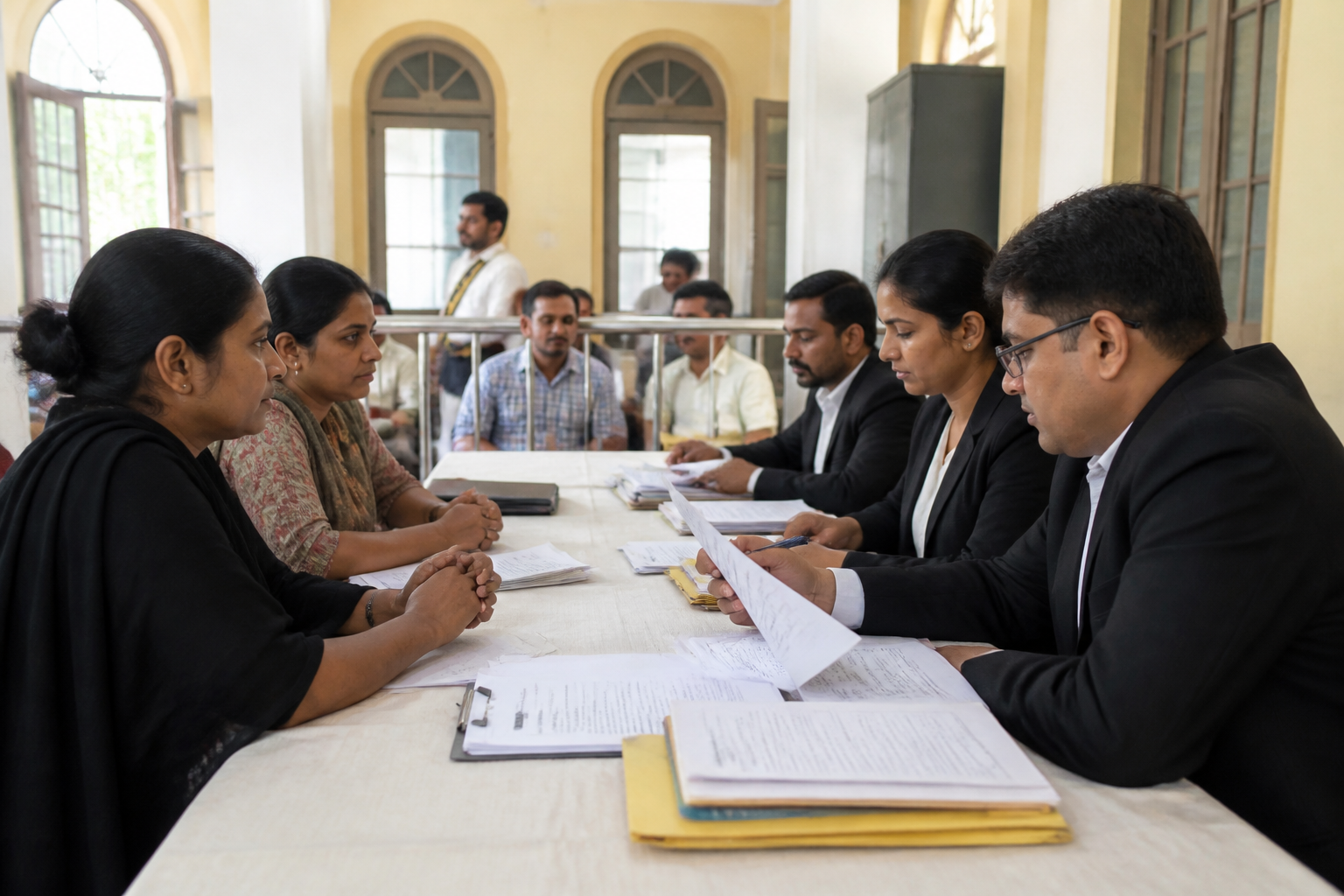
Thane’s latest National Lok Adalat produced a striking administrative outcome: 88,733 cases were settled in a single exercise, helping the district secure first place in Maharashtra for the sixth consecutive time. The figure is important not only as a performance ranking, but also because it shows how a court-linked settlement mechanism is being used to address both pending disputes and cases that have not yet formally entered the judicial system.
The Lok Adalat was held on 12 September as the third National Lok Adalat of the year. According to information provided by Ravindra S. Pajankar, secretary of the Thane District Legal Services Authority, the settlements involved a total amount of Rs 1,49,72,40,947. The cases covered compensation for motor accidents, dishonoured cheques, family disputes, bank recoveries, revenue and taxation matters, and minor criminal cases.
Of the total cases disposed of, 20,631 were pending matters and 68,102 were pre-litigation cases. This division is central to understanding the significance of the exercise. Pending matters already occupy space in the formal court system. Pre-litigation matters, by contrast, are disputes brought for settlement before they become full-fledged court cases. The larger number of pre-litigation settlements indicates that the Lok Adalat is functioning not only as a mechanism for reducing existing court workload, but also as an early intervention forum.
That distinction changes the way the result should be read. A disposal figure is often treated as a simple measure of institutional efficiency. In this case, the number reflects two different administrative tasks. One is the settlement of disputes that have already entered the judicial process. The other is the prevention of additional cases from moving deeper into that process. The source does not provide a comparison with earlier Lok Adalats in Thane, so it is not possible to establish from the available information whether the number of settlements increased or declined over time. It does, however, establish the scale of the latest exercise and the composition of the cases resolved.
The Lok Adalat model described in the report is based on consent. Both parties are heard, and an effort is made to reach a settlement with their agreement. This is different from a conventional contested proceeding in which a court determines the dispute after considering the claims and defences of the parties. The settlement process therefore depends on the ability of the parties to accept a negotiated resolution and on the forum’s capacity to bring them together.
The categories listed by the Thane District Legal Services Authority also show why such a forum has relevance beyond a single type of dispute. Motor accident compensation cases involve financial claims following injury or death. Cheque dishonour and bank recovery matters concern repayment and financial liability. Family disputes can involve relationships and household-level conflict. Revenue and tax cases connect citizens and institutions to administrative demands, while minor criminal matters form part of the lower-level disputes that can otherwise continue through formal procedures.
These categories do not all carry the same legal or social character. They are grouped here because the Lok Adalat can attempt settlement in matters where the parties’ consent provides a route to resolution. The source does not state how many cases belonged to each category, what the average settlement value was, or how long the disputes had remained unresolved. Those gaps matter because the headline total alone cannot show whether the exercise primarily resolved high-value financial claims, a large number of smaller matters, or a combination of both.
The total settlement amount of more than Rs 149 crore provides another measure of the exercise, but it should not be confused with money recovered by a single institution or with a direct public expenditure saving. The amount represents the value involved in settlements across the cases disposed of. The supplied report does not provide a category-wise breakdown, the proportion paid immediately, or the terms attached to individual agreements. What can be established is that the settlements covered a substantial aggregate value and that the agreements were recorded through the Lok Adalat process.
The legal character of the settlement is also significant for citizens deciding whether to participate. The report states that an award passed in a Lok Adalat settlement is final and binding, with the same status as a decree of a civil court. This gives the settlement a formal legal consequence rather than making it merely an informal compromise between parties. For disputants, the process therefore combines negotiated consent with an enforceable outcome.
The source identifies time and cost savings as key benefits for citizens. A conventional dispute can require repeated appearances and continued procedural engagement. The report does not quantify the time saved in Thane or provide a comparison of costs between Lok Adalat settlements and regular litigation. Still, the institutional logic is clear from the mechanism described: when parties agree to settle, the dispute can reach a binding conclusion without continuing through the full course of a contested case.
This is where the distinction between access to justice and access to courts becomes relevant. The available information does not suggest that Lok Adalat replaces the formal judiciary. Instead, it operates alongside the court system and offers a different route for disputes that are suitable for settlement. Its role is therefore partly corrective, by addressing pending cases, and partly preventive, by attempting to resolve pre-litigation disputes before they generate additional judicial workload.
The 68,102 pre-litigation matters settled in Thane are especially relevant to this institutional role. They account for the majority of the total cases reported. That number cannot by itself prove that future court filings have been prevented, because the source does not state how many of the matters would otherwise have become formal cases. It does show, however, that the settlement forum is handling a large volume of disputes before they reach that stage.
The sixth consecutive first-place ranking in Maharashtra adds an element of continuity to the latest result. It suggests that Thane has repeatedly recorded the highest disposal performance among districts in the state during the relevant National Lok Adalat exercises. The report does not specify the criteria used for the ranking, whether the comparison is based only on the number of cases settled, or whether the settlement value and other indicators are also considered. The ranking should therefore be read as a reported performance outcome, not as a complete assessment of the district’s legal services system.
There is also a practical limit to what the available figures can reveal. The number of cases settled is not the same as the number of people assisted, because a single dispute may involve multiple parties. Nor does the aggregate figure indicate whether all settlements were equally satisfactory to those involved. The process is based on consent, but the source provides no information on participant feedback, representation, accessibility barriers, or the distribution of settlements across Thane district’s urban and non-urban areas.
Those unanswered questions are important for evaluating the system from the citizen’s perspective. A high disposal figure demonstrates institutional reach, but it does not independently show who was able to use the forum, how parties were informed, or whether people with limited resources could participate on equal terms. The supplied report contains no such demographic or operational information. It therefore supports a conclusion about scale and formal outcomes, but not about the wider quality or inclusiveness of every settlement.
Even with those limitations, Thane’s latest result identifies a clear governance function. The District Legal Services Authority is coordinating a process that brings together disputes at different stages, applies a consent-based settlement model, and records outcomes with binding legal force. The exercise also links judicial administration with everyday issues such as accident compensation, household conflict, taxation, banking and minor criminal matters.
The larger urban question is how cities and districts manage the volume of disputes generated by dense economic and social interaction. The source does not provide data on Thane’s population, court pendency, filing rates or the number of judges and legal services personnel. It would therefore be inappropriate to claim that the Lok Adalat has resolved the district’s wider judicial pressures. The available evidence supports a narrower conclusion: a large, organised settlement exercise can process both pending and pre-litigation disputes at scale, while giving citizens a binding alternative to prolonged litigation where settlement is possible.
The next stage for understanding Thane’s performance would be more detailed public information on the cases settled, the categories involved, settlement values, participation levels and follow-up compliance. For now, the 12 September exercise confirms the scale of the district’s Lok Adalat operation: 88,733 cases settled, including 68,102 pre-litigation matters and 20,631 pending cases, with settlements valued at Rs 1,49,72,40,947. It also records Thane’s sixth consecutive first-place ranking in Maharashtra, as reported by the District Legal Services Authority.

