


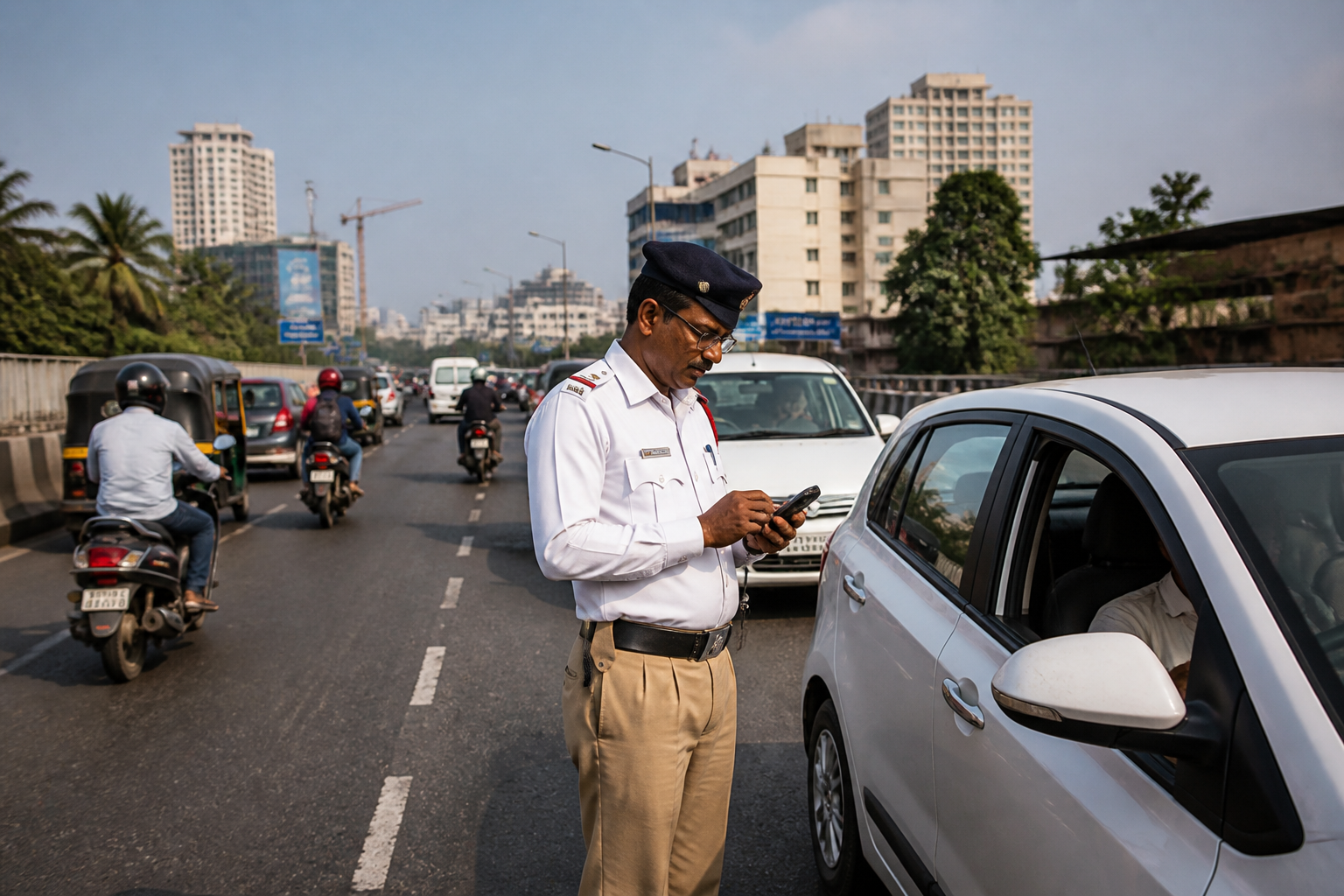
Thane’s latest e-challan settlement drive has recovered Rs 1.57 crore from 7,001 pending cases, but the larger significance lies in what the exercise reveals about the city’s traffic enforcement system: a digital fine does not end with a message on a vehicle owner’s mobile phone. When the penalty remains unpaid, the matter can move into the court system, adding an institutional layer to what begins as a routine traffic violation.
The cases were settled during the National Lok Adalat held on 12 September for pending matters under all 18 units of the Thane city traffic branch. According to Loksatta, the exercise resulted in the disposal of 7,001 cases and the recovery of Rs 1,57,33,075 in outstanding e-challan penalties. The amount was deposited in court and contributed to government revenue.
The figures offer a direct view of the volume of unresolved traffic-penalty matters in an urban jurisdiction. They also show why the enforcement of traffic rules cannot be understood only through roadside checks or the issuing of digital challans. The system has at least three connected stages: a violation is recorded, an e-challan is sent to the vehicle owner, and non-payment can lead to court proceedings. Lok Adalat then becomes a route through which eligible pending matters can be settled.
The Thane traffic branch uses e-challans to impose penalties for violations under the Motor Vehicles Act. The report states that the relevant vehicle owner receives the e-challan on a mobile phone. If the amount is not paid within the required period, a case may be filed in court against the concerned driver or vehicle owner. The unpaid fine therefore changes from an administrative demand into a pending legal matter.
That transition is important for understanding the administrative burden created by unpaid penalties. A traffic violation may take place on a road, but its unresolved consequences are managed across several institutions. Traffic police record and initiate enforcement. Courts handle cases that remain pending. The legal services authority supports the settlement process through the National Lok Adalat. The Thane exercise was conducted under the guidance of Thane Principal District and Sessions Judge R.D. Sawant, with the initiative of Ravindra Pajankar, secretary of the Thane District Legal Services Authority.
The involvement of 18 traffic units indicates that the settlement was not limited to one junction, neighbourhood or enforcement team. It covered pending cases under the Thane city traffic branch’s wider operational structure. The report does not provide a unit-wise breakdown, the age of the cases, the types of violations involved or the number of vehicle owners who appeared. Those details would be necessary to assess where unresolved penalties are concentrated and why they remained unpaid.
Even without that breakdown, the aggregate number is significant for the city’s enforcement chain. The disposal of 7,001 cases in a single Lok Adalat does not necessarily mean that 7,001 separate traffic incidents occurred during the same period. These were pending matters accumulated before the 12 September hearing. The number therefore represents both enforcement activity and the backlog created when penalties are not settled at the first stage.
This distinction matters because a high recovery figure can be read in two ways. It demonstrates that the enforcement system was able to bring a large number of pending cases before a settlement forum. At the same time, it shows that the system had to rely on a later legal process to resolve fines that had not been paid earlier. The available report does not establish why individual vehicle owners delayed payment. It only explains the institutional consequence of non-payment and the settlement opportunity offered through the Lok Adalat.
The National Lok Adalat is presented in the report as a recurring mechanism for resolving pending cases through compromise. Such hearings are held every three months, according to the information published by Loksatta. For traffic authorities, this creates a periodic channel for clearing unresolved matters. For vehicle owners, it provides an opportunity to settle pending fines without allowing the cases to remain indefinitely in the court system.
The arrangement also connects enforcement with access to justice. A vehicle owner who ignores an e-challan may eventually have to face court proceedings. The Lok Adalat route offers a negotiated settlement process for such pending cases, while also allowing the outstanding amount to be collected. The report describes this as relief for vehicle owners as well as an addition to government revenue. That dual outcome is central to the design of the exercise: the state recovers money that remained unpaid, while the affected individuals receive a route to close the pending matters.
However, settlement after a case reaches court is not the same as timely compliance with a traffic penalty. The report does not state whether the fines were reduced, whether any additional legal costs applied, or whether every pending matter was eligible for the same settlement terms. It also does not provide information about how vehicle owners were notified about the Lok Adalat, how attendance was managed or whether the process was available digitally. These unanswered questions determine how accessible the mechanism is in practice.
The e-challan system is therefore only as effective as the complete chain around it. A digital notice can record and communicate a violation, but compliance depends on the recipient receiving the notice, understanding the penalty, being able to pay it and doing so within the prescribed period. If payment does not occur, the case enters another institutional channel. The Thane figures show that the final stage can produce substantial recovery, but they do not reveal how many cases remain outside the settlement process.
The report also highlights the relationship between traffic enforcement and public revenue. The Rs 1.57 crore recovered at the Lok Adalat was deposited in court and added to government receipts. The primary purpose of traffic penalties is enforcement of the Motor Vehicles Act, not revenue generation alone. Yet once fines remain unpaid, their recovery becomes a measurable administrative outcome. The Thane exercise makes that connection visible without establishing whether revenue targets or collection performance influenced the selection of cases.
For urban governance, the important issue is the movement of a relatively small individual penalty through a larger public system. Each unpaid e-challan can require record-keeping, communication, legal processing and eventual disposal. When thousands accumulate, the issue becomes one of institutional capacity. The 7,001 settlements show the scale at which traffic enforcement intersects with courts and legal services administration in a growing city.
The exercise also raises a question about the point at which citizens engage with enforcement systems. A traffic fine sent by mobile phone is designed to make the process immediate and digital. A pending case before a Lok Adalat is a later and more formal stage. The available report does not compare payment rates before and after court referral, nor does it say how long the cases had remained pending. Without those figures, it is not possible to determine whether the settlement drive represents a temporary backlog clearance or a recurring pattern in Thane’s traffic administration.
That information would be valuable for evaluating the system beyond the headline recovery amount. A unit-wise case count could show where pending matters are concentrated. Data on violation categories could indicate whether the backlog is dominated by a few recurring offences. Information on the age of cases could distinguish recent delays from long-standing accumulation. Details of notices and attendance could indicate whether the process is reaching vehicle owners effectively.
What is established is that Thane’s 18 traffic units had 7,001 pending matters that were settled through the National Lok Adalat on 12 September, resulting in the collection of Rs 1,57,33,075. The process was conducted under the guidance of the principal district and sessions judge and with the involvement of the District Legal Services Authority. The report also states that National Lok Adalats provide such settlement opportunities every three months.
The next question for the city is whether periodic settlement drives can be matched by earlier payment and clearer case management. The supplied report does not provide evidence on future recovery targets, changes to the e-challan system or the number of cases still pending after the hearing. Those are the indicators that will show whether the Lok Adalat has merely cleared a backlog or has become part of a more efficient enforcement cycle.

