


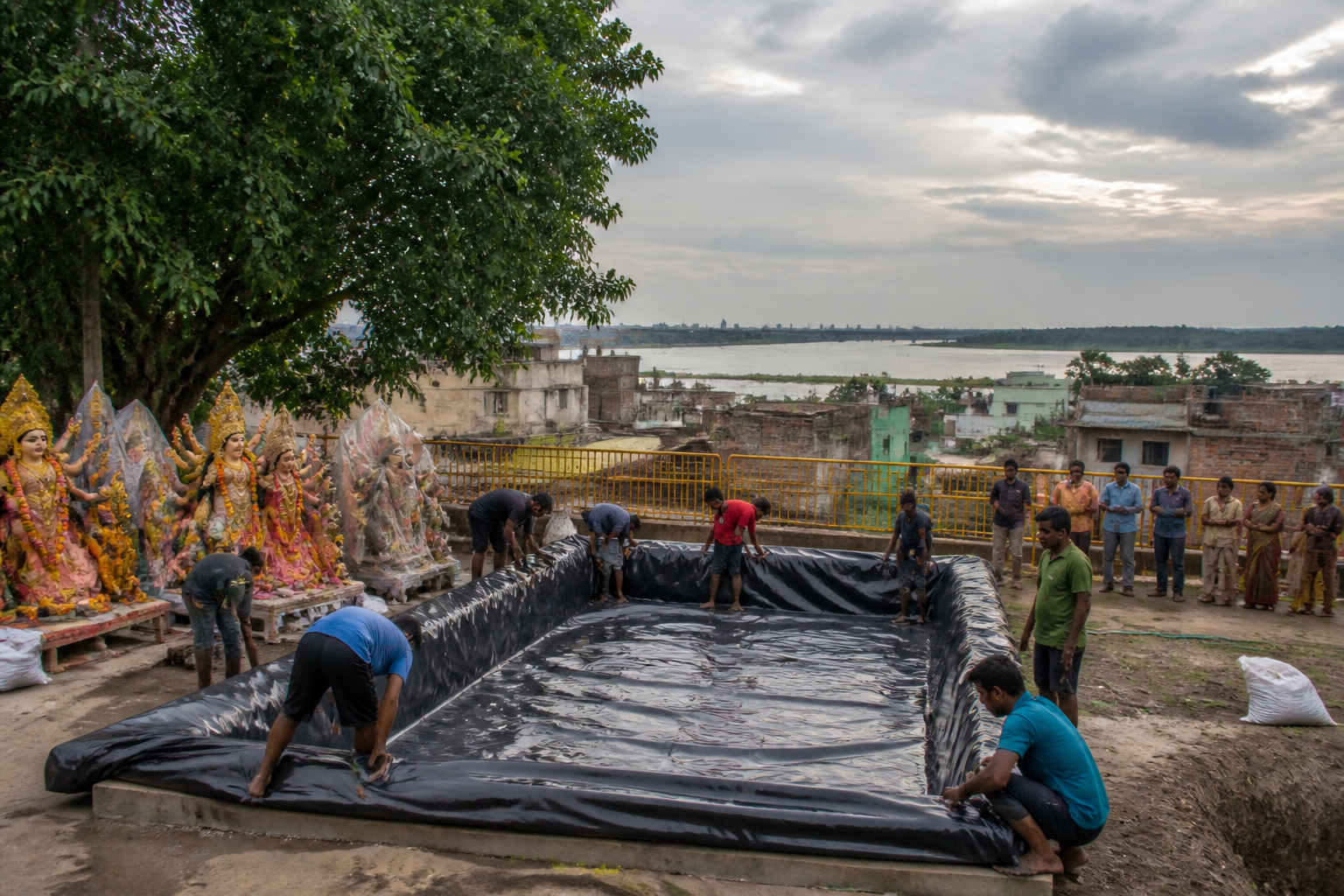
The Delhi Pollution Control Committee’s ban on idol immersion in the Yamuna and other waterbodies is more than a pollution-control directive. It places the responsibility for managing a recurring urban activity on Delhi’s municipal and enforcement machinery, requiring local bodies to provide artificial ponds, identify designated sites and monitor the river’s condition before and after immersions.
The order, dated September 9 and issued under the Water (Prevention & Control of Pollution) Act, 1974, prohibits all idol immersions in the Yamuna and other waterbodies except at locations identified by local bodies or other authorities. The direction was issued during Ganesh Puja and ahead of Durga Puja, when large numbers of idols may be immersed across the city.
The central administrative question is therefore not only where immersion is prohibited, but whether alternatives are available close enough to residential areas and puja locations for communities to use them. The DPCC has directed urban local bodies to create temporary artificial ponds near localities and residential areas. It has also asked residents and puja committees to consider household or residential immersion in buckets or temporary ponds, with the decanted water subsequently used for gardening.
This shifts the policy from a simple prohibition to a distributed service obligation. Local bodies must provide or facilitate sites, while district magistrates, the Delhi Police and other authorities must help enforce the restriction. The effectiveness of the order will depend on whether these responsibilities are visible and practical at neighbourhood level, rather than remaining only in an administrative notification.
The DPCC has set an environmental compensation of Rs 50,000 for violations. The order also directs municipal bodies and the Delhi Police to check vehicles and goods carriers entering Delhi with idols. This introduces an enforcement layer beyond the immersion site itself, covering the movement of idols into the capital. District magistrates have been tasked with enforcing a directive issued under the National Mission for Clean Ganga framework.
The arrangement involves several institutions with different roles. The DPCC is the pollution-control authority issuing the directions and conducting water-quality assessments. Urban local bodies are responsible for identifying or creating temporary artificial ponds. District magistrates have an enforcement role, while the Delhi Police are expected to assist with checks on vehicles and goods carriers. Puja committees, residents and idol makers are addressed as participants in compliance rather than as passive recipients of the ban.
That institutional spread is significant because water pollution from festival activity is not controlled at a single point. The order addresses the materials used to make idols, the paints and dyes applied to them, the transport of idols, the location of immersion and the condition of water before and after the activity. Each stage requires a different administrative response.
The DPCC cited concerns about plaster of Paris, chemical paints and dyes. According to the report, the committee said such materials may contain mercury, zinc oxide, chromium, lead and cadmium. These substances can harm aquatic life and create health risks for people. The order also refers to studies showing deterioration in water quality after immersions, particularly through changes in conductivity, biochemical oxygen demand and heavy-metal concentration.
These indicators matter because the policy is concerned with more than visible debris or floating material. Changes in conductivity and biochemical oxygen demand point to alterations in the water’s chemical and organic characteristics, while heavy-metal concentration relates to the persistence of toxic substances. The DPCC’s decision to assess water quality before, during and after idol immersion is intended to establish how conditions change across the activity.
The supplied report does not provide the results of those assessments, the number of designated immersion sites or the capacity of the temporary ponds. Those details will be important in judging whether the directive has created a workable alternative to river immersion. A ban can define the prohibited activity, but the city’s implementation capacity will determine whether compliance is feasible for communities organising public festivals and for households carrying out smaller immersions.
The order also points to a material transition in idol-making. Idol makers have been directed to use natural clay, biodegradable materials and natural colours. For plaster of Paris idols, the directive requires immersion only at designated sites. The distinction suggests that the policy combines restrictions on location with instructions about production materials, rather than treating the environmental impact as a problem limited to the riverbank.
At the neighbourhood level, artificial ponds could reduce the need to transport idols to the Yamuna or other waterbodies. The DPCC has specifically asked local bodies to locate such facilities close to residential areas. That proximity is an operational issue: the further the designated site, the greater the dependence on organised transport, traffic management and enforcement. The order’s reference to household immersion offers another decentralised option, but the report does not establish how many households or committees are expected to use it or how the city will support that process.
The directive also places a compliance burden on festival organisers. Residents and puja committees are expected to encourage immersion in buckets or temporary artificial ponds, while idol makers are expected to change materials and colours. This makes public communication an important part of implementation, although the supplied order summary does not specify an awareness campaign, helpline, site list or public timetable.
The Rs 50,000 environmental compensation creates a clear penalty for violations, but enforcement will require authorities to identify the violator and establish that immersion took place outside a designated site. Vehicle checks may help prevent or monitor the movement of idols, yet the report does not state how such checks will be organised, where they will occur or how they will distinguish between lawful transport and a planned violation. These operational details remain central to the order’s practical reach.
The policy also exposes the relationship between seasonal religious activity and permanent urban infrastructure. Festival immersions occur at specific times, but the pollution-control problem is tied to the city’s continuing dependence on waterbodies as public-use and disposal spaces. Temporary ponds are therefore being used as seasonal infrastructure to manage a recurring demand that cannot be accommodated within the river without environmental consequences.
For the Yamuna, the order creates a defined monitoring sequence: water quality is to be assessed before idol immersion, during the activity and afterwards. This can help establish whether the designated-site system and material restrictions are producing the intended result. However, the supplied report contains no baseline readings, post-immersion results or public reporting format. Without those figures, the directive’s effect cannot yet be measured through the evidence available.
What the order confirms is that Delhi’s pollution-control response now covers the full chain of idol immersion: materials, transport, location, enforcement and monitoring. What remains unclear is the implementation capacity of local bodies, the number and readiness of artificial ponds, the public availability of designated sites and the results of DPCC’s water-quality assessments.
The next significant evidence will come from how district authorities, municipal bodies, police, puja committees and residents operationalise the directions during the festival period. The DPCC’s before-and-during-and-after water assessments, together with enforcement outcomes and the functioning of temporary ponds, will show whether the Yamuna immersion ban has been converted from a legal restriction into a practical urban pollution-management system.
