


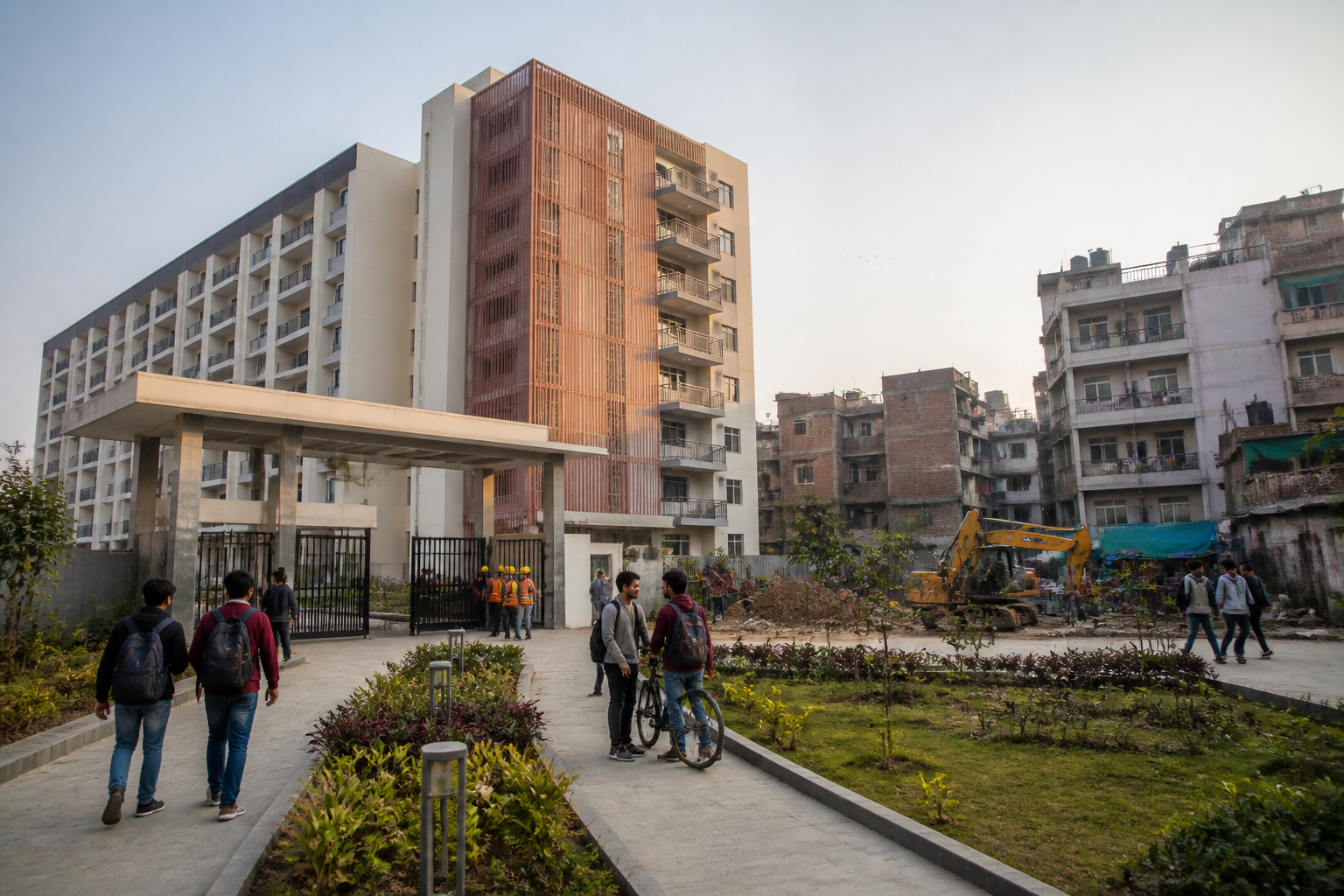
The Delhi government’s plan to build hostels for 10,000 students is more than a response to the Satya Niketan building collapse. It is an acknowledgement that the capital’s education economy has expanded without a matching supply of safe, affordable and institutionally managed accommodation.
Chief minister Rekha Gupta announced the initiative after a five-storey building being used as a paying guest facility collapsed in Satya Niketan near Delhi University’s South Campus on September 6. Seven people, including five Delhi University students, were killed. The incident brought renewed attention to the risks faced by students who depend on privately operated paying guest facilities because university hostels are insufficient.
The proposed hostels are intended for girls and boys from any university. According to the chief minister’s office, the initial capacity will be expanded as demand grows. The government has described the facilities as safe and economical accommodation for students who come to Delhi from across the country for higher education.
The announcement therefore addresses two connected failures. The first is the shortage of institutional housing. The second is the absence of a consistently enforced framework governing the buildings that fill that gap. When university accommodation is unavailable, students are pushed into a fragmented market of rented rooms and PG facilities, often in densely populated neighbourhoods and at high rents. The government’s own stated response combines new hostel construction with proposed regulation of existing PG accommodation.
Delhi University illustrates the scale of the mismatch. The university has around 2.5 lakh regular students, many of whom come from outside Delhi, but its current hostel capacity is about 7,210 seats. Even after a planned expansion to 12,754 seats, the capacity would remain far below the number of students requiring accommodation. The figures do not establish the precise number of students seeking rooms, but they show why private accommodation has become a structural part of the city’s education system rather than a marginal housing option.
That system operates with uneven oversight. The Times of India report said many PG buildings are located in densely populated areas and have been constructed in violation of building norms. The Satya Niketan collapse turned what is often treated as a private housing problem into a public safety issue. Students, families, universities, landlords and city agencies are all connected to the consequences of unsafe accommodation, but responsibility for the entire system is not held by one institution.
The government’s proposed response is being distributed across several departments. Construction is already under way or has been proposed at Ambedkar University, Dhirpur, GB Pant Engineering College and Polytechnic, Indira Gandhi Hospital and Medical College, and Delhi Sports University. Departments including health, higher education, and women and child development are involved in building hostels through the public-private partnership model.
This institutional arrangement matters because student housing is not solely an education department responsibility. Sites may be controlled by universities, hospitals or technical institutions, while construction and funding may involve other government departments and private partners. Fire safety, structural stability, water supply, electricity, sanitation and security require separate forms of oversight. A hostel programme can therefore increase capacity only if these responsibilities are clearly assigned and monitored through the life of the buildings.
The government has said the proposed hostels will include Wi-Fi, round-the-clock electricity and water supply, study rooms, libraries and hygienic messes. It has also promised CCTV surveillance, biometric entry systems, round-the-clock security, fire-safety measures and regular structural audits. These features respond directly to the concerns raised by the Satya Niketan collapse, but their effectiveness will depend on enforcement and maintenance after construction.
A structural audit is not a one-time substitute for safe building management. The announcement indicates that regular audits will receive priority, but the supplied report does not specify the audit authority, frequency, public disclosure process or consequences for non-compliance. Those details will determine whether safety is treated as an operational obligation or only as a feature in the project brief.
The proposed hostels also raise questions about access. The government has described them as open to students from any university, but the available information does not establish eligibility rules, allocation mechanisms, rent levels, reservation criteria or the locations and capacities of individual facilities. These details will shape whether the programme reaches students most exposed to unsafe and expensive accommodation or primarily serves those already connected to institutional networks.
The public-private partnership model introduces another layer of accountability. The report does not provide the proposed capital structure, concession terms, operator responsibilities or affordability safeguards. Without those details, it is not possible to assess how construction costs, maintenance obligations and rents will be divided between the government and private partners. The stated objective of providing safe and economical accommodation will ultimately have to be matched by transparent operating rules.
The government is also considering intervention in the existing PG market. Education minister Ashish Sood reportedly told a student delegation that comprehensive legislation and regulations for PG accommodation would be introduced within two months. An 18-member high-level committee is drafting the policy, which is likely to include mandatory licences, zone-wise rent bands, structural and fire-safety audits, and a central portal listing rents, amenities and compliance details.
This proposed framework could make the PG market more visible to students and families. At present, choosing accommodation can involve relying on informal listings, personal networks and visits to buildings whose compliance status may not be clear. A central portal with rent, amenity and safety information could improve transparency, but the report does not yet confirm whether listings would be independently verified, how violations would be recorded or whether unlicensed operators would be removed from the market.
Zone-wise rent bands would also represent a significant shift in how student accommodation is governed. They could provide a reference point in areas with high educational demand, but the available information does not explain how the bands would be calculated or enforced. Similarly, mandatory licensing would create a formal entry requirement for PG operators, but licensing alone would not ensure continued structural safety unless inspections and renewal procedures were adequately resourced.
The policy challenge is therefore not limited to constructing 10,000 beds. It involves coordinating land, finance, building approvals, safety inspections, operations and access across multiple institutions. It also requires the government to regulate the private supply that students will continue to use even after new hostels are built. The current numbers make clear that institutional capacity will remain below demand for the foreseeable period described in the report.
The Satya Niketan tragedy exposed the cost of leaving this mismatch to the market without consistent oversight. Delhi’s student housing shortage is tied to the city’s ambition to become a major education hub, a goal cited by the chief minister. If the capital attracts students without providing adequate accommodation, the pressure is transferred to neighbourhood housing markets, families and students themselves.
What the government has announced is a combined capacity and regulation response: new hostels, a survey of colleges with available space, safety standards and a proposed framework for PG facilities. What remains unclear are the delivery timelines, final locations, funding arrangements, eligibility rules, rent levels and enforcement mechanisms. Those details will determine whether the plan becomes a durable student housing system or remains a construction target shaped by the immediate shock of a building collapse.
