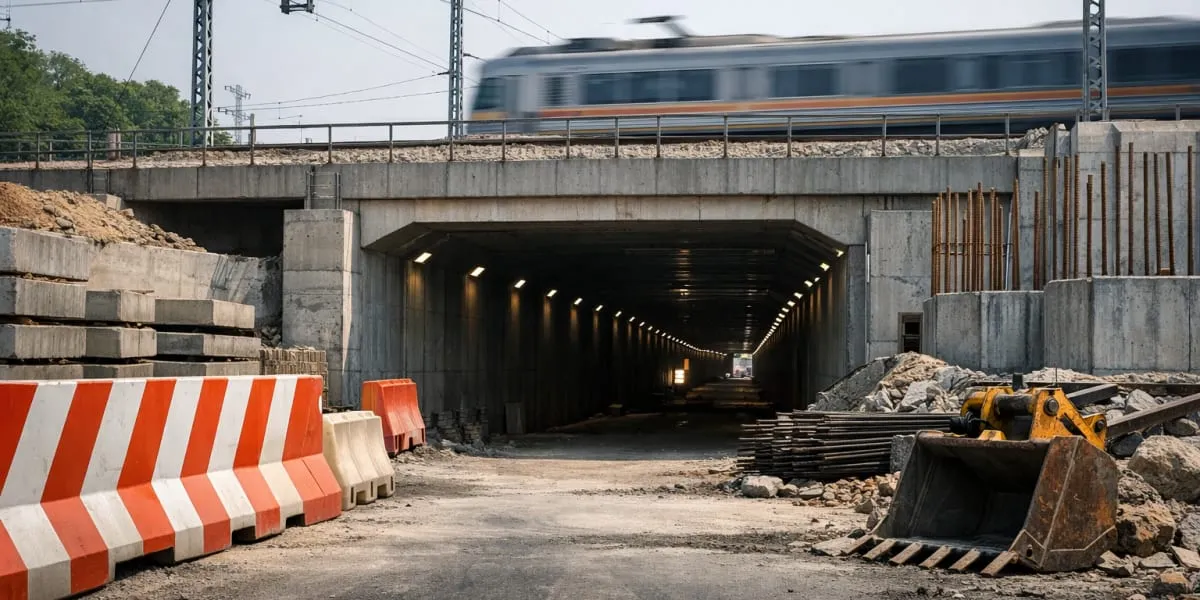
Delhi’s long-delayed Bhairon Marg underpass project is now expected to become operational by February 2027, offering partial relief to one of the capital’s most congested traffic junctions near Pragati Maidan and Ring Road. The project, however, also highlights how climate-linked disruptions and ageing transport infrastructure are increasingly reshaping urban construction timelines across Indian cities.
Officials associated with the project said a crucial phase of construction will require temporary suspension of railway movement later this year, as multiple rail tracks connecting Delhi with eastern states pass directly above the underpass corridor. The interruption is considered necessary to complete structural work that could not be safely executed during active rail operations. The Bhairon Marg underpass was initially planned alongside the larger Pragati Maidan redevelopment and tunnel corridor aimed at improving east-west mobility in the national capital. Yet repeated engineering setbacks, including severe flooding during the 2023 Yamuna overflow, significantly altered the pace and design of the project.
Urban infrastructure experts note that the flooding episode exposed the vulnerability of transport projects being built in ecologically sensitive and low-lying areas. Water accumulation at the construction site reportedly weakened soil stability and damaged portions of the partially built structure, forcing redesign interventions and fresh safety assessments. One major consequence of those changes is the reduction in vertical clearance inside sections of the underpass. As a result, the corridor will now accommodate only smaller vehicles such as cars and compact passenger transport, while buses and heavy commercial vehicles will continue using surface-level roads. Transport planners say this limitation could reduce the project’s overall traffic-handling capacity, even though it may still improve vehicular flow for daily commuters travelling between Central Delhi, Ring Road and the Pragati Maidan zone. The corridor is expected to benefit office workers, exhibition visitors and local residents who regularly experience bottlenecks around the ITO and Ashram-bound stretches.
The Bhairon Marg underpass also reflects a broader challenge confronting Indian cities: balancing rapid mobility expansion with climate resilience. Increasing instances of extreme rainfall, flooding and land subsidence are forcing urban agencies to rethink drainage systems, soil reinforcement methods and long-term infrastructure durability. Infrastructure analysts believe future transport investments in Delhi and other metropolitan regions will increasingly require integrated climate-risk planning rather than isolated engineering execution. Without stronger resilience measures, weather-related delays could continue escalating project costs and reducing public confidence in urban infrastructure delivery. For now, authorities are focusing on completing the remaining structural work within the revised timeline. Once operational, the Bhairon Marg underpass is expected to ease surface congestion in a critical section of Delhi’s road network, although questions around flood preparedness and multimodal mobility remain central to the city’s long-term transport planning agenda.