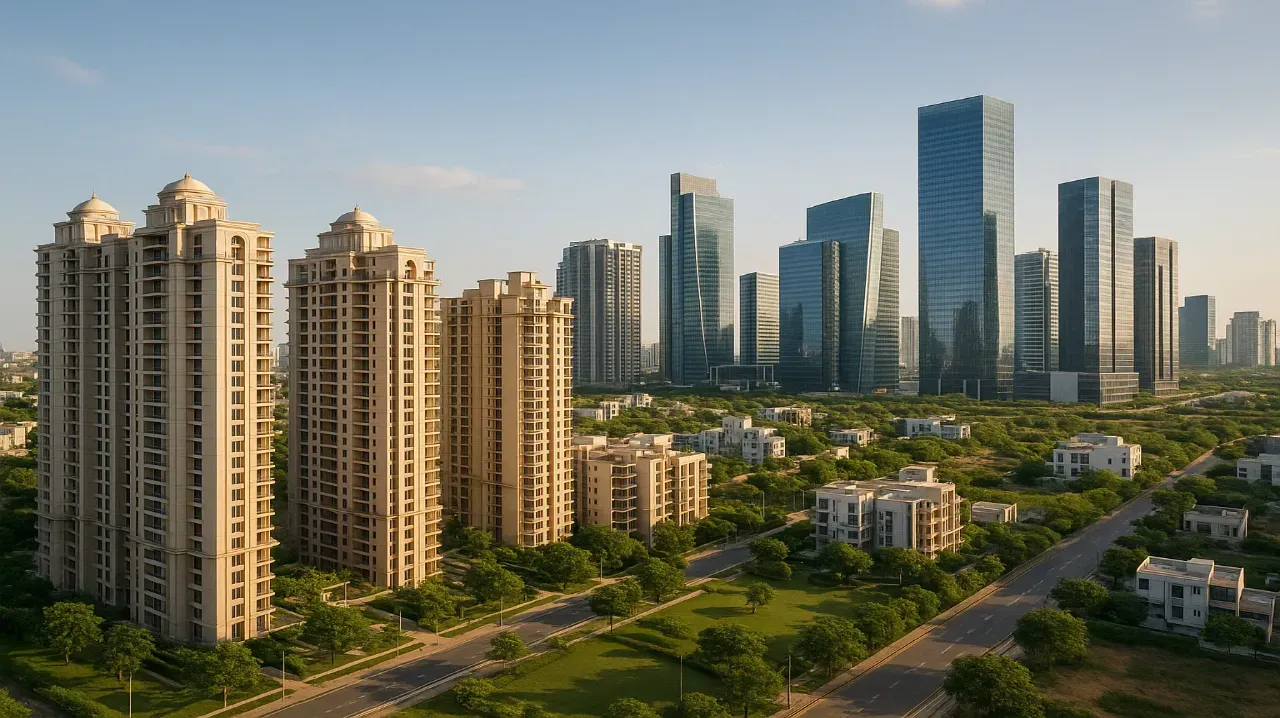
Delhi-NCR’s widening housing affordability gap is reshaping how middle-income residents live, commute and invest, as rising property prices continue to outpace salary growth across the region’s major urban centres. For households earning between ₹50,000 and ₹1 lakh a month, purchasing a home in established parts of Noida, Gurugram or Delhi is becoming increasingly difficult. Property analysts tracking the NCR market say the sharp escalation in apartment prices, combined with elevated borrowing costs, has reduced access to formal home ownership for a large section of salaried professionals.
Industry estimates suggest that financially sustainable housing is typically linked to loan repayments consuming no more than 30–40 percent of monthly income. Under current lending rates, this leaves many middle-income buyers eligible for home loans that fall well short of prevailing apartment prices in prime urban corridors. In several high-demand districts of Noida and Gurugram, entry-level two-bedroom apartments now command prices far beyond what average salaried households can comfortably finance. The growing mismatch between incomes and housing costs is pushing buyers toward peripheral locations such as Greater Noida West, the Yamuna Expressway belt and emerging sectors along Sohna Road.
Urban planners warn that the NCR affordable housing challenge is no longer only about property prices. The issue is increasingly tied to infrastructure quality, mobility access and liveability standards. Many lower-cost housing projects continue to emerge in areas lacking dependable public transport, healthcare facilities, schools and walkable civic infrastructure. As a result, residents often face longer daily commutes, higher transport expenses and weaker social connectivity. The pressure on affordability is also influencing the region’s environmental footprint. Experts note that rapid outward expansion without integrated transport planning increases dependence on private vehicles, contributing to congestion and higher urban emissions. In contrast, compact development around metro corridors and mixed-use neighbourhoods is increasingly viewed as critical for building climate-resilient cities.
Real estate observers also caution buyers against speculative purchases driven by aggressive marketing around “budget housing” opportunities. Concerns remain around delayed delivery timelines, incomplete infrastructure and misleading sales practices in certain emerging pockets. Market analysts advise prospective homeowners to prioritise regulatory approvals, developer credibility and ground-level infrastructure assessments before committing to purchases. At the same time, economists believe demand for smaller housing formats and resale units is likely to rise steadily as buyers recalibrate expectations. Compact homes near employment hubs, even with limited space, are increasingly preferred over distant low-cost projects with weak connectivity. The NCR affordable housing debate is expected to intensify further as urban migration continues and land values rise across major growth corridors. Policymakers and city authorities may face increasing pressure to align housing supply with transport networks, public services and income realities if the region hopes to sustain inclusive urban growth over the next decade.