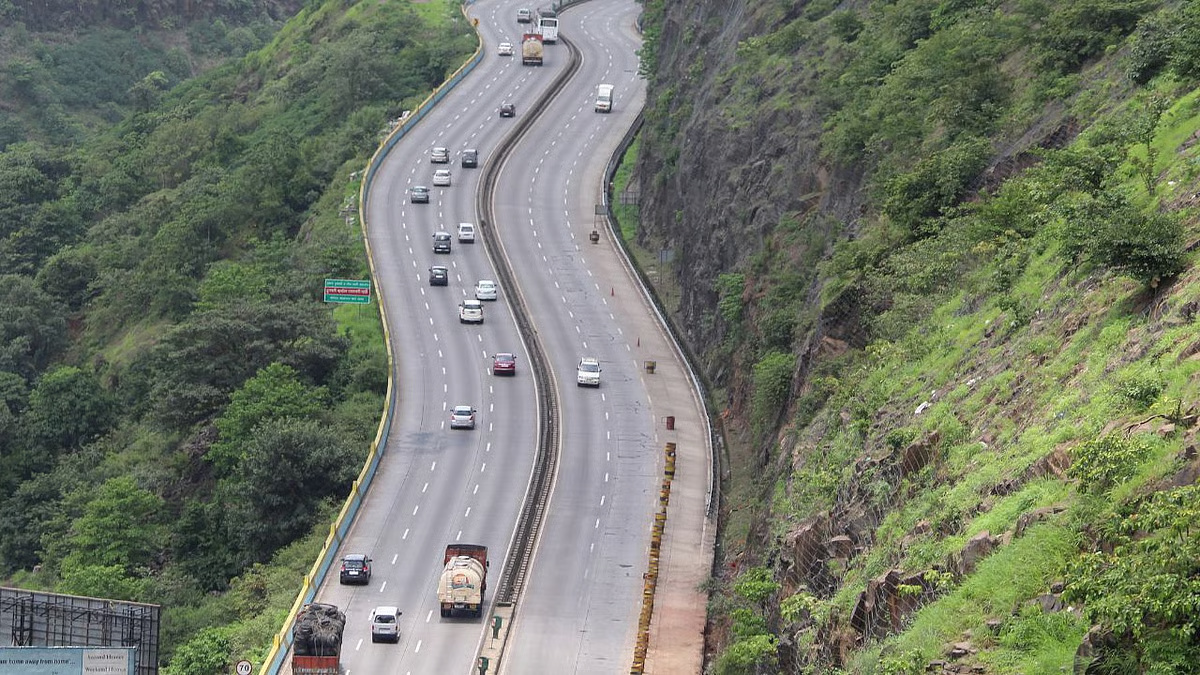
Maharashtra has operationalized a major new section of the Mumbai–Pune Expressway designed to bypass the accident-prone Khandala Ghat stretch, marking a significant shift in how one of India’s busiest transport corridors is expected to handle rising passenger and freight movement in the coming years. The newly completed missing link corridor introduces an alternative alignment featuring one of the country’s tallest cable-stayed road bridge structures, alongside expanded carriageways, viaduct systems and upgraded approach infrastructure. The development is intended to improve traffic flow, reduce travel delays and strengthen operational safety on a route that serves as a critical economic connector between Mumbai, Pune and the wider western industrial belt.
At the centre of the project is a 650-metre cable-stayed bridge suspended across a deep valley in the Sahyadri range. Supported by pylons rising more than 180 metres, the structure forms part of a broader elevated corridor engineered to navigate difficult mountain terrain while reducing dependence on steep ghat roads vulnerable to congestion, landslides and weather-related disruptions. Infrastructure analysts say the Mumbai Pune Expressway project reflects the growing importance of resilient transport systems capable of supporting both commercial logistics and regional mobility in rapidly urbanising corridors. The route carries high volumes of passenger vehicles, intercity buses and freight transport connecting ports, manufacturing clusters and commercial centres across Maharashtra. The new alignment also includes widened carriageways and expanded access infrastructure intended to distribute traffic more efficiently along adjoining sections of the expressway network. Urban transport experts note that such upgrades are increasingly necessary as vehicle density rises sharply between Mumbai and Pune, two metropolitan regions experiencing sustained real estate expansion and industrial growth.
Officials associated with the project indicated that construction was carried out under technically demanding conditions marked by steep valleys, intense monsoon rainfall, fog and limited working space in the Western Ghats. Engineers relied on specialised construction systems to assemble bridge segments at significant heights while maintaining structural stability and worker safety. The completion of the missing link is expected to shorten travel time and improve driving conditions by avoiding sharp curves and gradient-heavy stretches that have historically contributed to accidents and traffic bottlenecks. Freight operators and logistics planners are likely to benefit from more predictable transit times, particularly during peak tourism periods and monsoon months when the ghat section often experiences heavy slowdowns. However, environmental planners continue to stress the importance of balancing large-scale highway expansion with ecological safeguards in the fragile Sahyadri ecosystem. Experts argue that future infrastructure projects in mountain regions must integrate slope protection, biodiversity preservation and climate resilience measures to reduce long-term environmental stress.
Transport economists also note that while highway upgrades improve regional connectivity, sustainable mobility planning will require parallel investment in rail freight, public transport integration and low-emission logistics systems to manage long-term urban growth responsibly. As traffic demand continues to increase between Maharashtra’s two largest economic centres, the Mumbai Pune Expressway expansion is likely to become a key test case for how India modernises intercity infrastructure while navigating environmental and urban development pressures.