


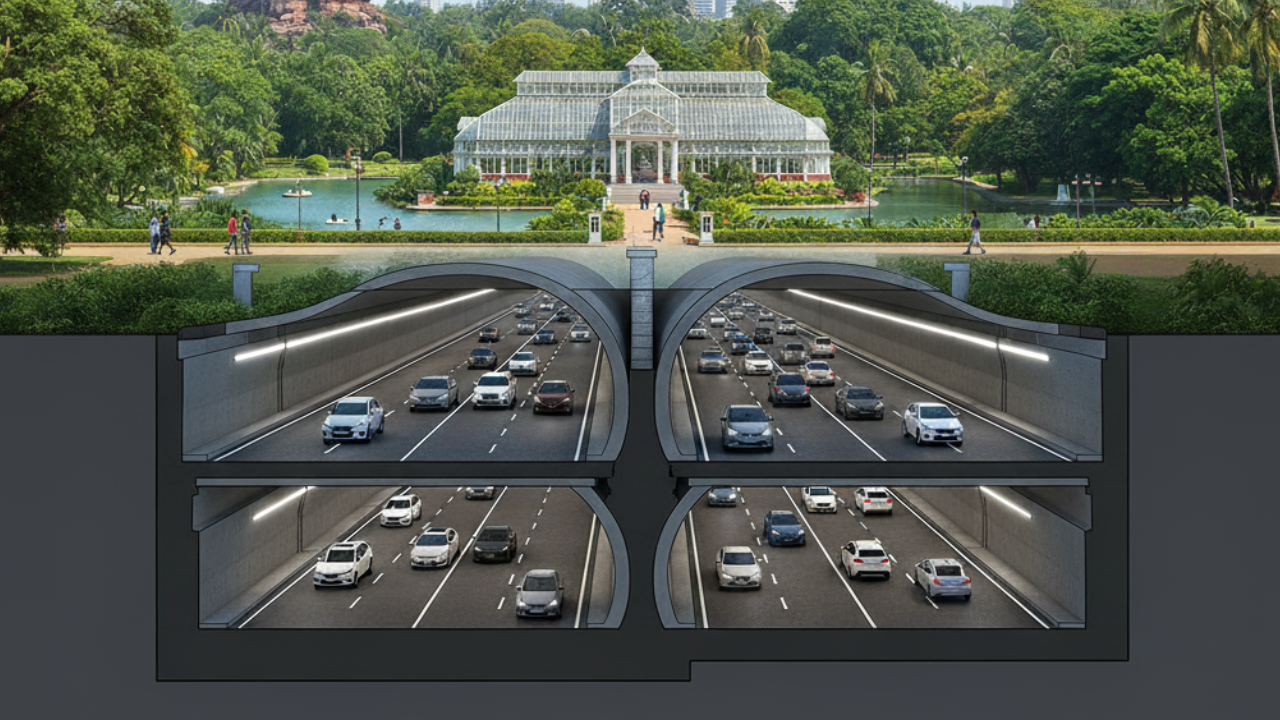
Bengaluru’s efforts to ease chronic traffic congestion around one of its busiest airport access corridors have entered a crucial execution phase, with civic authorities setting a three-month target for completing the long-pending Wind Tunnel Road underpass project.The infrastructure intervention, located along a strategically important stretch connecting eastern Bengaluru with key commercial and residential districts, is expected to improve traffic flow and reduce bottlenecks affecting daily commuters.
Officials overseeing the project have intensified monitoring amid concerns over prolonged delays and mounting commuter frustration.The underpass forms part of a broader mobility improvement strategy aimed at decongesting high-pressure junctions in Bengaluru’s rapidly expanding urban core.Transport planners say such projects are increasingly critical as vehicle ownership continues to outpace road capacity across the metropolitan region, resulting in rising travel times, fuel consumption and air pollution.Urban mobility specialists note that junction-level engineering solutions like underpasses can provide short-term operational relief, particularly in mixed-use corridors where traffic volumes have surged due to rapid commercial growth and residential densification. However, they caution that isolated road expansions alone cannot sustainably address congestion without parallel investments in mass transit and integrated transport planning.The Wind Tunnel Road corridor has witnessed significant real estate and business development over the past decade, transforming into an important connector between technology parks, airport-bound traffic and eastern suburban neighbourhoods.
Infrastructure gaps along the route have consequently carried economic implications, affecting commuter productivity and logistics efficiency.Residents and commuters in surrounding areas have repeatedly raised concerns over construction-related disruptions, traffic diversions and delays in project execution.Urban governance observers say Bengaluru’s recurring infrastructure delays often stem from coordination challenges involving utility relocation, contractor timelines and overlapping agency responsibilities.Transport economists argue that timely delivery of small and medium-scale mobility projects is becoming increasingly important for Indian cities where congestion imposes growing environmental and economic costs.Delayed roadworks not only increase emissions through vehicle idling but also reduce public confidence in urban infrastructure planning.At the same time, sustainability experts stress that road-based interventions must ultimately align with broader climate-responsive transport goals.Bengaluru’s long-term mobility future, they argue, depends on reducing dependence on private vehicles through stronger public transport networks, pedestrian infrastructure and multimodal connectivity.
Authorities are expected to closely track construction progress over the coming months as pressure mounts to complete the project before traffic volumes intensify further.Urban planners say the outcome could become a broader indicator of Bengaluru’s ability to deliver targeted mobility upgrades in a city struggling to balance rapid growth with liveability and efficient infrastructure management.
Also Read:Bengaluru Bullet Train Plans Advance Regional Connectivity
