


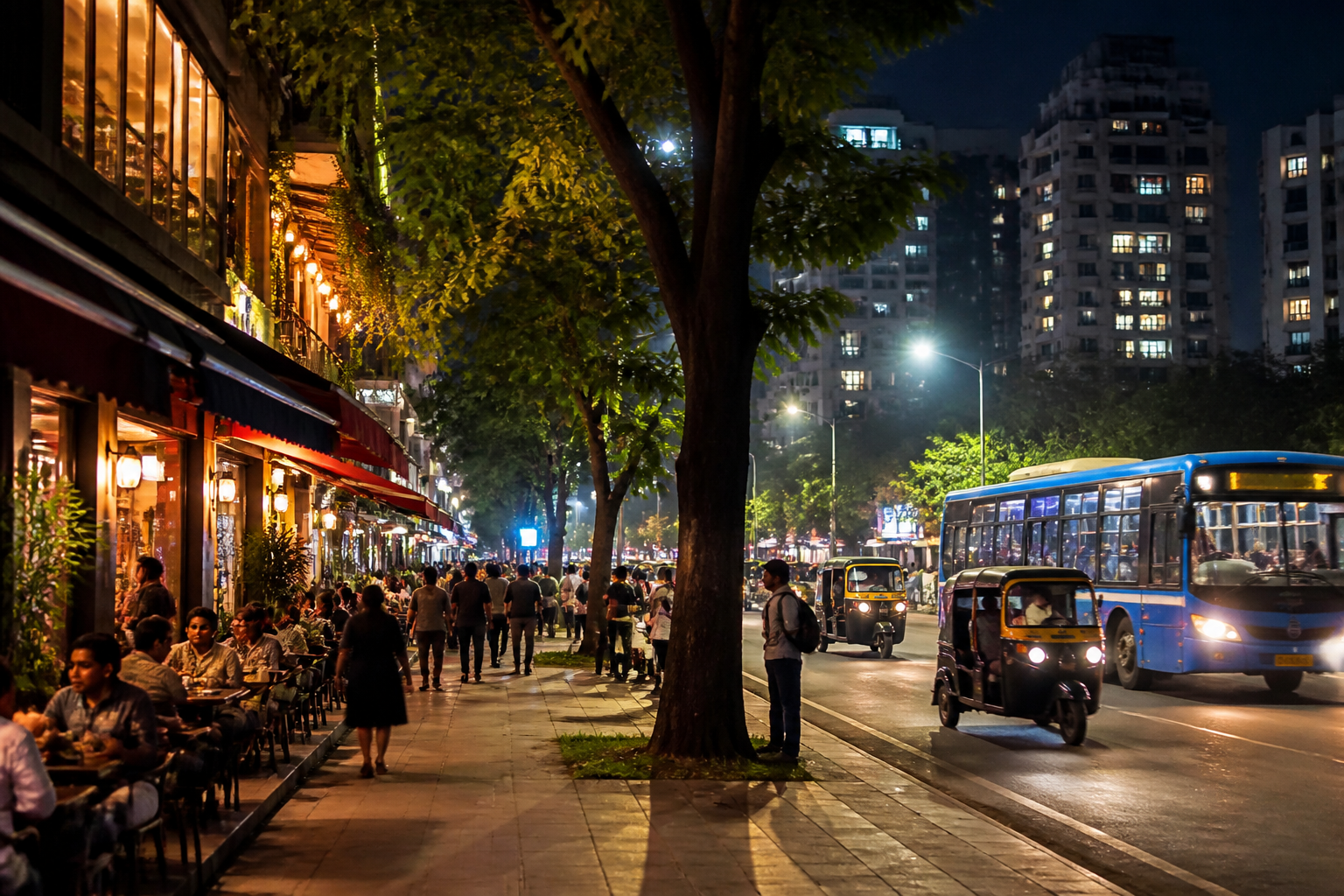
Subheadline: Bengaluru’s 17th-place ranking in Time Out’s 2026 global nightlife list highlights an expanding urban economy and the need to balance entertainment, tourism and residential life.
Standfirst: Bengaluru’s appearance at 17th in Time Out’s 2026 list of the world’s best nightlife cities is more than a lifestyle accolade. It reflects the city’s transformation alongside the growth of its information technology, business, education and scientific economies, and the arrival of new communities with different patterns of consumption and leisure. Pubs, cafés, craft beer, music, dance, food and late-evening cultural activity have become visible parts of the city’s identity. But the supplied evidence also points to a question that rankings cannot answer: how should a large, mixed-use city manage a night-time economy without weakening residential peace, public safety or mobility? Bengaluru’s challenge is not whether it should remain unchanged, but whether it can make its changing urban culture compatible with the city’s older institutions, neighbourhoods and civic responsibilities.
Bengaluru’s 17th-place ranking in Time Out’s 2026 list of the world’s best nightlife cities has placed the city alongside Bangkok, Berlin, New York, Melbourne and São Paulo. The ranking, as reported by Vijay Karnataka, presents the city’s changing lifestyle through its pubs, cafés, craft beer, music, dance, food and entertainment. It also provides a useful entry point into a wider urban question: what happens when a city’s night-time activity begins to acquire economic, cultural and tourism significance?
The answer cannot be found in the ranking alone. A list can identify visibility and reputation, but it does not establish how nightlife is distributed across the city, which neighbourhoods benefit from it, how workers travel at night or whether residents and businesses are operating under rules suited to their locations. The supplied material does not provide figures on the number of establishments, visitor spending, employment, noise complaints, late-night transport or enforcement. What it does provide is a framework for understanding nightlife as part of Bengaluru’s broader urban transition.
That transition has taken place over several generations. The city’s foundations are described through the development of the Pete, trade networks and lakes associated with Nadaprabhu Kempegowda. Later investments in education, water, electricity, industry and infrastructure under the Mysore state and its administrators helped create the conditions for a modern city. The Indian Institute of Science, established through Jamsetji Tata’s scientific vision and the support of the Mysore state, strengthened Bengaluru’s identity as a centre of knowledge.
Industrial institutions including HAL, ITI, BEL, HMT and BEML added another layer to the city’s economic base. Vidhana Soudha gave the state capital a distinct civic identity, while the work of scientists including Vikram Sarabhai, Satish Dhawan and U. R. Rao contributed to Bengaluru’s emergence as a centre for space science. The development of Electronics City later supported the information technology expansion that reshaped the city’s employment, migration and consumption patterns.
This history matters because nightlife did not emerge in isolation. It developed on top of a city that had already accumulated institutions, skilled employment, industrial capacity and educational infrastructure. The growth of the IT sector brought millions of young professionals from within India and abroad, according to the supplied source. Alongside them came new food preferences, music, cafés, pubs, fashion and entertainment practices. Nightlife is therefore one expression of a deeper transformation in the city’s social and economic geography.
The central policy question is whether this transformation should be treated narrowly as a pub-and-bar issue or more broadly as a night-time economy. The source makes the broader case. Night-time activity can include dining, music, dance, theatre, art, shopping, cafés, local food, cultural programmes and guided walks around heritage sites. Under that definition, the night-time economy includes both commercial entertainment and public-facing cultural activity.
That distinction is important for urban planning. A city that sees nightlife only through alcohol regulation may overlook restaurants, performance spaces, markets, cultural venues, transport services, security systems and small businesses that operate after dark. Conversely, a city that treats every late-night activity as an automatic sign of progress may ignore the unequal effects of noise, traffic, parking pressure and public disorder on people living near commercial areas.
The source proposes a differentiated approach rather than a single rule for the whole city. Commercial, tourism and residential areas have different functions, and the timing and intensity of activity could be set accordingly. It suggests that selected commercial zones could host regulated 24-hour food, shopping and entertainment, while residential areas should be protected from loud music, unnecessary honking, traffic congestion, irregular parking and public nuisance.
This is fundamentally a land-use question. The same activity can have different effects depending on whether it is located in a commercial district, a mixed-use corridor or a residential street. A citywide extension of operating hours without a corresponding system for zoning, access, servicing, waste management, noise control and enforcement could transfer the costs of nightlife from businesses and visitors to nearby residents. The supplied material does not establish whether Bengaluru currently has a coordinated framework for managing these interactions, but it identifies the areas that such a framework would need to address.
Safety and mobility form the second major layer. If people are permitted or encouraged to remain out later, the city needs reliable ways for them to return home. The source specifically identifies late-night metro and BMTC services, taxis, tourist vehicles and last-mile connections as potential complements to nightlife. It also calls for strict action against drunk driving. These are not separate concerns. A night-time economy depends on how safely workers, customers, performers and service providers can move between venues and homes.
The discussion also exposes the importance of workers who are less visible in lifestyle coverage. Restaurants, cafés, cultural venues, transport services, security operations and cleaning systems all support activity after dark. The supplied material does not quantify these jobs, but its emphasis on employment and small traders points to a wider distributional question: whether the benefits of a growing nightlife economy reach local businesses and workers, or remain concentrated among larger venues and better-connected commercial districts.
Tourism is another proposed avenue. Bengaluru’s international airport receives travellers throughout the day and night, while visitors come to the city for business, information technology, healthcare, education and conferences. The source argues that a stronger night-time offering could encourage some of these visitors to stay longer. It also links Bengaluru to a wider Karnataka tourism circuit, including Mysuru, Hampi, Kodagu, Chikkamagaluru, Kabini, Bandipur and coastal Karnataka.
The tourism opportunity described here is not limited to nightlife in the narrow sense. Karnataka’s food, Mysuru silk, Channapatna toys, handicrafts and other local products could be connected to evening markets and cultural programmes. This suggests a model in which nightlife becomes a gateway to regional identity rather than an imported lifestyle category alone. Whether that model can be implemented would depend on planning, permissions, transport, public-space management and coordination among tourism, municipal, police and transport authorities details not established in the supplied material.
The source’s most significant proposition is that Bengaluru should pursue a 24-hour economy without becoming a 24-hour disturbance. That formulation captures the conflict at the heart of the debate. Global-city branding rewards activity, visibility and consumption, while urban governance must also protect sleep, privacy, safety and the everyday functioning of neighbourhoods. Families, older residents and children experience the city differently from visitors and late-night consumers. A viable policy must recognise all of these users rather than allowing one group’s convenience to define the entire city.
The ranking should therefore be read as a signal, not a target. Bengaluru’s 17th-place position confirms that its night-time culture has acquired global visibility, but it does not by itself determine what kind of night-time city Bengaluru should become. The supplied material leaves several questions open: which areas could support extended hours, what agencies would enforce the rules, how noise and parking would be monitored, what transport would operate late at night, and how small businesses and local cultural producers would participate.
The evidence confirms a city in transition, with nightlife emerging from the same economic and institutional changes that made Bengaluru a knowledge, industrial, technology and tourism centre. The unresolved issue is governance. Bengaluru’s next test will be whether it can accommodate new patterns of work and leisure while retaining the civic, cultural and residential qualities that shaped its identity. The city may remain active through the night, but the quality of that activity will depend on whether growth is matched by regulation, safe mobility and respect for different urban uses.
