


KPSC recruitment scam: how alleged OMR manipulation points to institutional risk
The CID’s latest findings in the alleged Karnataka Public Service Commission recruitment scam have shifted attention from individual candidates and middlemen to the systems that govern competitive examinations. Investigators have reportedly examined bank accounts, property purchases, digital devices and examination records linked to Basavaraj Kannale, while also alleging that former examination controller Gyanendra Kumar Gangwar altered candidates’ OMR sheets to improve their scores. The claims have not been tested in court, but the investigation raises a wider question: how much of a recruitment process can be protected when question papers, answer sheets, interviews and financial transactions are all vulnerable to intervention?
The case relates primarily to the recruitment of veterinary officers. According to the report, candidates seeking the posts allegedly paid lakhs of rupees in advance to Kannale. The CID is said to have found that money was deposited or invested through several cooperative and other bank accounts in the names of relatives and associates in Bidar district. Officers led by a deputy superintendent reportedly inspected banks in Bidar on Wednesday and collected details of transactions connected to Kannale and Gangwar.
The reported investigation therefore has two distinct tracks. One concerns the alleged movement and use of money. The other concerns the integrity of the examination process itself. The combination matters because financial evidence may help investigators trace relationships and benefits, while examination records and digital data may help establish whether marks were manipulated and how candidates were selected.
The report says Kannale allegedly transferred money received from candidates to accounts associated with relatives and later to Gyanendra Kumar Gangwar, described as an IAS officer who held an important position in the commission, as well as to some commission members. These are allegations attributed to investigative sources and have not been independently established in the material available for this report. The CID has reportedly collected bank transaction details and searched the KPSC office again, including conducting a spot inspection.
Investigators have also examined assets and lifestyle indicators linked to Kannale. The report says he recently bought 15 acres of land in Bhalki, gifted a car to his father for a birthday and acquired a commercial complex. It also says he travelled abroad several times over recent months. Such information can become relevant to a financial investigation, but property ownership or travel alone does not establish the source of funds or prove wrongdoing. That distinction is central to any recruitment case, where public suspicion can quickly move ahead of documentary proof.
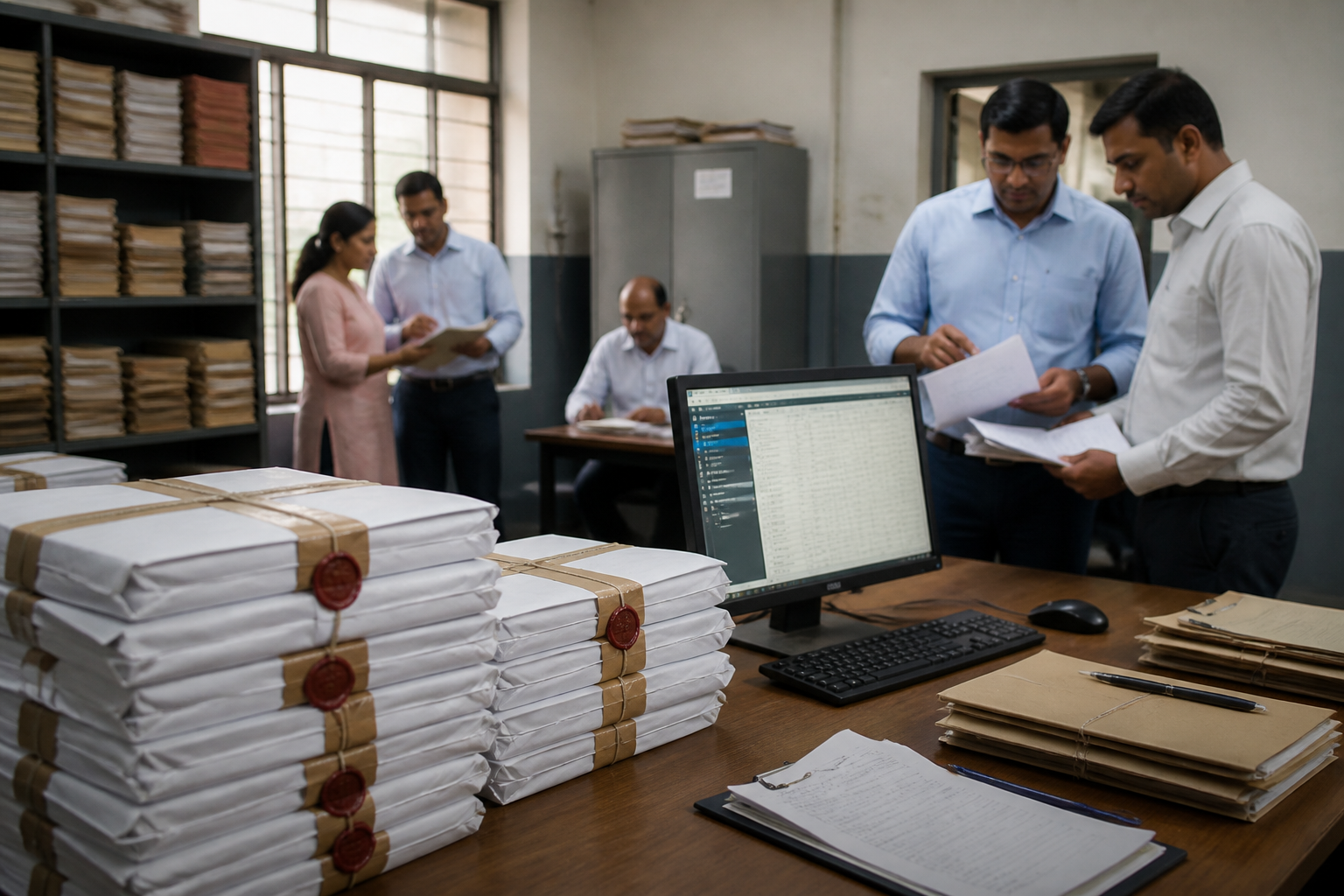
The most consequential allegation concerns the OMR answer sheets. Investigators reportedly found that Gangwar, who was serving as examination controller, altered the answer sheets of candidates who had allegedly paid in advance. According to the report, five question-paper models had been prepared before the examination, and questions selected for the final paper were allegedly handwritten by Gangwar and passed to Kannale two days before the test.
The report further alleges that Kannale brought candidates to an office in Rajajinagar, took them to locations in Tumakuru and Andhra Pradesh to write the examination, and later returned them to the examination centre. It says candidates who did not mark correct answers had their OMR sheets altered to produce higher scores. The allegations extend to the interview stage, where candidates who had allegedly paid were said to have received higher marks during interviews held under the chairmanship of former KPSC president Shivashankarappa Sahukar.
If established, the alleged method would represent a breach at several points in the recruitment chain. Competitive examinations depend on the separation of functions: question-paper preparation, examination administration, answer-sheet evaluation, interviews and final selection are expected to operate under controls that limit the ability of one person or group to alter results. The reported allegations suggest that investigators are examining whether those controls were bypassed or coordinated rather than treating the matter as a single act of cheating.
The case also appears to be widening beyond the veterinary officer examination. The CID has reportedly issued notices to eight candidates selected for Group B posts in different departments after finding admit cards for a 2025 Group B recruitment examination during a search of Kannale’s residence in Bengaluru’s Sanjaynagar. Investigators are also said to have found photographs of Kannale with candidates selected for deputy superintendent posts. The presence of examination documents or photographs does not by itself prove a criminal offence, but it explains why investigators are seeking statements and additional records from selected candidates.
Digital evidence is another part of the investigation. The report says laptops and mobile phones belonging to Gangwar and Kannale were seized and sent to the Forensic Science Laboratory. Investigators also reportedly recovered data and a video showing Gangwar dancing at the birthday celebration of a candidate allegedly selected for a veterinary officer post. The video was said to have circulated on social media. Digital material may help establish contact, timing and relationships, but its evidentiary value will depend on forensic examination, authentication and its connection to specific recruitment decisions.
The CID has also sought information from Tumakuru University about Kannale’s appointment as a syndicate member. University sources reportedly said officers contacted the acting vice-chancellor’s office to verify when Kannale was appointed and the length of his tenure. The report states that he was appointed to the syndicate in August 2025. This line of inquiry indicates that investigators are mapping the accused person’s institutional roles and networks, although the material does not establish that the university appointment was connected to the recruitment allegations.
The reported findings expose the importance of institutional boundaries in public recruitment. A commission may have formal rules, but the effectiveness of those rules depends on access controls, audit trails, secure handling of question papers, chain-of-custody procedures for answer sheets and transparent interview records. The supplied report does not provide details of KPSC’s internal safeguards or identify which specific controls may have failed. It does, however, show that the investigation is examining both the formal examination process and the informal relationships around it.
The political response has introduced a separate layer to the case. Karnataka Chief Minister D.K. Shivakumar said information was available about links between the alleged KPSC irregularities and BJP leaders, and that information held by the home minister would be disclosed. He also alleged that the NDA was responsible for KPSC scandals and referred to the appointment of a former president who was later removed over allegations of nepotism and corruption. These are political statements, not investigative findings, and the material supplied does not establish the alleged political links. The chief minister said the state cabinet had discussed and approved matters related to a report from the governor and the investigation, with further action to follow on the basis of the inquiry.
That distinction will matter as the investigation proceeds. A recruitment scam can involve candidates, intermediaries, officials and political actors, but each relationship requires separate evidence. Notices to candidates, bank records, property documents, forensic reports, examination files and witness statements will need to be examined together. The report indicates that the CID is gathering precisely these categories of material, but it does not state that the investigation has reached a final conclusion.
For applicants, the immediate consequence is uncertainty over the validity of selections and the credibility of future examinations. The report says relatives of suspended former office-bearers and members who were selected through alleged irregularities have been identified in documents, and that notices have been issued to such candidates. It does not specify how many selections may ultimately be reviewed, whether appointments have been cancelled or whether a re-examination has been ordered.
The larger urban governance issue is the dependence of cities and public institutions on credible recruitment. Bengaluru and Karnataka’s wider administrative system require officials and technical personnel selected through processes that citizens can trust. When allegations reach examination controllers, commission members, intermediaries and candidates, the damage extends beyond a single recruitment cycle. It affects confidence in the state’s capacity to staff departments through transparent competition.
The evidence currently reported confirms that the CID investigation has expanded across financial transactions, suspected OMR manipulation, other recruitment examinations, digital devices and institutional appointments. It does not yet establish the full chain of responsibility, the number of appointments affected or the final legal status of the allegations. The next significant milestones will be the forensic examination of seized devices, the questioning of candidates who received notices, further verification of banking and property records, and any formal action announced by the investigating agency or the state government.
