


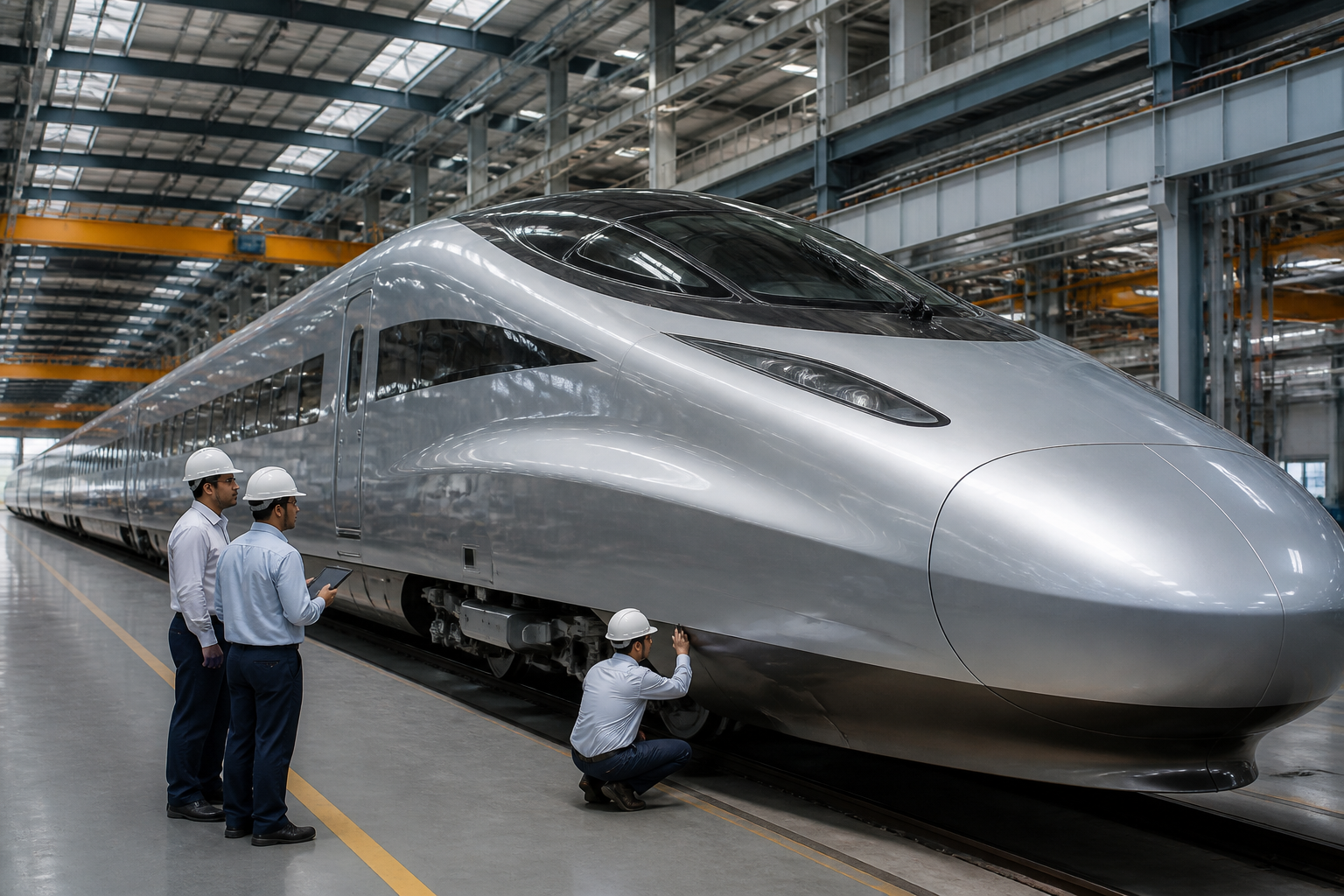
India’s move to develop an indigenous bullet train is not simply a race to put a faster train on the tracks. It is a test of whether Indian Railways and its manufacturing partners can build the specialised engineering, control systems and production capabilities required for high-speed passenger operations.
The immediate development is the planned rollout of a prototype high-speed train by March 2027. According to the Times of India report, Integral Coach Factory in Chennai has awarded BEML Limited a contract worth Rs 866.87 crore to design, manufacture and commission two prototype trainsets. Each trainset will have eight coaches and will be designed to operate at 280 kmph, with the trains capable of crossing 250 kmph in service-related testing and operation parameters described in the report.
The planned train is linked to the wider Mumbai-Ahmedabad high-speed rail programme, which is expected to see its first operational section between Surat and Bilimora by August 2027. The corridor is intended to become India’s first high-speed rail line. The prototype trains, however, represent a parallel ambition: building domestic capability rather than relying entirely on imported rolling stock and technology.
That distinction matters because a high-speed train is not simply a conventional railway coach with a more powerful engine. The report describes the domestic programme as a major engineering challenge, involving the design of vehicles that can maintain ride quality and stability at significantly higher speeds. The train body must combine structural strength with lower weight, while its wheels and suspension systems must support passenger comfort and safe operation.
The control environment is also more demanding. At high speeds, onboard systems must coordinate propulsion, braking, stability and passenger comfort with greater precision. The source report identifies high-powered motors and train-control software as crucial areas for India to develop or adapt. Braking systems, crash safety, aerodynamic performance and the management of sudden changes in air pressure are also part of the technology challenge.
These requirements create a different manufacturing problem from the one associated with India’s existing LHB coach production. Conventional coach-building experience provides an industrial base, but high-speed rolling stock requires tighter tolerances, more advanced systems integration and a higher level of testing. The significance of the B-28 trainsets therefore lies as much in the capabilities built around them as in their headline speed.
BEML has established a dedicated Aditya High-Speed Rail Complex in Bengaluru for the project. The Times of India report says manufacturing of the train has started. The proposed trainsets will use stainless steel and include fully air-conditioned chair-car coaches, reclining and rotatable seats, onboard infotainment and facilities for divyangjan passengers. These features point to an effort to develop a complete passenger product rather than only a high-speed technical demonstrator.
The Indian operating environment adds another layer to the design challenge. High-speed trains used in Japan and Europe are generally engineered for conditions that include cold weather. The train being developed for India will need to account for heat and dust, according to the report. That means the domestic design exercise is not only about reproducing an established international format. It is also about adapting high-speed systems to local climatic and operational conditions.
The choice of materials could evolve as the programme develops. The initial trains are planned to use stainless steel, while aluminium trainsets are being considered for speeds above 300 kmph. The report also cites Railway Minister Ashwini Vaishnaw’s statement that the next generation of bullet trains is expected to be developed for speeds of 350 kmph. This suggests a two-stage learning curve: an initial 280 kmph design followed by trainsets with higher-speed capability.
That staged approach is important for a programme whose first corridor is still under construction. The initial trainsets can provide a platform for testing design decisions, production processes and safety systems before the proposed higher-speed generation is introduced. The available material does not establish how the transition between the two generations will be managed, but it makes clear that the current prototypes are being positioned as the beginning of a broader capability-building exercise.
The manufacturing programme is also connected to the scale of India’s high-speed rail ambitions. The Union Budget, according to the report, announced seven additional high-speed rail corridors. The proposed routes are Mumbai-Pune, Pune-Hyderabad, Hyderabad-Bengaluru, Hyderabad-Chennai, Chennai-Bengaluru, Delhi-Varanasi and Varanasi-Siliguri via Patna.
The stated travel times illustrate the intended role of these corridors. The report lists 48 minutes for Mumbai-Pune, one hour and 55 minutes for Pune-Hyderabad, two hours for Hyderabad-Bengaluru, two hours and 55 minutes for Hyderabad-Chennai, one hour and 13 minutes for Chennai-Bengaluru, three hours and 50 minutes for Delhi-Varanasi, and two hours and 55 minutes for Varanasi-Siliguri via Patna.
Those proposals create a potential long-term requirement for a larger fleet of high-speed trainsets. If domestic manufacturing succeeds, it could support the rolling stock needs of future corridors and reduce dependence on overseas production. The source report describes this as a possible cost advantage, although it does not provide a comparative estimate of imported and domestically produced trainsets.
The corridor list also shows that high-speed rail is being considered as a network rather than a single Mumbai-Ahmedabad demonstration line. Yet the proposals remain at different stages of development in the supplied material. The Mumbai-Ahmedabad project has a stated operational milestone for the Surat-Bilimora section, while the seven additional routes are presented as part of the broader high-speed rail plan. The report does not provide construction schedules, financing structures or implementation timelines for those corridors.
That distinction is central to assessing the manufacturing strategy. A domestic train programme can become more economically meaningful when several corridors require compatible rolling stock. But the scale of that opportunity depends on the progression of the corridors themselves, the performance of the prototype trains and the ability of the manufacturing system to produce reliable trainsets in sufficient numbers. None of those outcomes is established yet.
The first prototype is scheduled for rollout in March 2027 and will undergo extensive testing by the Research Designs and Standards Organisation, or RDSO. That testing stage is a critical institutional link between manufacturing and passenger service. A train can be assembled in a factory, but it cannot enter regular high-speed operation until its systems, performance and safety characteristics have been evaluated through the prescribed process.
The planned August 2027 opening of the Surat-Bilimora section would provide a potential early operating context for India’s high-speed rail programme. However, the supplied report does not confirm that the indigenous B-28 trainsets will be the trains used for that launch. It establishes only that the prototype rollout, RDSO testing and the expected opening of the section are part of the same wider programme.
India’s high-speed rail project therefore contains two linked but distinct transformations. The first is physical: constructing a dedicated corridor capable of supporting much faster passenger services. The second is industrial: developing trains, software, propulsion, braking, aerodynamics and safety systems suited to that corridor. The second transformation may determine whether the first can expand beyond one route.
The immediate evidence confirms that the manufacturing effort has moved from an abstract policy ambition to an active contract and production programme. It does not yet confirm the final performance of the train, the outcome of testing, the cost of series production or the timetable for the additional corridors. Those are the milestones that will show whether the current prototype becomes a scalable national high-speed rail platform.
For now, the most significant feature of the B-28 programme is not its proposed 280 kmph design speed alone. It is the attempt to make high-speed rail an Indian manufacturing capability, beginning with two eight-coach prototypes and a dedicated production facility. The next test will come when the first train is rolled out and RDSO begins evaluating whether the design can meet the demands of India’s future high-speed network.
