


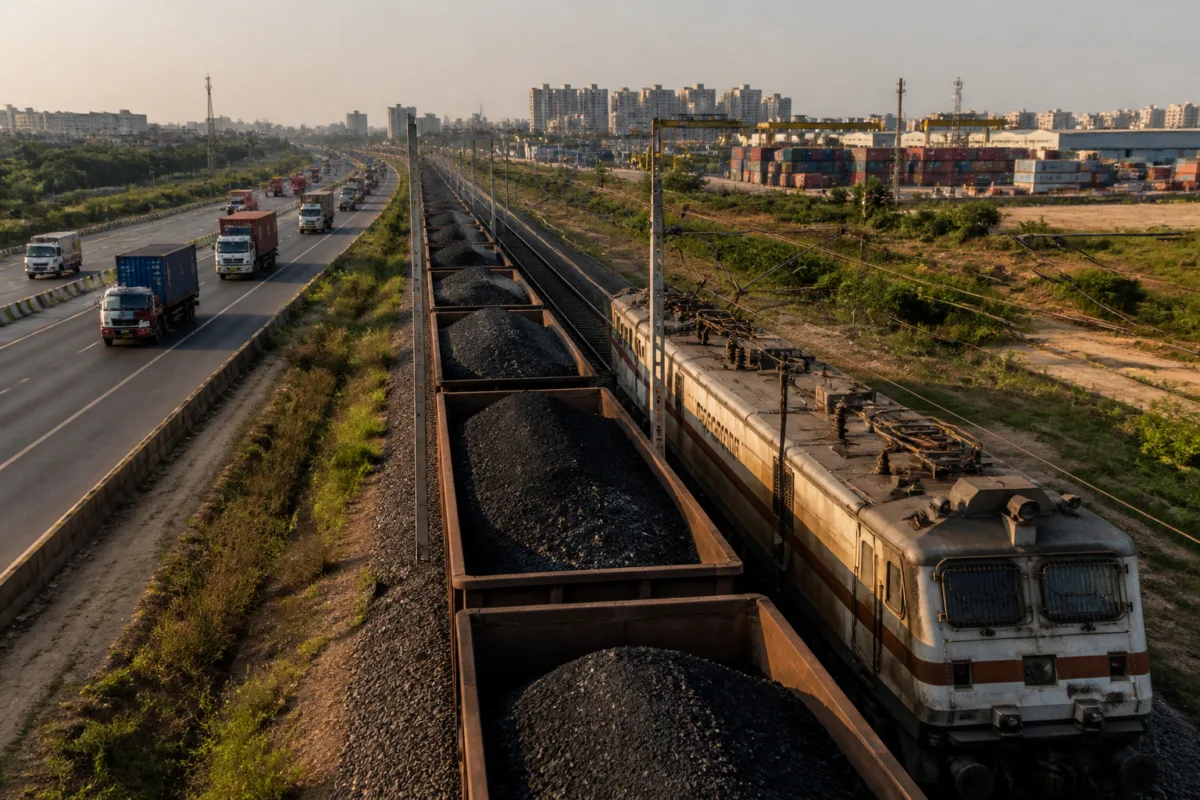
Indian Railways has completed the infrastructure-heavy phase of its freight revival, with the eastern and western dedicated freight corridors now fully operational. Yet the harder part is only beginning: persuading customers to choose rail in a logistics market where roads increasingly offer the flexibility, reach and accountability that businesses require.
That distinction matters because freight performance is often measured through volumes. Railway freight loading rose from 1,098 million tonnes in fiscal 2015 to 1,617 million tonnes in fiscal 2025, and reached a record 1,670 million tonnes in the following fiscal year, according to the report by Jagannarayan Padmanabhan published in the Times of India. These figures indicate that rail is moving more cargo than before. They do not, however, show that rail is winning a larger share of India’s freight market.
A parliamentary committee recently estimated rail’s share of national freight tonnage at about 27% in fiscal 2025. That remains well below the National Rail Plan’s target of 45% by 2030. The gap exposes the central tension in India’s freight strategy: the railway network can add capacity and move large volumes, but customers choose a transport system based on the performance of the entire journey rather than the strength of the main line alone.
## Indian Railways freight is growing, but market share remains weak
Rail freight remains concentrated in commodities such as coal, iron ore, steel and cement. Coal alone contributes nearly half of railway freight revenue, making it both a commercial foundation and a useful indicator of competition between modes. But even in coal, where rail has traditionally been strong, road transport has established a substantial position.
Road’s share of raw-coal dispatches increased from 24.4% in fiscal 2021 to 33.8% in fiscal 2024 before easing to 31.1% in fiscal 2025. Rail’s share fell from 53.9% to 47.4% over the same period, then recovered to 50.5%. The recovery shows that rail remains competitive, but the broader trend also demonstrates that roads are no longer confined to small or peripheral freight movements.
Iron ore presents a similar picture. Railways moved about 178 million tonnes in fiscal 2025 against production of roughly 289 million tonnes, implying a rail transportation coefficient of just over 60%. The comparable ratios for steel and cement were materially lower. These figures do not directly represent modal share, but they indicate that substantial volumes of bulk freight continue to move outside the rail network.
The issue, therefore, is not that India’s freight economy lacks cargo. It is that rail has not converted its infrastructure investment into a sufficiently convenient commercial proposition for a wider set of customers.
## Roads benefited from India’s changing freight geography
The geography of demand is changing as urbanisation, rising incomes and e-commerce spread consumption beyond a small number of metropolitan centres. India’s urban population is estimated to have reached 522 million in 2025 and is projected to approach 600 million by 2036. At the same time, Tier II and Tier III cities reportedly generated around two-thirds of incremental direct-to-consumer orders in the last fiscal year.
Warehousing, industrial activity and distribution are following this wider pattern. Demand is increasingly dispersed across hundreds of cities and smaller markets rather than concentrated in a few large urban centres. This creates a problem for a freight system designed around high-volume line-haul movement between major nodes.
Road transport has adapted quickly to that geography. India’s national highway network expanded by nearly 60%, from 91,287 km in 2014 to 146,204 km by March 2025. A truck can serve a warehouse, distributor, factory or construction site directly, or can be deployed quickly when demand changes. The customer often deals with one transport provider and faces less handling between origin and destination.
Rail, by contrast, is strongest on the long-distance segment between terminals. It still depends on road transport for first-mile and last-mile connections, as do most large freight systems. The weakness is not multimodality itself but the fragmented transition between modes. Additional handling, uncertain schedules and incomplete information can make a theoretically cheaper rail movement less attractive in practice.
A cement producer or steel manufacturer is not evaluating the railway tariff in isolation. It is evaluating the total cost, transit time and reliability of the entire journey. If cargo is handled several times, wagon availability is uncertain or the delivery window cannot be trusted, a lower line-haul rate may not compensate for the operational risk.
## The service gap begins after the tracks are built
The dedicated freight corridors should improve the speed and reliability of line-haul movement. But faster movement on the main corridor addresses only one part of the customer experience. Businesses also need assured wagon availability, predictable departures, reliable arrival schedules and real-time shipment visibility.
For an industrial plant, a delayed wagon can disrupt the supply of raw material. For an exporter, an uncertain arrival at a port can create a risk of missing a vessel. In both cases, the customer is buying a delivery outcome rather than a rail journey.
This suggests that Indian Railways needs to measure freight performance through customer-facing indicators alongside loading and revenue. On-time arrivals, terminal turnaround time, schedule adherence and customer retention would reveal whether additional capacity is producing a dependable service. The key institutional shift is from treating freight as a volume business to treating reliability as a product.
That shift is particularly important because infrastructure capacity is difficult to translate into market share if customers cannot understand or control the service. A railway may have an available corridor, but a manufacturer needs to know whether wagons will be available, when the shipment will depart, when it will arrive and how disruptions will be managed.
## Cargo terminals will determine whether rail reaches more cities
The next phase of freight development is tied to the location and performance of cargo terminals. The Gati Shakti Cargo Terminal programme has expanded freight-handling capacity, but simply increasing the number of terminals will not guarantee a stronger rail network.
The more important question is whether terminals function as integrated logistics hubs. Such facilities would allow cargo to be consolidated, stored, containerised and transferred between rail and road with fewer breaks in the journey. Their value would depend on how effectively they connect with surrounding warehouses, factories, distribution networks and urban consumption centres.
Location is therefore a strategic issue. Terminals built mainly where railway land is available may not serve the new geography of manufacturing, warehousing and consumption. The report argues that facilities should be developed where freight demand is growing and where connections to other logistics providers can be made efficiently.
This has a direct urban dimension. As distribution networks extend into Tier II and Tier III cities, the location of logistics infrastructure will influence truck movements, warehousing demand and the efficiency of goods reaching markets. A rail terminal that is poorly connected to the city or industrial cluster it is meant to serve can add handling and road distance rather than remove them.
## The policy challenge is coordination, not only construction
The freight system is governed by several connected decisions: railway capacity, highway expansion, terminal development, warehousing, industrial location and digital information systems. The completion of dedicated freight corridors addresses the railway component, but it does not by itself create a unified logistics service.
Indian Railways may not need to extend tracks to every customer. A more practical model would involve closer partnerships with trucking companies, warehouse operators and third-party logistics providers. These partnerships could help create door-to-door services in which rail performs the long-distance movement while road transport handles collection and delivery.
Digital platforms could support that model by providing unified booking, tracking and shipment visibility across modes. For customers, the distinction between rail and road would then matter less than the ability to book a shipment, monitor its progress and receive it within a predictable window.
The objective is not necessarily to replace trucks with trains. In many freight movements, the more efficient solution will be rail and road working together. The policy test is whether the institutional and commercial arrangements make that combination as simple to use as a direct truck movement.
## What the freight numbers reveal
The available data presents a mixed picture. Rail loading has grown substantially, but its estimated share of national freight remains far below the National Rail Plan’s ambition. Rail continues to dominate or play a major role in selected bulk commodities, yet roads have gained ground even in coal and remain important in iron ore, steel and cement.
At the same time, demand is spreading across a larger and more dispersed urban and industrial geography. The national highway network has expanded significantly, while e-commerce and consumption growth are strengthening the need for flexible distribution. These trends help explain why road transport can remain commercially attractive even when rail offers lower rates for the line-haul segment.
The evidence does not show that rail infrastructure investment has failed. The corridors have unlocked capacity and can improve transit times. It shows instead that infrastructure is a necessary but incomplete condition for modal shift. Rail must connect capacity with terminals, digital systems, road partners and service commitments that match how businesses now operate.
The larger urban question is whether India’s freight network can keep pace with a consumption economy that is no longer organised around a few metropolitan centres. If logistics hubs, warehouses and industrial activity continue to spread, the winning system will be one that combines long-distance efficiency with local reach. That requires coordination across modes rather than competition defined only by rail versus road.
Indian Railways has built much of the physical platform needed for a stronger freight business. The remaining challenge is commercial and institutional: turning corridors, terminals and wagons into a dependable door-to-door service. The next evidence to watch will be whether freight performance improves not only in tonnes loaded, but also in delivery reliability, terminal efficiency, customer retention and the ability to serve India’s expanding network of cities.

