


The agreement could lower the effective US tariff on Indian goods from 50 per cent to 18 per cent, but implementation is being held back until India secures a clearer advantage over competing manufacturing economies.
The next phase of the India-US trade agreement is not only a question of tariff schedules. It is also a test of whether India can convert preferential market access into sustained manufacturing growth across the industrial clusters, logistics networks and urban economies that support exports.
Commerce and Industry Minister Piyush Goyal said India would announce the final details of the agreement once Washington provides New Delhi with a tariff advantage over competing economies. Speaking at a national workshop on leveraging free trade agreements, Goyal said the deal would be finalised after India secured preferential treatment and that the country had protected its interests in sensitive sectors.
That condition places competitiveness at the centre of the agreement. Indian exporters may receive lower tariffs in the US, but the benefit will depend on how their terms compare with those available to producers in Vietnam, Thailand, the Philippines, China, Malaysia, Bangladesh and Sri Lanka. For companies operating in sectors such as textiles, leather, gems and jewellery, marine products and small-scale manufacturing, the relative position of India’s goods in the American market may matter as much as the nominal tariff reduction itself.
The interim agreement was announced through a joint statement by US President Donald Trump in early February 2026, following a call with Prime Minister Narendra Modi. According to a fact sheet issued by the US Mission in India, Washington removed an additional 25 per cent tariff imposed on Indian imports over India’s purchases of Russian oil. The move followed India’s commitment to halt those purchases.
Separately, the US agreed to reduce its base reciprocal tariff on India from 25 per cent to 18 per cent. Taken together, those measures would lower India’s effective tariff from a peak of 50 per cent to 18 per cent. The reduction creates a potentially significant opening for Indian exporters, but the agreement has not yet fully taken effect because New Delhi is seeking a more explicit tariff edge against competing manufacturing locations.
The terms also require India to eliminate or reduce tariffs on all US industrial goods and a broad range of American food and agricultural products. The listed products include dried distillers’ grains, red sorghum, tree nuts, fresh and processed fruit, soybean oil, and wine and spirits. India has also committed to purchases exceeding $500 billion of American energy, information and communication technology, coal and other products, while agreeing to address non-tariff barriers in priority sectors.
The two countries are expected to negotiate rules of origin and bilateral digital trade rules. These provisions are important because tariff access alone does not determine whether a product can move efficiently through a cross-border supply chain. Rules of origin establish how the source of a product is determined, while digital trade provisions can shape the way businesses manage transactions, documentation and services across borders. The supplied material does not establish the final content or timetable for those negotiations.
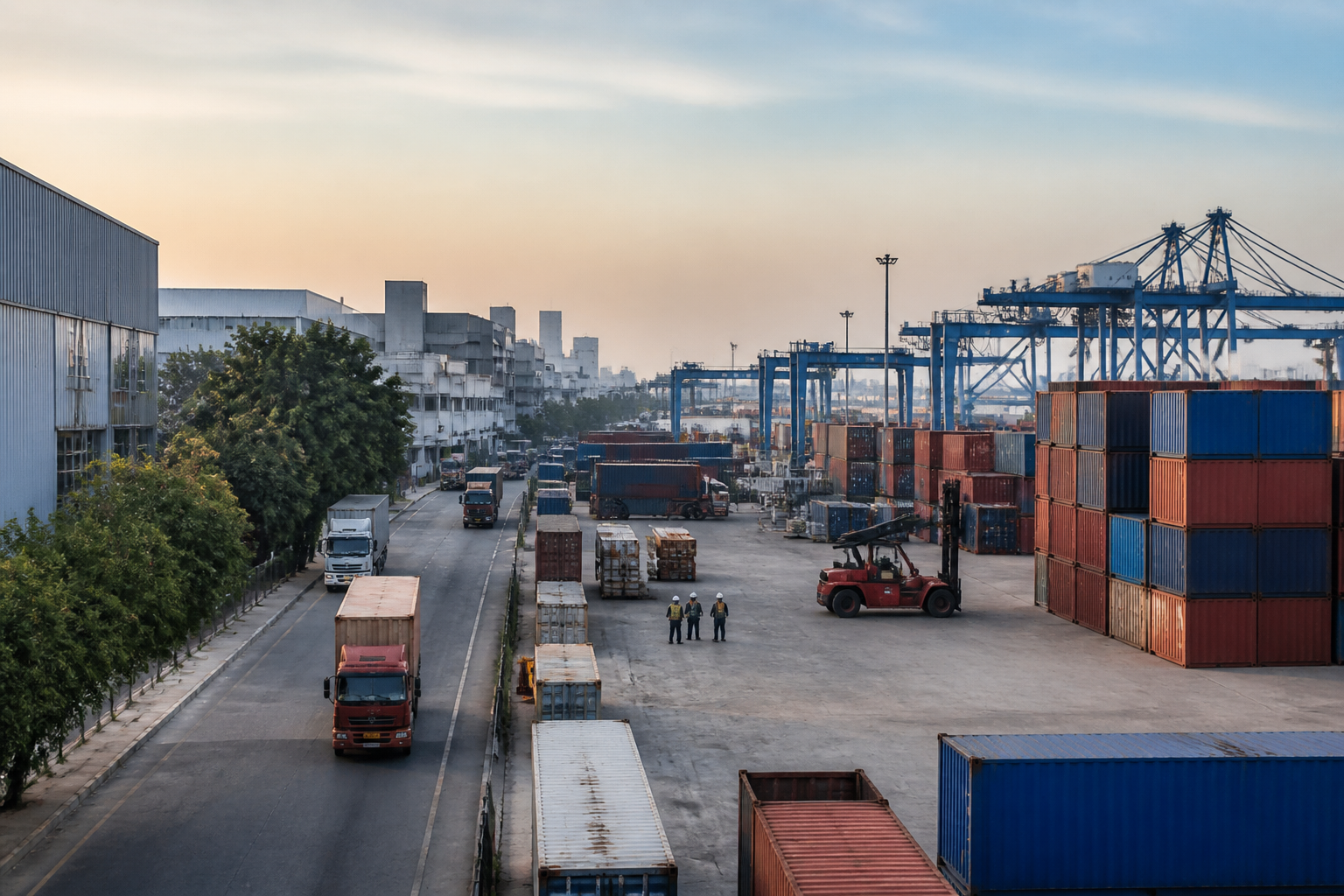
The urban consequences of the agreement would be distributed through manufacturing corridors rather than concentrated in a single city. Export-oriented industries depend on industrial estates, warehouses, ports, roads, freight services, power supply, water access and worker housing. If lower tariffs lead to higher orders, the effect would be felt in the cities and towns where these systems are located, as well as in the transport networks connecting production centres to ports and airports.
That connection is especially relevant for micro, small and medium enterprises. Goyal said MSMEs, textiles, gems and jewellery, leather goods and marine products were among the sectors expected to benefit once the lower tariff took effect. These industries often operate through dense networks of suppliers, contractors and service providers. Their ability to respond to additional export demand can therefore influence local employment, commercial real estate, freight activity and demand for urban services.
At the same time, the agreement’s effects will not be automatic. A tariff advantage can improve the price position of an Indian product, but businesses must still meet delivery schedules, quality requirements and market standards. They also need access to finance, reliable utilities and transport capacity. The minister’s insistence on a comparative tariff advantage reflects this competitive environment: Indian exporters are not competing only with the US tariff applied to their goods, but with the full operating conditions offered by alternative manufacturing economies.
The agreement also draws a boundary around sectors that India considers particularly sensitive. Agriculture and dairy remain protected under the reported terms, even as India opens or reduces tariffs on selected American goods. This selective approach reflects the tension between export promotion and domestic protection. The material supplied does not specify the full list of protected products or the precise tariff changes for each category, but it confirms that agriculture and dairy are being treated differently from the industrial and consumer categories included in the proposed concessions.
The broader policy framework is built around India’s attempt to become a more outward-facing economy. Goyal said the country should move from an inward-looking economy to an international player of significance and linked that objective to a collective ambition of creating a $30 trillion economy by 2047. He also urged industry associations to set ambitious export targets.
The government’s immediate export targets indicate the scale of that ambition. Merchandise shipments crossed $200 billion for the current financial year by August 21, growing by more than 15 per cent according to government estimates. Petroleum products, electronics and engineering goods were identified as key drivers. The government is targeting $1 trillion in combined goods and services exports during the year, compared with $863 billion recorded in the previous financial year.
Those figures show momentum, but they do not by themselves demonstrate that the trade agreement has created new capacity. The reported growth predates the full implementation of the proposed tariff arrangements, and the source does not provide a sector-by-sector breakdown of how much additional activity is attributable to the agreement. The distinction matters for cities because export expansion can either deepen existing industrial clusters or place new pressure on infrastructure that is already operating near capacity.
The timing of implementation will therefore be important. India is waiting for a framework from the US that provides a clear advantage over rival manufacturing economies. Until that condition is met, the announced reduction in tariffs remains a negotiated framework rather than a fully operational commercial regime. Rules of origin, digital trade provisions and the treatment of non-tariff barriers also remain part of the work required to complete the arrangement.
The agreement’s urban significance lies in this gap between market access and productive capacity. A tariff reduction can open demand, but the ability to capture that demand depends on how efficiently goods are manufactured, assembled, certified, stored and transported. It also depends on whether smaller firms can participate rather than leaving export growth concentrated among the largest companies.
For policymakers, the central question is not simply whether the US tariff will fall. It is whether the agreement can be translated into a durable advantage for the places and firms that make India’s export economy work. The available evidence confirms that the government is pursuing lower barriers and faster export growth, while protecting agriculture and dairy. It does not yet establish the final implementation framework, the distribution of gains among sectors or the infrastructure requirements that would follow from a sustained increase in orders.
The developments to watch are the US tariff framework, the final details of the agreement, the rules of origin and digital trade negotiations, and evidence of changes in export performance across MSMEs, textiles, engineering, electronics and other identified sectors. Until those details are settled, the India-US trade deal remains as much a test of execution and competitiveness as of diplomacy.
