


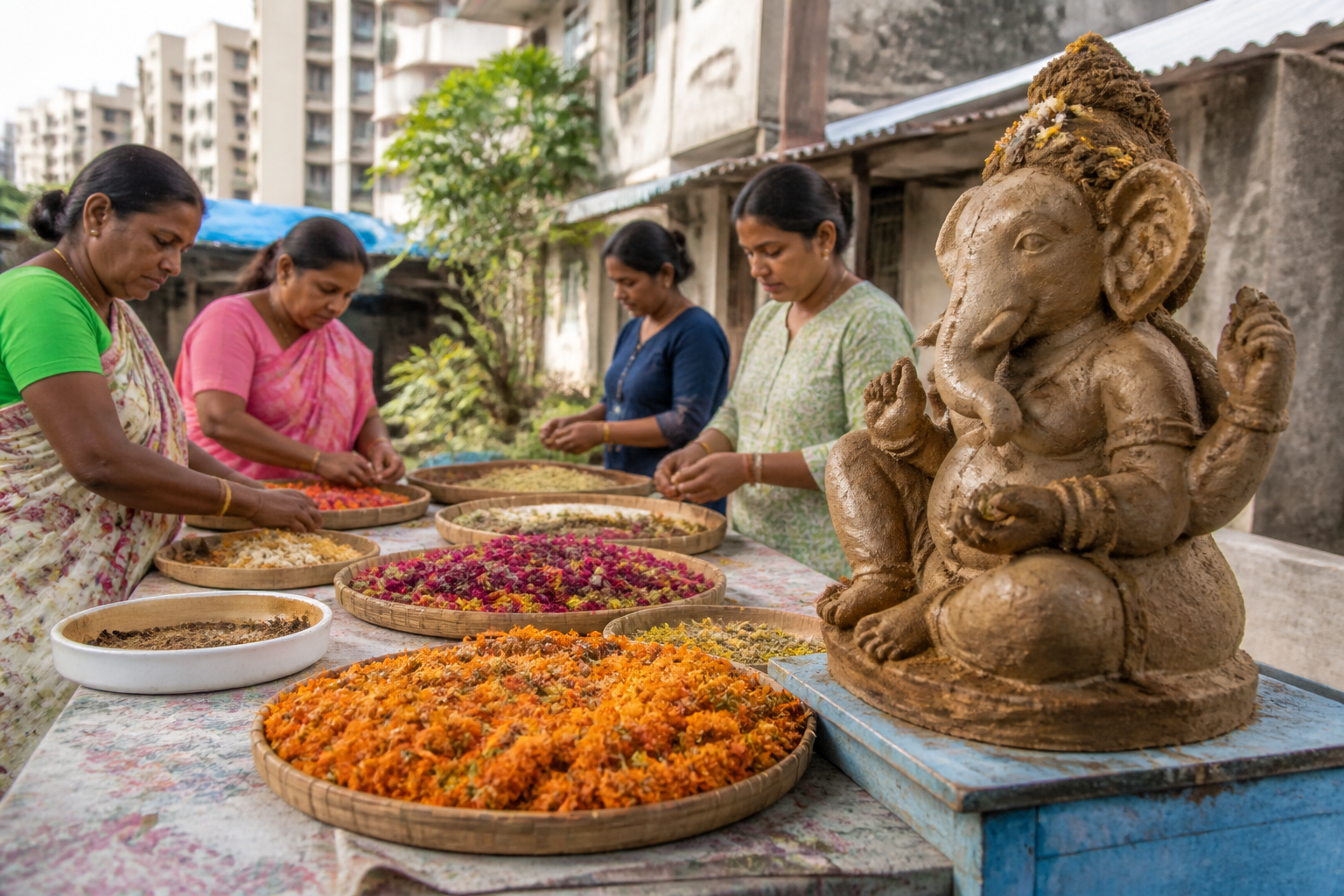
A Ganesh idol made from flower waste collected across Mumbai and Navi Mumbai has brought a familiar urban problem into focus: what happens to the large quantities of floral offerings generated during public festivals? The initiative by the Morya Cultural Art and Sports Mandal in Koparkhairane uses nearly one tonne of discarded flowers to create an idol for the group’s silver jubilee year.
The project is not presented as a replacement for the city’s wider waste system. It is a local example of how religious offerings can be collected, processed and reused before they are immersed or disposed of. Its significance lies in the chain it has created between festival organisers, residents, temples, collection points and the municipal corporation.
According to the report by Loksatta – Mumbai, the mandal collected flowers from public Ganesh festival venues in Mumbai and Navi Mumbai, from local residents, from Navi Mumbai Municipal Corporation nirmalya kalash collection points and from several Ganesh temples. The mandal itself gathered about 300 to 400 kilograms of floral waste. Other festival groups, citizens, temples and the municipal system supplied the remaining quantity, bringing the total collection to approximately one tonne.
The collected material was processed in batches of 100 kilograms. The organisers used dehydration technology as well as natural sun-drying. After processing, the flowers produced approximately 200 to 250 kilograms of pure floral powder. That powder was then used to shape the Ganesh idol for the mandal’s 25th anniversary year.
The numbers provide a simple but important picture of material conversion. A large quantity of fresh floral offerings was first separated from the broader stream of festival waste. It was then dried and reduced into a smaller volume of powder that could be used in a new cultural object. The supplied report does not establish the complete composition or structural design of the idol, nor does it quantify how much waste was avoided through the process. It does, however, document a defined collection and processing method.
This distinction matters because the initiative depends on more than the final idol. The model begins at the point where devotees and festival organisers decide that flowers should be placed in designated collection channels instead of being mixed with other waste or sent directly for immersion. The presence of NMMC nirmalya kalash points in the collection network suggests that municipal infrastructure formed part of the process, although the report does not specify the number of collection points, the corporation’s operational role or whether the arrangement is formalised through a written programme.
The Koparkhairane mandal has continued the practice for four consecutive years, according to the report. The current project therefore represents an ongoing local experiment rather than a one-time publicity exercise. The report says the foundation for the broader concept was laid through an environmentally friendly initiative conducted during the 2025 Ganesh festival. The latest idol brings together flowers offered by multiple public festival groups and devotees, giving the organisers a way to connect individual offerings to a shared object.
That continuity is one of the strongest aspects of the initiative. Waste-reduction projects often receive attention when a new product is unveiled, but their urban value depends on whether collection, segregation and processing can be repeated. Four years of using only floral nirmalya to make an idol indicates that the mandal has maintained a recurring process. The available material does not provide year-by-year collection figures, processing costs, labour requirements or details of how the finished idols are handled after the festival. Those gaps prevent a full assessment of scale or efficiency.
The project also shows the importance of distributed participation in managing festival waste. Flowers were not sourced from a single venue. They came from public Ganesh mandals, residents, temples and municipal collection points across two urban areas. This makes the initiative dependent on coordination across institutional and community boundaries. The mandal acted as the principal organiser, but the material supply was wider than the group itself.
In practical terms, this arrangement raises questions about the interface between civic infrastructure and community-led reuse. A municipal nirmalya kalash can provide a point for separating floral offerings, but collection alone does not complete the recycling process. The flowers must be transported, dried or dehydrated, processed and stored before they can be reused. The report confirms that these steps took place, but it does not identify who managed each stage, what equipment was used beyond the reference to dehydration technology, or how the process was financed.
These details are important for understanding whether the model can move beyond a single mandal. The initiative’s reported input of about one tonne and output of 200 to 250 kilograms of powder offers a starting point for evaluating the process. Yet the figures cannot by themselves be treated as a standard conversion rate. Moisture content, flower type, collection conditions and processing methods can affect the final quantity, and the supplied report does not provide those variables.
The initiative’s environmental message is therefore strongest when understood as a demonstration of separation and reuse. Flowers that would otherwise have been immersed or discarded were collected as a distinct material stream and given a second use. The report describes this as giving the flowers a new life by creating another representation of Ganesh. That framing connects environmental management with the cultural meaning of the offerings, rather than presenting waste handling as a purely technical activity.
The social dimension is equally central. Morya Cultural Art and Sports Mandal president Rishikesh Palve said that the flowers represented the faith and emotions of devotees from different mandals, and that bringing them together in one idol made the initiative a celebration of unity. This is an attributed statement from the organiser, not an independent assessment of the project’s social impact. It nevertheless explains why the organisers chose to aggregate flowers from several communities instead of relying only on their own collection.
The model also illustrates how environmental practices can be embedded in existing urban traditions. The Ganesh festival already creates organised spaces, volunteer networks and collection arrangements. The Koparkhairane initiative uses those existing structures to introduce another stage: converting collected floral offerings into a usable material. Its approach does not require the festival to abandon its established cultural form. Instead, it changes how one material associated with the celebration is handled after use.
At the same time, the report does not establish whether similar initiatives are operating across Navi Mumbai or Mumbai at comparable scale. It does not provide data on the total quantity of floral nirmalya generated during the festival, the proportion captured by municipal collection points, or the amount diverted from disposal through this project. Without those figures, the Koparkhairane effort should be read as a documented local practice, not as evidence of a citywide solution.
The institutional question is also unresolved. NMMC’s collection points contributed to the supply of flowers, but the available information does not clarify whether the corporation only hosted collection vessels or also supported transport, processing or monitoring. Nor does it state whether other mandals have adopted common guidelines for separating floral waste. These are the administrative details that determine whether a community initiative can be integrated into routine municipal waste management.
What the evidence does confirm is a complete, if small-scale, reuse sequence: flowers were offered during religious celebrations, collected from multiple sources, processed in 100-kilogram batches, converted into floral powder and used to make a Ganesh idol. The mandal has repeated the practice for four years, and the 2026 project has expanded the collection effort to include public festival groups, citizens, temples and municipal nirmalya points in Mumbai and Navi Mumbai.
The larger urban question is whether such material streams can be identified and managed before they become mixed waste. The Koparkhairane example suggests that community organisations can create a link between cultural activity and resource recovery when collection and processing are planned together. It also shows the limits of judging an environmental initiative only by its finished product. The more consequential questions concern consistency, costs, labour, municipal coordination, processing capacity and the ability to measure the material diverted.
For now, the project offers a clear example of local experimentation in festival-waste management. It confirms that floral offerings can be separated, dried, processed and reused in a culturally meaningful form. What remains uncertain is its total environmental benefit and its potential for replication at municipal scale. Future reporting would need to establish the role of NMMC, the economics of processing, annual collection trends and whether the model is being adopted by other festival organisations.
