


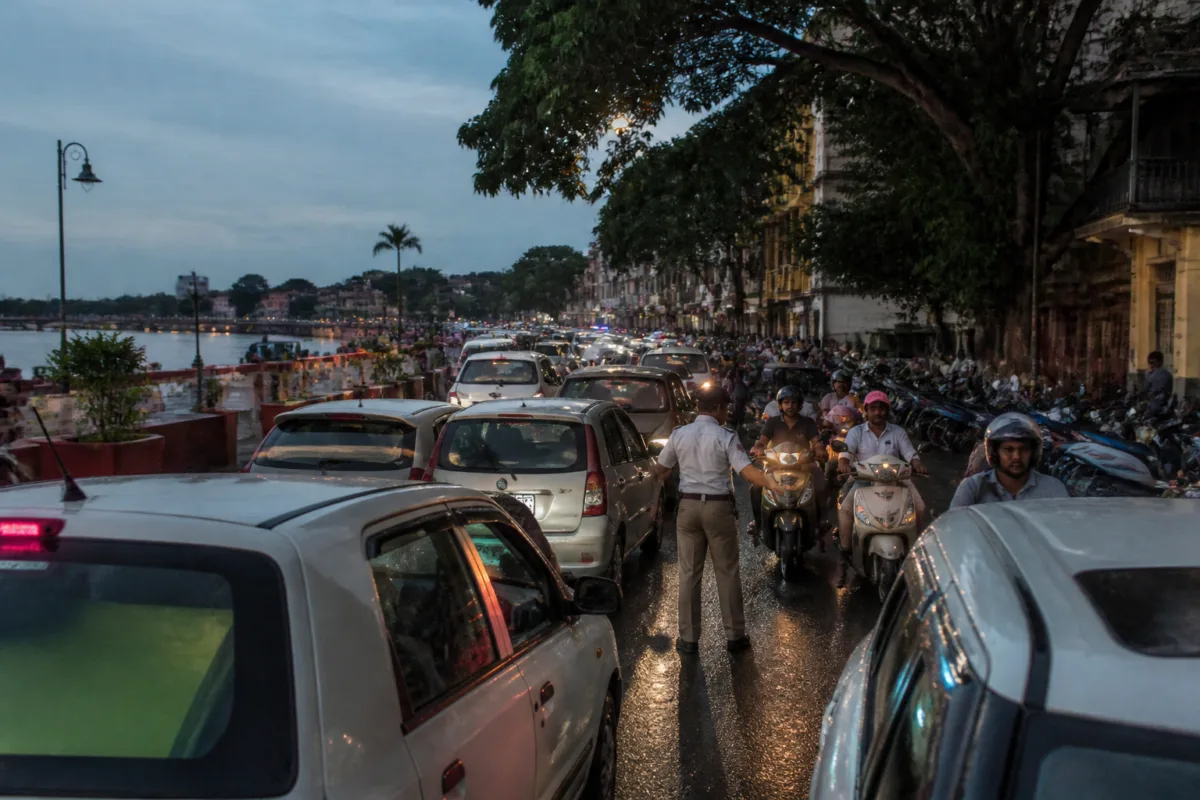
Panaji traffic congestion is no longer limited to festival peaks or isolated bottlenecks. Residents describe a capital where weekend gridlock has become predictable, ambulances are getting trapped, parking spills into narrow streets and reaching home in the evening can depend on whether an event, casino drop-off or traffic diversion has occupied the road network. The immediate problem is visible on streets such as D B Marg, but the deeper failure is institutional: Panaji has a mobility plan, an integrated command and control centre and repeated warnings about rising vehicle pressure, yet the measures intended to manage that growth remain largely unimplemented.
The latest flashpoint was Oktoberfest Goa on November 1, when the riverside stretch of D B Marg at Campal came to a standstill. Residents and councillors say similar congestion now appears on ordinary weekends, particularly in the evening. With the International Film Festival of India and Serendipity approaching, residents fear that the capital’s already strained roads will face another surge in demand.
This is not simply a question of too many vehicles on one road. It is a problem of how Panaji allocates limited street space, approves large events, manages commercial activity and connects enforcement with transport planning. The city’s current congestion exposes a mismatch between the scale of urban activity being permitted and the capacity of the streets expected to absorb it.
The 2020 mobility plan prepared by Urban Mass Transit Company Ltd had already identified the direction of the problem. According to the report, it warned that vehicle growth in Panaji was unsustainable and that intervention would be required by 2038 to prevent the capital from reaching the levels of gridlock seen in larger metros. It also projected that carbon emissions could rise 1.62 times by 2038 if the government did not address the increasing number of two-wheelers and cars entering the city.
The significance of that plan lies less in its projections than in the measures it proposed. Recommendations included shifting tourist taxi layovers to peripheral areas and introducing dynamic parking fees. The report says these measures remain largely unimplemented, while enforcement remains weak. A plan can identify future pressure, but it cannot change travel behaviour unless its recommendations are translated into regulations, infrastructure, pricing and daily enforcement.
Panaji’s current experience suggests that the city has moved from a planning problem to an implementation problem. Authorities appear to recognise congestion as an issue: the Corporation of the City of Panaji has said it is working on a traffic plan, residents have raised complaints with traffic police and the collector, and the Bombay High Court has directed the Goa government and civic authorities to implement stricter traffic management measures along D B Marg around casino and ferry points. Yet residents say the response has often shifted congestion rather than reduced it.
The clearest example is the movement of parked vehicles. After police began discouraging parking along D B Marg, residents said vehicles spilled into M G Road and adjoining streets. The reported bottleneck has moved towards Abbe Faria and the city’s entry points. This is a familiar urban management pattern: when enforcement is applied to a single corridor without providing a wider parking, access and circulation strategy, the pressure is displaced to the next available street.
The problem is intensified by the loss of usable public space. Commercial encroachments, unorganised vending, tourist taxis and self-drive rentals have steadily reduced the space available for movement and parking, according to the report. Out-of-town vehicles occupy bays used by daily commuters, while residents may spend up to an hour searching for parking during peak periods. Double parking has become common, reducing two-lane roads, including links between 18th June Road and Fontainhas, to single lanes.
That loss of road capacity has consequences beyond inconvenience. A street narrowed by double parking or unmanaged drop-offs is less resilient when an emergency vehicle needs to pass. Local IT entrepreneur Prajyot Mainkar said his criticism of the city’s “24/7 congestion” followed another ambulance being stuck in traffic. Residents also say casinos continue to allow drop-offs at entrances on D B Marg, despite efforts to discourage parking in the area.
The mobility challenge therefore involves several overlapping kinds of demand. Daily residents need reliable access to homes and workplaces. Visitors arrive by private vehicles, taxis and rental vehicles. Casinos generate concentrated evening movements. Major events create short-duration surges that can exceed the capacity of the surrounding roads. Ferry points and tourist destinations add another layer of circulation. These users do not operate under one traffic-management system, and the road network cannot absorb their combined demands without coordinated controls.
This is where event permissions become a planning question. Panaji councillor Jack Sukhija has questioned why the smart city’s integrated command and control centre remains unused. He has also raised concerns about a proposed ropeway expected to bring about 2,000 people into the city and a planned 500-room luxury hotel at the old GTDC Miramar Residency site. His argument is that venue capacity and transport impact should be assessed before permissions are granted.
Councillors Leonid Furtado and Kabir Makhija Pinto have made similar points. Furtado said D B Road could not handle the current density of traffic and called for more police presence at night, particularly around casinos. Pinto has suggested shifting major events out of Panaji. Furtado also said event organisers should deploy traffic marshals, arguing that organisers benefiting from large events should share responsibility for managing their traffic impact.
These proposals point to a missing link in the city’s governance framework: the organisation that permits an activity is not necessarily the organisation that manages its transport consequences. If an event is approved without a detailed access, parking, emergency-movement and dispersal plan, the cost of that decision is transferred to residents, traffic police and ordinary road users. The same issue applies to future facilities. A ropeway or hotel may have a specific project boundary, but its effect is distributed across approach roads, parking areas, public transport and pedestrian routes.
The unused integrated command and control centre raises a related institutional question. Intelligent traffic management is useful only when cameras, control systems, enforcement teams and decision-making procedures operate together. The report does not establish why the centre remains unused, but its reported non-use is significant because the city is already experiencing predictable congestion at recurring locations and times. A system designed to observe and manage traffic cannot improve conditions if it is not operational or connected to on-ground action.
The plan’s proposed dynamic parking fees also indicate that parking is not merely a construction deficit. Pricing can be used to manage demand, but only if residents and visitors have clear alternatives and enforcement is consistent. Similarly, shifting tourist taxi layovers to peripheral zones requires those zones to be accessible, safe and connected to destinations. Without the wider system, individual interventions risk becoming restrictions that move vehicles elsewhere rather than reducing the number of vehicles entering the most constrained areas.
The contraction of parking capacity, alongside an increase in Panaji’s population and vehicle registrations in Goa, has widened the gap between demand and available street space. The supplied report does not provide the underlying registration totals or a current parking inventory, so the precise scale of that gap cannot be quantified here. It does, however, record the consequences at street level: longer searches for parking, blocked lanes, displaced congestion and reduced access to homes.
Panaji’s case also shows why a mobility plan cannot be treated as a one-time document. The 2020 plan identified a trajectory towards 2038, but the city’s immediate congestion is being shaped by decisions made every week: event permissions, casino access arrangements, parking enforcement, road diversions and the use of public space. Long-term projections matter only when they inform these routine decisions.
The bigger urban question is whether Panaji is managing growth by design or responding to each traffic crisis after it appears. A capital city with narrow streets, concentrated destinations and limited public space needs a single operating framework that connects planning, permissions, parking, enforcement, emergency access and public communication. The report shows that these elements currently remain fragmented across the smart city company, the civic corporation, traffic police, the collector, event organisers and private establishments.
What the evidence confirms is a widening gap between Panaji’s planned mobility response and the city’s lived transport reality. The 2020 recommendations have not been fully implemented; court-directed measures have not eliminated congestion; and local responses have often displaced traffic to adjoining roads. What remains unclear is the status of the mobility plan, the operational readiness of the integrated command and control centre and the traffic conditions attached to upcoming events and projects. Those details will determine whether the city’s next traffic plan changes how Panaji functions or simply documents a problem residents already know by experience.

