


Kabini backwater tourism is expanding beyond a wildlife getaway into a local economic system built around resorts, homestays, boating, transport and hospitality. The growth is creating jobs in and around Heggadadevankote taluk of Mysuru district, but it is also intensifying the governance challenge of developing visitor infrastructure in a sensitive landscape adjoining the Nagarahole and Bandipur forest areas.
The account published by Prajavani describes the Kabini backwaters as a destination shaped by dense green forests, a wide water spread, riverbank landscapes, birdlife and the movement of wild animals. These features have drawn visitors from across India as well as from overseas. Nature lovers, wildlife photographers and other tourists are visiting the region for its combination of water, forest and wildlife experiences.
That combination is important because the destination is not growing around a single attraction. It is an interconnected tourism economy. The waterbody provides the setting, the adjoining forests provide the wildlife experience, and accommodation, transport, guiding and food services convert visitor interest into local economic activity. This makes the region’s tourism expansion a question not only of promotion, but also of land use, environmental management and the distribution of economic benefits.
According to the report, more than 25 resorts and over 50 homestays are operating in the taluk’s Kabini region. Hundreds of tourists visit the area regularly, while some foreign visitors are reported to spend substantial amounts staying in Karapura and experiencing the surrounding environment. The figures indicate the scale of accommodation-led growth described in the report, although it does not provide a separate official registry or occupancy data for these establishments.
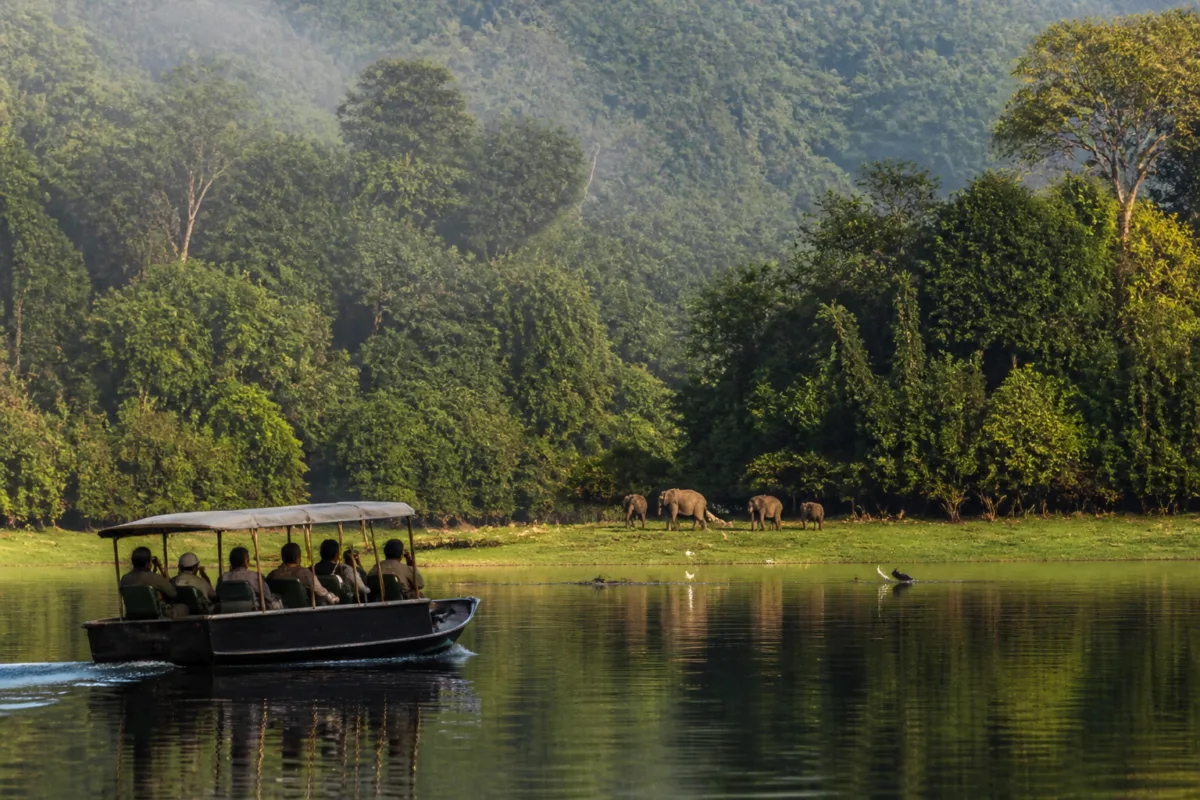
Boating has added another layer to the visitor economy. A boat safari is being operated in collaboration with the Forest Department, with government-owned Jungle Lodges and Resorts providing a service that lasts about three hours. During the safari, visitors may see tigers, elephants, crocodiles, aquatic animals and different species of birds along the riverbank, according to the report.
This experience also shows why Kabini cannot be treated as a conventional waterfront tourism site. The same natural features that attract visitors are habitats for wildlife and part of a larger forest landscape. A boat ride, resort, homestay or access road therefore has implications beyond the immediate tourist transaction. The tourism product depends on the continued functioning of the ecosystem, while unmanaged tourism can place pressure on that ecosystem.
The employment effects are visible across several levels of the local economy. Educated young people as well as general workers are finding opportunities in private resorts, homestays, vehicle services, safari guiding, hotels and tea shops. As visitor numbers rise, the report identifies potential opportunities for local residents to work as tourist guides, boating staff, drivers, cooks and hospitality workers.
The growth also reaches smaller producers. Local farmers, women’s self-help groups and small entrepreneurs are selling products to visitors, creating opportunities for additional income and economic self-reliance. This is a significant feature of the tourism model described in the report: local participation is not limited to formal employment in resorts. It can include the sale of food, local products and services, provided that visitors are connected to the wider community rather than confined to privately managed accommodation compounds.
However, the report does not establish how much of the tourism revenue remains within local villages, how many jobs are permanent, or how employment is distributed between residents and workers brought in from elsewhere. Those questions matter because a rise in tourist spending does not automatically guarantee broad-based local gains. The available account confirms the presence of livelihood opportunities, but not their scale, quality or long-term security.
The environmental limits are clearer. Kabini’s backwaters are described as part of a sensitive ecological zone adjoining Nagarahole and Bandipur forests. The area also faces human-wildlife conflict. Expanding tourism in such a setting requires the visitor economy to operate without disturbing animal movement, degrading water quality or reducing the habitat value that underpins the destination’s appeal.
Local concerns reported by Prajavani include unauthorised boating, excessive noise, plastic waste, water pollution and uncontrolled tourist movement. These are not separate problems. They represent different ways in which tourism activity can escape the capacity of the landscape to absorb it. Unregulated boating can affect wildlife and water use; noise can disturb animals and other visitors; plastic and sewage can damage the water environment; and uncontrolled movement can increase encounters between people and wildlife.
The central policy issue is therefore not whether Karnataka should promote backwater tourism. The report says tourism activity is increasing around several river and reservoir landscapes across the state, including the backwaters of the Krishnaraja Sagar reservoir, Bhadra, Sharavathi, Almatti, Tungabhadra, Hemavathi and Harangi, as well as areas around Sagar and Dandeli. The larger question is how this expansion should be governed in places with different ecological sensitivities and different levels of existing infrastructure.
A reservoir backwater near a major tourist centre may have a different carrying capacity and administrative arrangement from a wildlife-linked waterbody such as Kabini. Yet the report presents a common pattern: accommodation facilities are increasing, water-based activities are attracting visitors, and local businesses are positioning themselves around the tourism economy. That pattern creates the need for location-specific controls rather than a uniform model of resort and boating expansion.
The institutional arrangement visible in the Kabini account is also divided. The Forest Department is involved in the boat safari, while Jungle Lodges and Resorts operates through a government-owned hospitality platform. Private resorts, homestays, vehicle operators, guides, shops, farmers, self-help groups and small businesses form the wider service network. The report does not specify the full approval process for these activities, the applicable limits on construction, or the mechanisms for monitoring waste, noise and boating.
That gap in the available information is important. Tourism growth is often measured through visitor numbers, accommodation capacity or new attractions, while ecological governance depends on less visible systems: permits, inspections, waste collection, water-quality monitoring, route management and enforcement. Without information on those systems, it is difficult to assess whether the region’s tourism infrastructure is keeping pace with the pressure created by rising visitation.
The report’s reference to more than 25 resorts and over 50 homestays provides a snapshot of accommodation supply, but it does not include a time series showing how quickly those numbers have grown. Nor does it provide visitor counts, boating capacity, waste volumes or data on wildlife incidents. These are the indicators needed to distinguish controlled growth from unmanaged expansion. Their absence does not negate the economic opportunity; it limits what can be concluded about the sustainability of the current model.
There is also a direct connection between environmental protection and the future of local livelihoods. Kabini’s tourism economy relies on visitors continuing to value its forests, riverbanks, wildlife and open landscape. If pollution, excessive construction or disturbance reduces those qualities, the destination’s economic base may weaken. Conversely, if conservation rules are applied without creating legitimate local livelihood pathways, residents may have fewer reasons to support restrictions. The report’s emphasis on local jobs and community participation points to this interdependence, even though it does not quantify it.
For Karnataka’s other backwater destinations, Kabini offers a useful case of both opportunity and risk. Tourism can add income to rural economies and connect local products and services to a wider market. But the expansion of resorts, homestays and water activities also makes the quality of planning decisive. The infrastructure needed for visitors—accommodation, roads, boating access, transport and waste services—must be considered alongside the ecological functions that make the place attractive.
What the evidence supplied by Prajavani confirms is that Kabini has developed a substantial nature-tourism economy with a visible local employment component. It also confirms that residents are raising concerns about activities that may harm wildlife and water resources. What remains unestablished in the report is the scale of environmental pressure, the effectiveness of existing enforcement, the exact number of visitors and the distribution of tourism income across local communities.
The next stage of scrutiny should therefore focus on how the Forest Department, tourism authorities, local administrations and private operators manage these pressures. The future of Kabini backwater tourism will depend not simply on attracting more visitors, but on whether the institutions overseeing the landscape can protect the ecological assets on which the entire visitor economy depends.

