


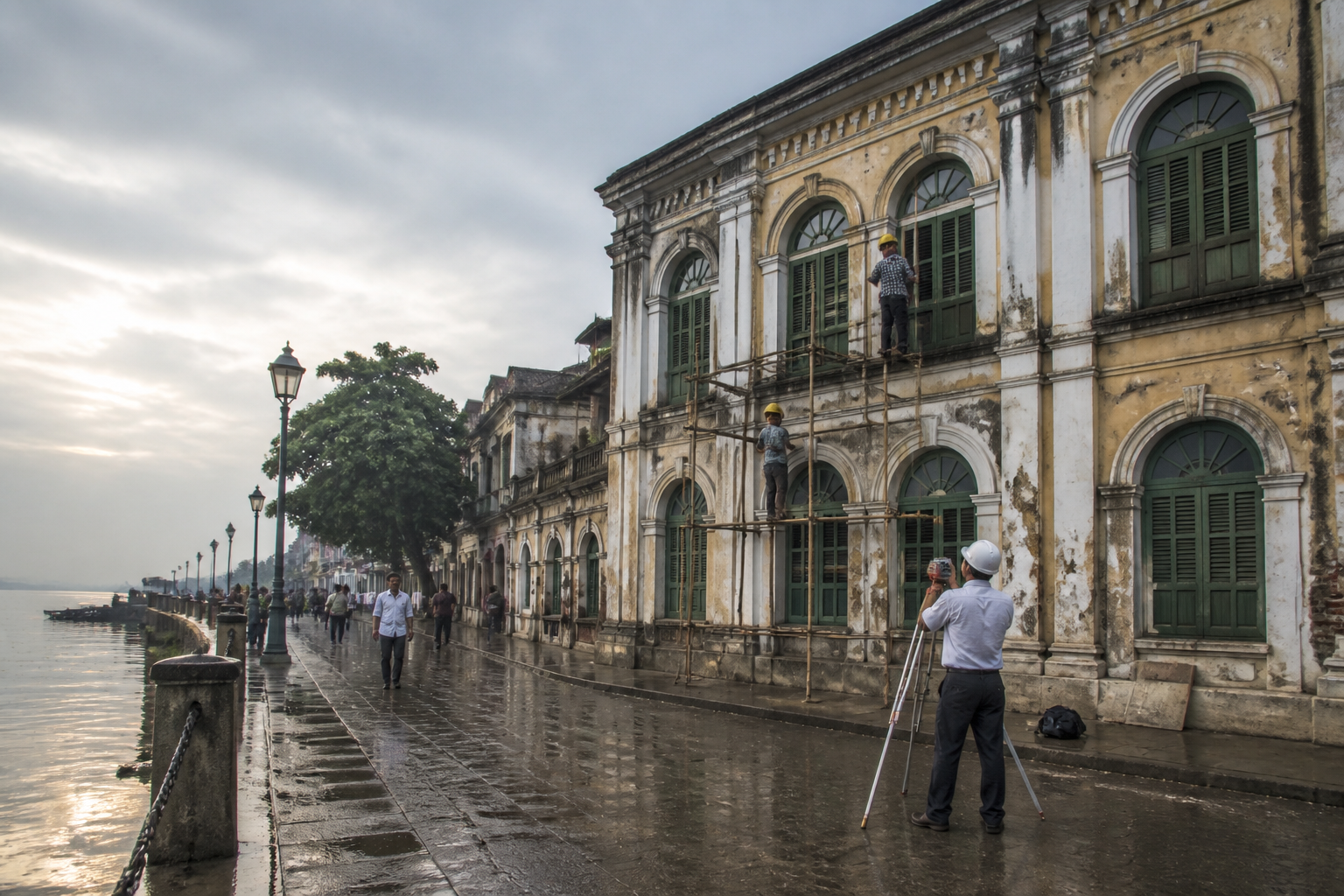
The restoration of Chandernagore’s Registry Building is more than the rescue of a deteriorating colonial-era structure. It is the clearest physical test yet of whether heritage in the Hooghly towns can be converted from a collection of endangered buildings into a functioning public, cultural and tourism system.
The West Bengal government has approved around ₹5.74 crore for restoring the two-storey building, which was constructed in 1875 as the first French courthouse in India. The structure, located at one end of Chandernagore’s Strand facing Rani Ghat, had once been declared condemned and faced a demolition order. It is now expected to become the anchor for the tourism department’s proposed “Little Europe on the Ganges” project.
The announcement came during a three-day festival along the illuminated Strand, where French ambassador Thierry Mathou and tourism minister Shankar Ghosh walked from the Registry Building to the St Joseph’s Convent auditorium. The riverfront featured food and book stalls, performance stages and lights depicting French cultural references, including the Eiffel Tower and the Louvre Museum.
That setting matters. The Registry Building is not being restored as an isolated monument. The proposal places it within a wider riverfront experience, connecting architecture, public space, cultural programming and movement along the Hooghly. The state government has also outlined a river tourism circuit linking the Portuguese heritage of Bandel, the Dutch heritage of Chinsurah, the French heritage of Chandernagore, the Danish heritage of Serampore and the British influence on Barrackpore.
The proposed circuit shows how the project is being framed institutionally. Instead of treating each town’s heritage as a separate tourism product, the plan attempts to organise several historical settlements into a connected regional route. The tourism department has placed orders for two vessels with Garden Reach Shipbuilders and Engineers and has said it will buy more electric vessels for river tourism. The stated focus is both the colonial past of these settlements and their contribution to the freedom struggle.
Yet the project’s most important question is not whether a heritage building can attract visitors. It is whether restoration can give residents a continuing use for the building and whether the riverfront can support that use without becoming a purely decorative festival setting.
### Chandernagore Registry Building and the long route to protection
The building’s present status is the outcome of a long conservation campaign rather than a single government decision. According to conservation architect Aishwarya Tipnis, the structure had a demolition order in 2004. It was eventually listed in 2017, when the West Bengal Heritage Commission installed a blue plaque.
The building had once stood within the campus of Hotel de France, which now houses the subdivisional court. Tipnis said the two sites became disconnected after a Women’s Polytechnic was built between them. That physical separation is significant because heritage value is often weakened when buildings lose their relationship with the streets, institutions and public spaces that originally gave them meaning.
The conservation effort also involved mapping Chandernagore’s built heritage. An inventory of 99 buildings was produced in 2012 with seed funding from the French heritage non-profit Vieilles Maisons Françaises, and the inventory was later made available online. This created a documented base for identifying the town’s heritage assets instead of relying only on prominent or visually recognisable landmarks.
That inventory is one of the project’s most consequential elements. Heritage protection is difficult to administer when buildings are not identified, recorded and placed within a public framework. The Registry Building’s survival shows that listing can prevent demolition, but it also shows that protection alone does not restore a building, fund its maintenance or determine who will use it.
The latest phase follows two memoranda of understanding signed with the Trinamool Congress government in 2018 and 2021, according to the French ambassador. The initiative gained momentum after a change of government. The timeline reveals a familiar governance problem in urban conservation: projects may have diplomatic support, local enthusiasm and a documented plan, yet remain stalled until funding, administrative approval and implementation responsibility align.
### From monument to community facility
The proposed layout for the restored Registry Building is intended to include a visitor information centre, a café and a library. Additional chief secretary, tourism, Barun Kumar Roy said the building could explore adaptive uses supporting Indo-French language and culture.
The proposed uses extend beyond displaying the building itself. Officials have discussed job-oriented courses for young people to train as tourist guides, translators, chefs and sommeliers. Homestays for overnight visitors have also been proposed. If implemented, these functions would place skills, employment and local hospitality alongside conservation.
This is the project’s strongest urban proposition. A restored building that only accommodates occasional ceremonies may preserve an exterior while leaving the surrounding local economy unchanged. A building with a library, visitor services, training facilities and food-related uses can become part of everyday civic life. The source material does not establish which of these uses has been finalised, but their inclusion in the proposal indicates an attempt to make adaptive reuse central to the restoration.
The distinction is important for Chandernagore because its heritage is embedded in a lived urban setting. The ambassador described it as part of a larger history of commerce, ideas, language, architecture, food, education and culture. Tipnis called it “a French town with a Bengali heart”. Those descriptions point to a hybrid identity rather than a frozen colonial exhibit.
That identity also creates an operational challenge. The project will need to reconcile diplomatic cultural programming with the needs and routines of Chandernagore residents. The proposed community facility is therefore more significant than the planned visual restoration alone. It offers a mechanism through which the building could remain locally relevant after the festival lights are removed.
### A riverfront strategy with several moving parts
The Registry Building is being developed alongside other proposed interventions. The tourism minister announced plans for structural reforms at Prabartak Sangha, founded in 1920 and used as a safe house by revolutionaries including Sri Aurobindo. The government also plans to repair the Clock Tower on the Strand. A light-and-sound show on Chandernagore’s freedom fighters has been proposed as an additional attraction.
Together, these elements create a heritage circuit within Chandernagore before the larger Hooghly route is considered. The Strand, the Registry Building, Prabartak Sangha and the Clock Tower are being treated as connected points in a cultural landscape. The proposal to use electric vessels adds another layer by linking river mobility with tourism infrastructure.
The available information, however, establishes announcements and approvals rather than completed works. The restoration tender is expected to begin soon, but no completion date is provided. The number of additional electric vessels, the operating model for the river circuit and the final governance arrangements for the restored building have also not been specified in the supplied material.
Those details will determine whether the project becomes a functioning regional system. A river route requires more than vessels: it needs landing points, schedules, safety arrangements, visitor information, maintenance and coordination among multiple local administrations. The source material confirms the intention to connect several heritage towns, but it does not yet establish how those administrative and operational questions will be resolved.
### The institutional value of cultural diplomacy
The project is also an example of cultural diplomacy being tied to physical urban assets. The French embassy has supported the initiative, while the state government is responsible for restoration funding and tourism planning. The ambassador proposed an annual French festival in Chandernagore during the Franco-Indian Year of Innovation, featuring French culture, cinema, artists and cuisine. He also said a large French business delegation would visit Bengal in December for an investment conclave.
This combination gives the Registry Building several potential roles: a heritage monument, a cultural venue, a visitor facility, a training location and a diplomatic platform. The breadth may help sustain attention and funding, but it also makes institutional clarity important. The building’s long delay demonstrates that goodwill among partners is not enough without a defined implementation path.
The project’s history also shows why municipal and local participation matters. The proposed uses are directed at residents as well as visitors, and the event included local school students learning French through an initiative supported by the Univart Foundation. Their recital in Bengali and French presented language education as part of the heritage landscape rather than as a separate cultural activity.
The focus on local use is particularly relevant to the economic claims around tourism. Training guides, translators, chefs and sommeliers could connect visitor spending to local livelihoods if the courses are actually established and linked to demand. Homestays could extend the economic benefit beyond the riverfront, but the supplied material does not yet provide targets, funding details or an implementation schedule for these proposals.
### What the project will reveal
The Registry Building’s restoration marks a shift from heritage protection to heritage-led urban programming. The ₹5.74 crore approval addresses the immediate physical rescue of a structure that was once considered condemned. The planned community uses address the question of what happens after conservation. The proposed river circuit addresses the question of how individual sites can be connected.
The evidence confirms that Chandernagore now has three building blocks for a wider heritage strategy: a documented inventory of 99 structures, a major restoration project with approved funding and a state-backed plan to connect heritage towns through the Hooghly. It also confirms that the effort has required more than a decade of advocacy and has crossed changing administrations and two earlier memoranda of understanding.
What remains uncertain is the delivery chain. The next visible milestone is the tender process for restoration. After that, the public interest will lie in whether the adaptive-use plan is finalised, whether the proposed training and homestay components are implemented, and how the river tourism circuit is operated. The condition of the Clock Tower and Prabartak Sangha will also indicate whether Chandernagore’s heritage programme extends beyond one flagship building.
The larger urban question is whether historic river settlements can use conservation to strengthen everyday public life rather than merely stage heritage for visitors. Chandernagore’s Registry Building has survived demolition pressure and administrative delay. Its next test is more demanding: becoming a working civic and cultural asset within a connected Hooghly riverfront system.
