


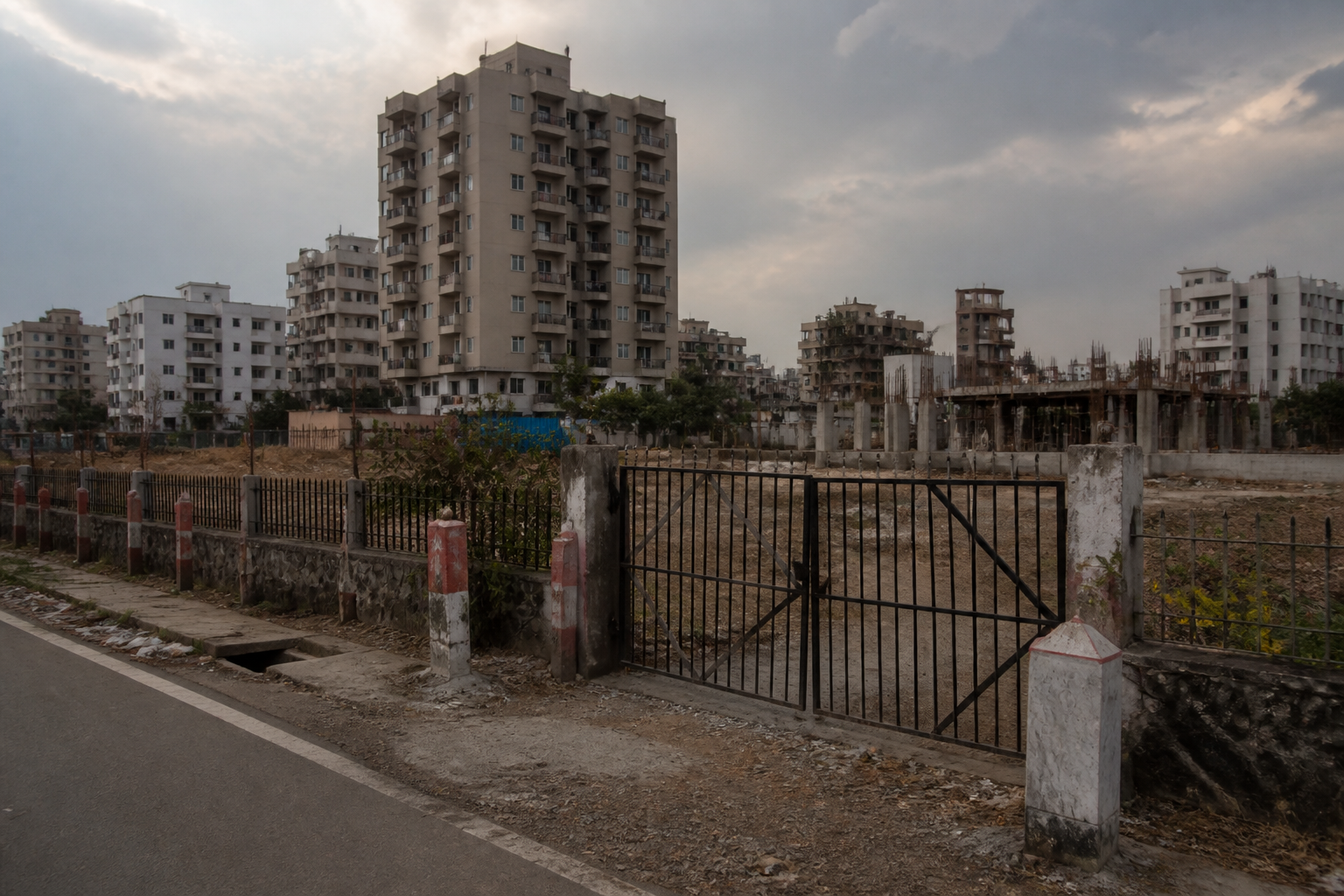
The Bhayander land dispute involving 81-year-old Mira Road resident Asgarali Vohra has moved into a new administrative phase after he met Prime Minister Narendra Modi on September 8 and sought a Central Bureau of Investigation probe. Vohra alleges that land he acquired through a registered agreement in 1989 was later encroached upon, divided through disputed records and shown in the names of two construction companies. The case highlights a recurring urban governance problem: ownership disputes can remain unresolved for years while land continues to be treated as a development asset.
Vohra’s meeting with the prime minister is the latest development in a dispute that, according to the report, has already involved the police, revenue department, municipal authorities and the courts. Vohra has alleged that Swayam Builders and Seven Eleven Constructions encroached on approximately 2,810 square metres of land at Navghar in Bhayander East in 2011. He has also alleged that forged documents were created and that the original owner was kept unaware of the transactions. These claims remain allegations and have not been established by a final judicial finding in the supplied material.
The case is significant not simply because of the individuals involved, but because it shows how urban land conflicts cross institutional boundaries. A property dispute may begin with a registered agreement, but resolving it can require examination by the registration and revenue authorities, verification of municipal records, police investigation into alleged forgery, and adjudication by a court. Each institution may hold a different part of the documentary trail. For a claimant, that can mean repeated approaches to multiple offices without a single authority being responsible for delivering a final resolution.
The reported chronology illustrates this difficulty. Vohra purchased the land through a registered agreement in 1989. He says the encroachment occurred in 2011, and an FIR was registered in 2015. The case remains pending before a court. The gap between the alleged encroachment and the present hearing is therefore not a minor delay in a single administrative file; it is a prolonged period during which the ownership and possession of urban land have remained contested.
That duration matters in a city where land is under constant development pressure. A parcel of approximately 2,810 square metres in Bhayander East is not only a private asset. Its records may affect construction activity, municipal permissions, taxation, access, neighbouring property rights and the credibility of the local land administration. The supplied report does not establish whether any project was completed on the disputed land, what permissions were issued, or which records were relied upon by the parties. Those gaps are important because the legal status of the property cannot be inferred merely from the allegation that possession was shown in company names.
The reported involvement of Swayam Builders and Seven Eleven Constructions adds a development dimension to the dispute. Vohra has alleged that the land was divided into two portions and that possession was shown in the names of the two companies. The companies’ representatives have been directed to attend a hearing scheduled for September 16. Their response to the allegations is not included in the supplied report, and no conclusion about their role can be drawn before the relevant authorities and court examine the records.
The reference to an FIR registered in 2015 is also not equivalent to a finding of guilt. An FIR records the registration of a criminal complaint and begins an investigative process; it does not by itself determine whether forgery, encroachment or any other alleged offence occurred. The supplied material does not provide the sections of law invoked, the investigation outcome, a charge sheet, a court order or the present procedural status of the criminal case. These documents would be necessary to establish how the allegations have progressed through the justice system.
The same caution applies to the registered agreement cited by Vohra. Registration is an important part of the property record, but the report does not provide the agreement, subsequent title documents, survey records, mutation entries, development permissions or court filings. Nor does it explain whether the original owner’s title, the chain of transfers or the boundaries of the land have been formally determined. Without those documents, the dispute can be described but not resolved journalistically.
The case also exposes the difference between administrative attention and legal resolution. Following Vohra’s meeting with the prime minister, the municipal administration has reportedly taken note of the matter. State transport minister Pratap Sarnaik released photographs and a press note about the meeting and expressed hope that the matter would receive justice. These developments may increase institutional attention, but they do not replace the evidentiary process required to determine ownership, possession or criminal liability.
This distinction is especially important in cases involving political figures or public personalities. The report says Vohra studied with the prime minister at B N School in Vadnagar, Gujarat, and approached him as a former schoolmate. That personal connection explains the visibility of the meeting, but it does not alter the formal roles of the municipal administration, revenue authorities, police and court. A land dispute still requires decisions based on records, inspections, investigations and judicial orders rather than personal access.
The scheduled September 16 hearing is therefore the next concrete institutional milestone. Representatives of Seven Eleven Constructions and Swayam Builders have been directed to remain present. The available material does not state whether the hearing is before a municipal authority, a revenue office or another forum, nor does it specify the relief sought at that hearing. Those details will determine whether the meeting is intended to examine land records, hear the companies’ responses, review municipal action or address another aspect of the dispute.
The broader urban lesson is that land records are not merely archival documents. They shape who can build, who can occupy, who can pay taxes and who can challenge a development claim. When records are disputed or institutions do not provide a clear route to resolution, uncertainty can persist even after a complaint is registered. That uncertainty affects the claimant, the alleged developers, public authorities and any resident or buyer who may later rely on the property’s status.
At the same time, the supplied report does not establish a wider pattern of similar disputes in Bhayander, nor does it provide data on the number of pending land cases, the functioning of local record systems or the scale of alleged encroachment in the area. It would therefore be inaccurate to treat this single case as proof of systemic failure across the entire city. What it does establish is a documented example of how one property conflict has moved between several institutions over decades without a reported final resolution.
The case now depends on what the relevant authorities and court records show. The September 16 hearing may clarify the positions of the two companies and the municipal administration. Further examination of the registered agreement, land records, alleged forged documents, FIR and court proceedings will be necessary to determine the facts. Until then, the Bhayander land dispute remains an allegation-led case that demonstrates the high public cost of unresolved urban land conflicts, while leaving the ultimate question of ownership and liability to the competent authorities.
