


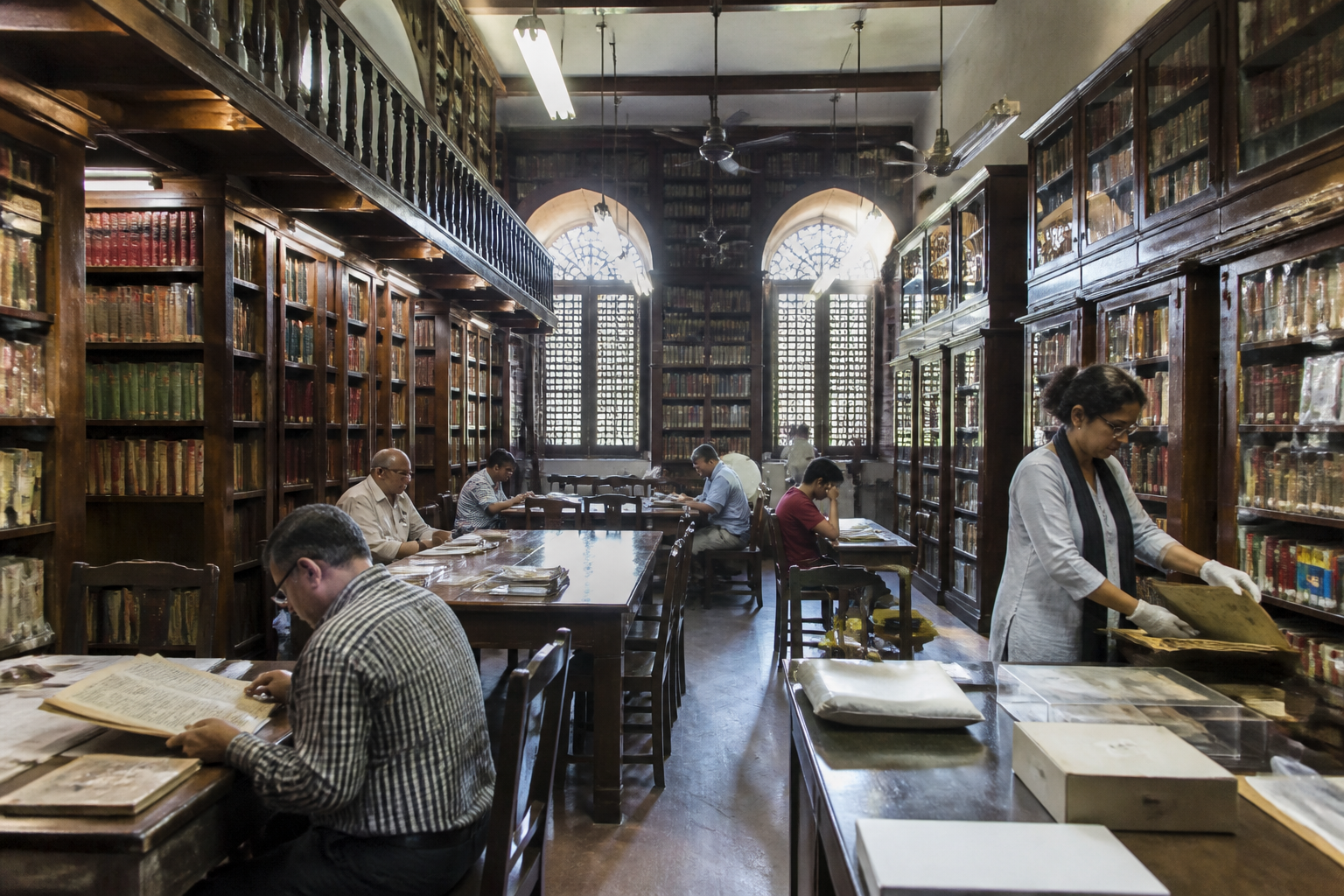
The reopening of Kolkata’s 96-year-old Mohammed Ali Library is more than the return of a reading room. It is a test of whether a neighbourhood institution can preserve its public purpose when its building, furniture, catalogue and archival holdings have all begun to fail at the same time. After three years of restoration and archival conservation, the library on Kanai Seal Street has reopened with repaired interiors, strengthened shelves and a digitisation programme that has already covered about half of its rarest books and century-old journals.
The library resumed operations on Teachers’ Day at Barry House, near Zakaria Street in central Kolkata. Its revival followed a community-funded effort after years of deterioration. The work addressed both the visible and less visible causes of decline: structural repairs, improved lighting, renovation and reinforcement of wooden shelves, and a programme for indexing, cataloguing and digitising the collection.
That combination is significant because the condition of a library is not defined only by the state of its walls. A building may remain open while its collection becomes increasingly inaccessible. At Mohammed Ali Library, damp had damaged books, pages had begun to come loose, wooden shelves had decayed and some racks had become unstable. Inadequate labelling and cataloguing made parts of the collection difficult to access, while the reading room also required better lighting. The restoration therefore had to treat the library as both a physical space and an archival system.
Founded in 1930 by Mulla Mohammad Jan to encourage reading among youngsters in the neighbourhood, the institution was renamed in 1931 after Mohammad Ali Jauhar, the freedom fighter, scholar and co-founder of Jamia Millia Islamia. Over the decades, it developed beyond its original function as a place to borrow or consult books. It became a regular study and reading space for generations of residents, students and researchers.
This history helps explain why the library’s decline was not simply a maintenance problem. When shelves weaken, lighting deteriorates and catalogues become unreliable, the damage affects the everyday usability of a civic institution. Readers may find it harder to locate material, researchers may lose access to fragile documents, and older members may no longer be able to use a familiar public space. The report of the library’s reopening describes several older members, many in their 80s, returning to the reading room.
The collection gives the restoration an importance beyond the neighbourhood. Mohammed Ali Library holds more than 15,000 books and periodicals dating back a century. Among the notable material are an Urdu translation of the Ramayana published in 1901, an Urdu translation of the Mahabharata, issues of Tahzeeb-e-Niswaan, described as one of the pioneering Urdu women’s journals of the early 20th century, and original copies of Awadh Punch, an Urdu satirical weekly.
These holdings show why preservation cannot be reduced to storing books in a repaired room. The collection contains evidence of reading practices, translation, publishing and public debate across different periods. Its value lies not only in the individual titles but also in the relationship between them. A rare translation, a women’s journal and a satirical weekly can help researchers understand how ideas circulated and how communities encountered literature and public life. Once such material is damaged or lost, replacing it is difficult even when a digital copy may later be created.
The library’s digitisation programme is therefore an important second layer of protection. About 50% of the rarest books and century-old journals have already been digitised, with the remaining collection expected to be digitised soon. Digitisation can reduce the need for repeated handling of fragile material and improve the possibility of access for readers and researchers. It also creates a record that can support preservation when age, humidity and use continue to place pressure on the originals.
At the same time, digitisation does not remove the need for a functioning physical institution. The source report makes clear that the library’s revival involved both archival conservation and restoration of the reading environment. The shelves, lighting, room and catalogue remain part of the public experience. The return of older readers also points to an aspect that digital preservation cannot replicate: the library as a shared neighbourhood space where people study, read and maintain a connection with a place.
The restoration also highlights the administrative challenge faced by old community institutions. The report attributes the revival to a community-funded drive and quotes Mohammad Khalil of Mohammed Ali Library thanking committee members and friends of the library for their labour, patience and perseverance. This indicates that the immediate intervention depended on local participation rather than a routine restoration process described in the supplied material.
That model has strengths and limits. Community involvement can mobilise attention around an institution whose decline might otherwise remain unnoticed. It can also bring together people who use the library, know its history or understand the value of its holdings. But a community-funded restoration does not, by itself, establish how future maintenance, conservation, cataloguing and digitisation will be financed or managed. The supplied report confirms the restoration and the ongoing archival programme, but it does not establish a long-term operating model beyond the library’s current opening schedule.
That unresolved question matters because preservation is a continuing process. Damp can return, wooden furniture can deteriorate again, and digitised files require organised storage and access systems. A catalogue is useful only if it is maintained and can be used by readers. The report establishes that indexing, cataloguing and digitisation are underway, but it does not provide details of the technology, institutional partnerships, conservation standards or funding arrangements supporting the work.
The library is currently open seven days a week from 2 pm to 10 pm for readers, students and researchers. Those hours preserve its role as an active public facility rather than turning it into a closed archive. The challenge will be to balance continued use with the protection of material that has already suffered from age, humidity and repeated handling.
Mohammed Ali Library’s revival consequently presents a wider urban question: what happens to small civic institutions that carry substantial cultural value but do not command the visibility of major museums, monuments or new public projects? In this case, the institution survived long enough for a restoration effort to begin, but the condition of its books, shelves and reading room shows how easily everyday infrastructure can decline without regular attention.
The evidence available from the reopening confirms three achievements: the physical space has been repaired, the library has returned to public use, and about half of its rarest material has been digitised. It also confirms that the work is unfinished. The remaining collection still requires digitisation, and the longer-term arrangements for maintenance and access are not established in the supplied account. For Kolkata, the library’s reopening is therefore both a recovery and a reminder that cultural infrastructure depends on continuous care long after the public celebration of its revival has ended.
