


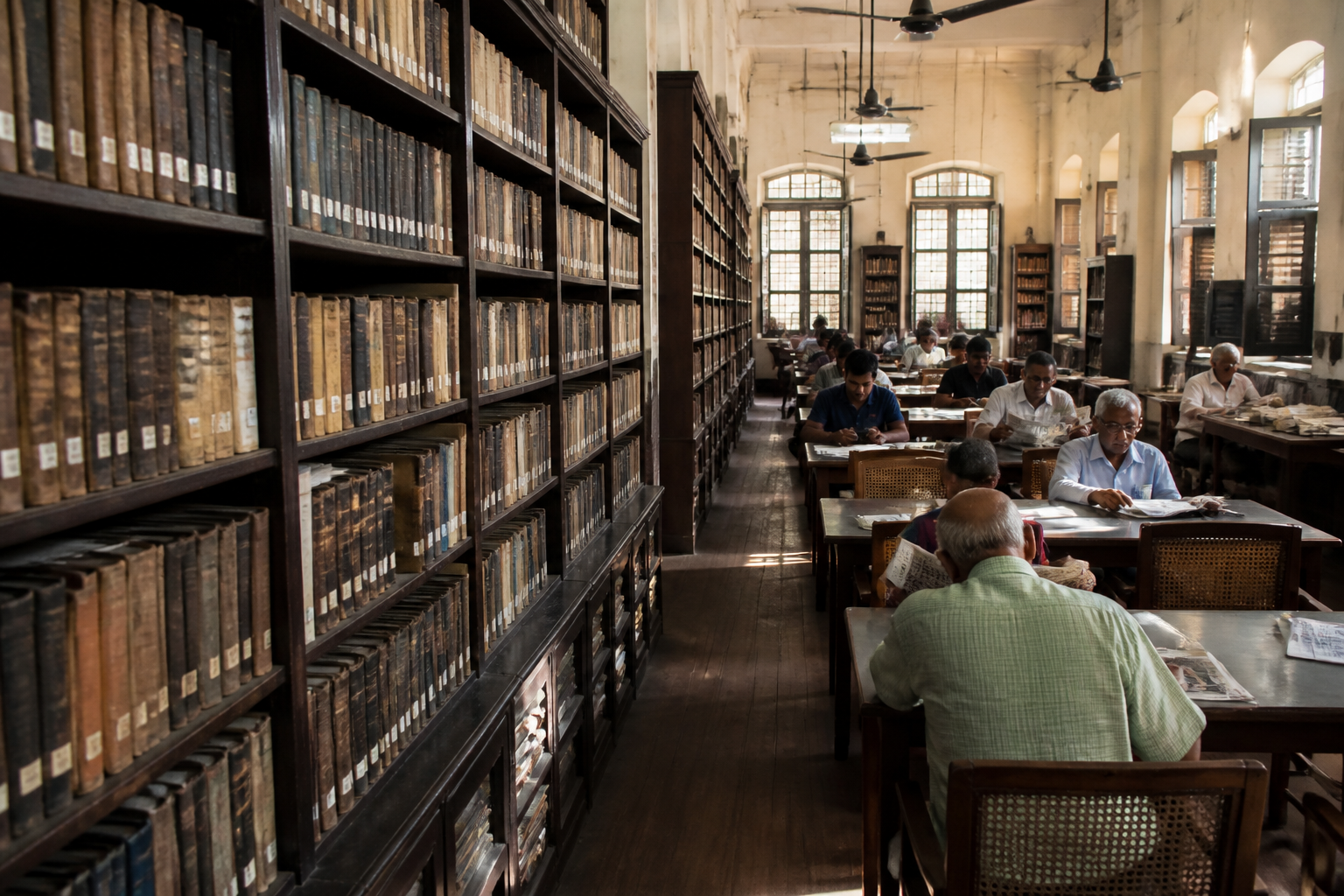
The reopening of Mohammed Ali Library in central Kolkata is more than the return of a reading room. It is the recovery of a neighbourhood institution whose physical deterioration had begun to threaten a collection of rare books, century-old journals and the everyday public use that had sustained it for generations.
The 96-year-old library on Kanai Seal Street, on the ground floor of Barry House near Zakaria Street, resumed operations after three years of restoration and archival conservation. The work addressed both sides of the institution’s decline: the building and furniture needed repair, while the collection required indexing, cataloguing and digitisation. Around 50% of the library’s rarest books and century-old periodicals have already been digitised, according to the report on its reopening.
That combination matters because a library is not preserved simply by repairing its walls or protecting its books. It must also remain usable. Mohammed Ali Library has reopened to readers, students and researchers seven days a week, from 2 pm to 10 pm. The return of older members, including several in their 80s, shows that the restoration has restored a functioning civic space rather than created only a protected archive.
Founded in 1930 by Mulla Mohammad Jan to encourage reading among young people in the neighbourhood, the institution was renamed in 1931 after Mohammad Ali Jauhar, the freedom fighter, scholar and co-founder of Jamia Millia Islamia. Its history places the library within the social life of central Kolkata, where access to books and a quiet place to study became part of the neighbourhood’s institutional fabric.
The library’s present collection contains more than 15,000 books. It also includes periodicals dating back a century, among them an Urdu translation of the Ramayana published in 1901 and an Urdu translation of the Mahabharata. The collection preserves issues of Tahzeeb-e-Niswaan, described in the report as one of the pioneering Urdu women’s journals of the early 20th century, as well as original copies of Awadh Punch, an Urdu satirical weekly.
These holdings give the restoration a significance beyond the survival of an old building. They represent a record of reading, publishing and cultural exchange that is held in a local institution rather than a national archive or a purpose-built museum. The collection’s value is therefore connected to its content, but also to the fact that it has remained part of a neighbourhood library accessible to readers and researchers.
The condition of the library shows how easily such institutions can become vulnerable. Damp had affected the collection, pages had begun to come loose, wooden shelves had decayed and some racks had become unstable. Inadequate labelling and cataloguing made parts of the collection difficult to access. The reading room also needed brighter lighting, while furniture required repairs.
This was not a single failure confined to one damaged shelf. The account describes a linked problem involving the building, storage systems, cataloguing, lighting and reader access. When these functions deteriorate together, a library can remain technically open while becoming progressively less useful and less capable of protecting its holdings. The three-year restoration addressed these connected weaknesses rather than treating the collection as separate from the space in which it is stored and used.
The repairs included structural work, improved lighting and the renovation and reinforcement of wooden shelves. The physical intervention was accompanied by an archival programme involving indexing, cataloguing and digitisation. The reported progress—about half of the rarest books and century-old journals digitised—suggests that preservation is being treated as both a physical and an information-management task.
Digitisation cannot replace the original collection or the reading-room experience. It can, however, reduce the need for repeated handling of fragile material and create an additional layer of protection against age, humidity and use. The report says the remaining collection is expected to be digitised soon. It does not provide a completion date, the technical standard used for digitisation, or details of how the digital material will be accessed. Those details will determine how far the archival programme extends the library’s reach beyond its premises.
The restoration was supported by a community-funded drive. That detail is important because it identifies a local institution’s users and supporters as active participants in its recovery. The source does not specify the total cost, the contributors, the administrative structure of the drive or whether public authorities were involved. What is established is that the revival depended on collective effort and that the repaired institution has returned to public use.
Mohammad Khalil of Mohammed Ali Library described the reopening as the result of the committee members’ and friends’ labour, patience and perseverance. Librarian Anwarul Haque said the books were decaying, the shelves were falling off and the library needed renovation, adding that the intervention was critical to safeguard a unique literary heritage. Together, the statements describe the project as an institutional rescue rather than a cosmetic refurbishment.
The library’s experience also highlights a recurring challenge in the management of older urban cultural spaces: preservation is rarely only a question of age. The collection deteriorated because damp, storage, furniture, access systems and lighting were not functioning adequately together. A building may retain historical value while its daily operating systems weaken. In a working library, those operational details determine whether heritage remains accessible or becomes effectively closed to the public.
The location adds another layer to the story. Mohammed Ali Library sits near Zakaria Street, in a busy part of central Kolkata, but the report presents it primarily through its interior life: shelves, reading tables, periodicals, researchers and long-time members. This contrast is significant. An institution can occupy a central urban location and still become vulnerable if its maintenance and cataloguing systems are not sustained. Visibility within the city does not automatically guarantee institutional protection.
The library’s restoration therefore raises a governance question about small public institutions. The available account does not identify a larger government programme, a formal heritage designation or a dedicated preservation authority responsible for the library. Instead, the documented intervention emerged through the library committee, friends of the institution and a community-funded effort. That model can mobilise local knowledge and urgency, but the source does not establish how long-term maintenance, future repairs or ongoing digitisation will be financed.
The reopening schedule—seven days a week from 2 pm to 10 pm—also makes the library’s public function visible in practical terms. It is not being preserved as an occasional exhibit. Readers, students and researchers can use it across the week, and older members have returned to a familiar space. The schedule indicates a continuing service commitment, although the source does not provide visitor numbers, membership figures or information about the library’s current staffing and operating costs.
The available numbers tell a compact but important story. The institution is 96 years old. Its collection exceeds 15,000 books. Its periodicals include material dating back 100 years, and around 50% of the rarest books and century-old journals have been digitised. The restoration itself took three years. These figures show the scale of the preservation task, but they do not establish how many items require repair, how many have been catalogued, or what proportion of the full collection remains at risk.
That distinction matters. Digitising half of the rarest material is a significant milestone, but it is not the same as completing preservation. Physical conservation remains necessary for the original books, while cataloguing is required to make them discoverable. The future value of the programme will depend on whether the remaining materials are digitised, whether the digital records are maintained and whether the repaired shelves and rooms are protected from the conditions that caused the earlier deterioration.
Mohammed Ali Library’s reopening confirms that the institution’s decline was reversible once the physical and archival problems were addressed together. It also shows that the meaning of urban infrastructure extends beyond roads, buildings and transport systems. A public library is a piece of civic infrastructure when it provides a shared place for learning, research and intergenerational use. Its loss would not be measured only in damaged books, but in the disappearance of a local public function.
The evidence supplied here does not establish whether other historic libraries in Kolkata face similar conditions, nor does it provide a comparative assessment of public library funding or preservation across the city. Those questions remain open. What is clear is that Mohammed Ali Library’s future will depend on the next phase: completing the digitisation programme, maintaining the repaired structure and ensuring that the collection remains catalogued and available to readers. For now, a neighbourhood institution that had been weakened by damp, decay and neglect has reopened with its public role intact.

