


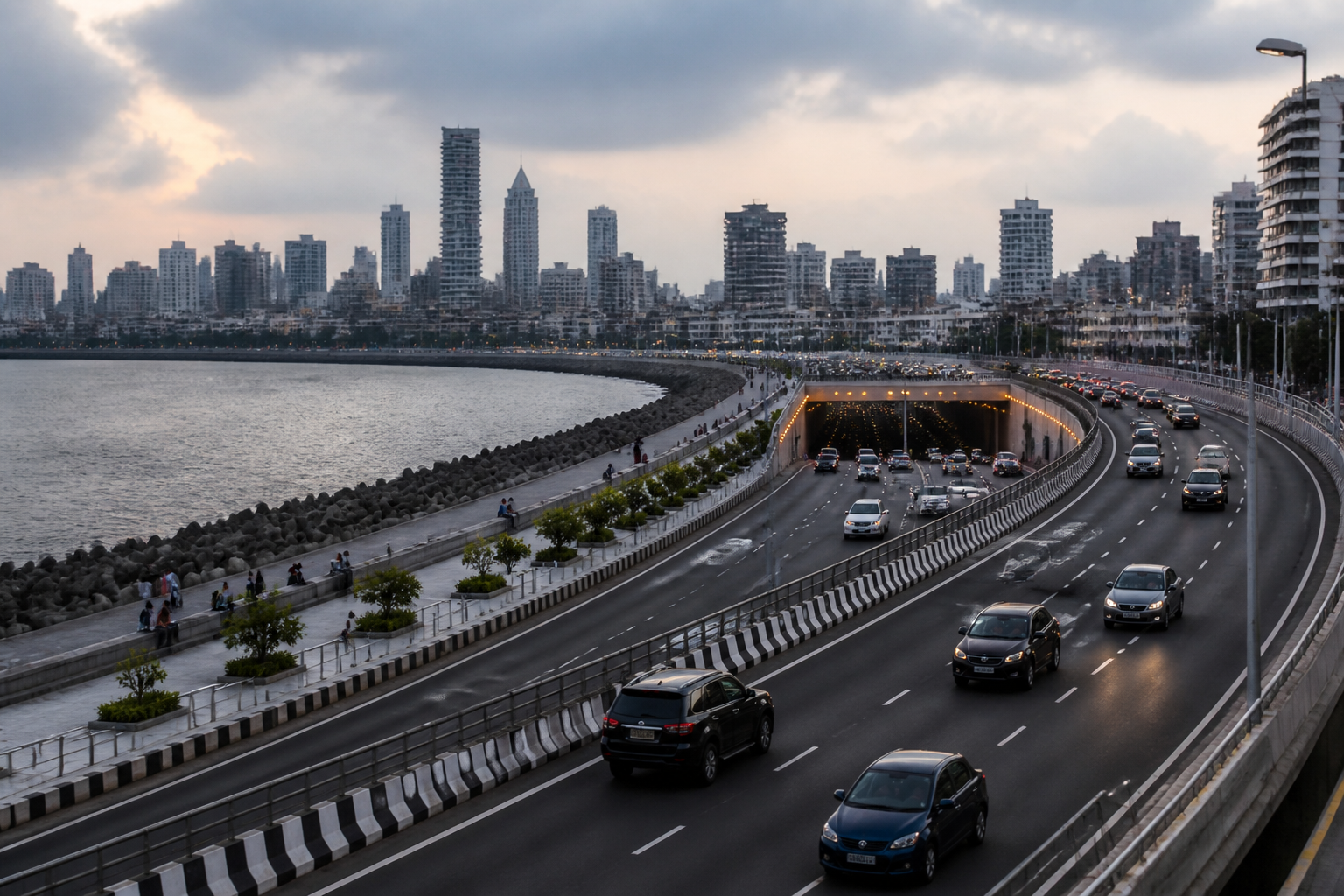
Mumbai Coastal Road has become substantially busier since it began operating around the clock, but its first year of 24×7 use also exposes a wider limitation of road-led urban planning: higher traffic on a new corridor does not by itself establish that the city’s congestion problem has been solved.
The south section recorded average daily traffic of 62,640 vehicles after 24×7 operations began on August 15, 2025, according to figures reported by the Times of India. That was an increase of nearly 81% from the 34,538 vehicles recorded when the road was available only from 7am to midnight. Monthly vehicle movements also rose from about 11.35 lakh to nearly 18.79 lakh, an increase of around 66%.
The numbers show that extending operating hours changed how motorists used the corridor. Before round-the-clock access, the road carried an average of 19,209 vehicles southbound and 15,330 northbound each day. After 24×7 operations began, the corresponding figures rose to 33,077 southbound and 29,563 northbound. Since the first section was inaugurated in March 2024, 4.11 crore vehicles have used the south section.
Yet the project is still below the traffic volumes anticipated during its planning. Planners had estimated that nearly 68,000 cars would use the road in one direction alone after commissioning. The current southbound average is less than half that projection. This gap is important because the project was not designed only as a standalone road. It was expected to redistribute traffic from the Bandra-Worli Sea Link and the Pedder Road-Hughes Road corridor.
The difference between actual and projected use does not, on its own, establish that the road has failed. It does, however, complicate the claim that additional road capacity automatically produces better traffic conditions. Alan Abraham, a Bandra-based architect and urban planner, said the road had diverted some traffic but questioned whether that should be treated as an improvement in the city’s overall transport performance.
“When you build more roads, you will get more cars. This does not mean the city’s traffic has improved; it only means some of the traffic has been diverted on the new road,” Abraham said. He described the approach as focused largely on private cars and argued that the project had not been accompanied by a corresponding strengthening of public transport.
That concern is built into the road’s operating design. The signal-free corridor prohibits pedestrians, two-wheelers and heavy vehicles. Public transport users therefore depend on buses to access a facility that was built at a reported cost of Rs 13,984 crore. At present, only two BEST services operate along the route: A84, linking Dr Shyama Prasad Mukherjee Chowk with Oshiwara Depot, and A78, running between NCPA and Byculla.
The limited bus network has become a point of formal administrative pressure. MLA Rais Shaikh has asked the BEST general manager to deploy additional buses, arguing that a road financed through public money risks becoming an exclusive corridor for car and cab users if mass transit access remains weak. The request places the project within a larger question of who can practically benefit from urban infrastructure when its access rules favour private vehicles.
The road’s experience is not uniformly negative for users. Susieben Shah, general secretary of the Malabar Hill Citizens Forum, described it as a “game changer” for residents, citing smoother connectivity and savings in time and fuel. She said residents were also looking forward to a northward extension, while noting that congestion still occurs near the MHADA junction in Bandra East and near the university after the southbound journey continues beyond the Coastal Road.
Her comments point to the network effect that large transport projects depend on. A signal-free segment can reduce travel friction on its own alignment while leaving bottlenecks at connecting roads and junctions. In this case, the reported benefits are strongest on the completed south section, while the broader journey remains shaped by congestion beyond the corridor. Transport expert Vivek Pai said the planned Versova-Bandra Sea Link could extend the benefits to motorists from Andheri West and Versova once completed.
The project also illustrates that operating a major urban tunnel and road system involves more than moving vehicles. Over the past two years, the south section has faced incidents involving tunnel fires, water leakage and theft of cables and other infrastructure. In July, a car fire inside the southbound tunnel below Girgaon Chowpatty led some motorists to abandon their vehicles and run out. Traffic was temporarily stopped, causing a major jam along the Breach Candy stretch.
A separate July incident involved the removal of bolts and copper wiring from an electric pole at Worli. Maintenance workers detected the damage before the 12-metre-high structure could collapse over the road. The two incidents raised different operational issues: the first concerned the movement of people and emergency vehicles during a tunnel emergency, while the second concerned the vulnerability of supporting infrastructure to theft.
Civic officials said the Integrated Command and Control Centre at the Breach Candy interchange brings traffic management, tunnel ventilation, firefighting, surveillance and mechanical and electrical systems together on one platform. An official said the systems had worked as designed during tunnel fires and that the delay in resuming traffic during the July incident occurred because rescue vehicles could not move freely amid panic among motorists.
Pai said incidents of this kind are considered in the planning of infrastructure of this scale and that preparedness depends on standard operating procedures and regular drills. His emphasis on motorist response is significant because the effectiveness of tunnel safety systems depends not only on equipment but also on whether users know how to react without obstructing emergency access.
The Coastal Road’s first year of 24×7 operation therefore produces three different readings. It has attracted substantially more vehicles since access was extended through the night. It has not reached the one-direction traffic volume projected during planning. And it has delivered clear benefits to some residents while leaving public-transport users with limited direct access.
The available figures also show why traffic counts need to be read alongside network design. A rise from 34,538 to 62,640 vehicles a day confirms increased use of the corridor, but it does not measure travel-time changes across Mumbai, the effect on parallel roads, or the distribution of benefits between car users, bus passengers, pedestrians and two-wheeler users. Those questions remain outside the traffic numbers reported so far.
The next stage will depend on how the completed road connects to the rest of Mumbai’s transport network, whether BEST services are expanded, and how effectively the civic system manages fire, maintenance and security risks. The proposed northward connections, including the Versova-Bandra Sea Link, are expected to determine whether the Coastal Road functions as part of a wider corridor or remains a heavily used but limited south Mumbai facility.
