


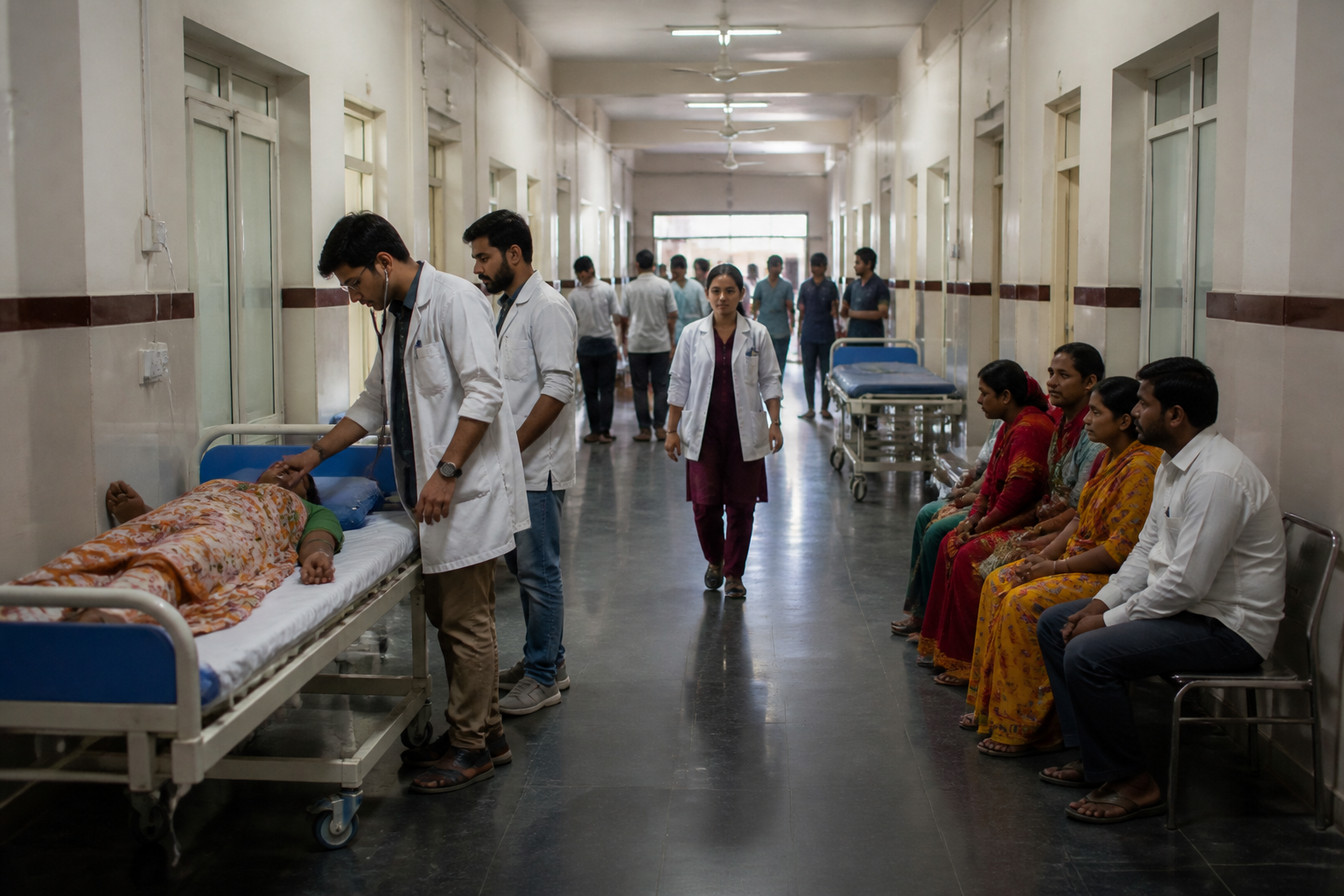
Telangana doctor vacancies are not evenly spread across the state’s government hospital network. Health department data tabled in the Legislative Council shows that 2,238 of 7,515 sanctioned doctor posts remain unfilled in government teaching and secondary hospitals, leaving nearly 30% of positions vacant. The sharper problem lies below the state’s major medical centres: secondary hospitals, which provide district-level care and act as the referral system’s middle tier, have a vacancy rate of about 36%.
The figures were provided in response to a question raised by BRS MLC Naveen Kumar Kurumaiahgari. Telangana has 203 government hospitals covered by the data, including 35 teaching hospitals, 16 speciality hospitals and 152 secondary hospitals. Together, these facilities have a bed strength of 36,984. The numbers establish the scale of the staffing gap, but they also show why a single statewide vacancy percentage can conceal the pressure experienced by individual districts.
Government teaching hospitals attached to medical colleges have 758 vacancies out of 3,423 sanctioned doctor posts, or about 22%. Secondary hospitals have 1,480 vacancies against 4,092 sanctioned positions, taking the vacancy rate to roughly 36%. In absolute terms, secondary hospitals account for nearly two-thirds of all unfilled posts included in the department’s figures. In functional terms, they are also the part of the network expected to manage patients closer to their homes before cases are referred to higher-level facilities.
That distinction is central to understanding the data. A government hospital system is not only a collection of buildings and beds. It depends on a distribution of staff, specialties and responsibilities across different levels of care. When vacancies are concentrated in district and secondary hospitals, the formal referral structure can become less effective even if some large city hospitals are comparatively well staffed.
Dr Kiran Madhala, secretary general of the Telangana Teaching Govt Doctors Association, said shortages at the district and secondary levels could increase workloads on existing doctors and encourage patients to seek care at tertiary hospitals in Hyderabad and other major cities. “When district and secondary hospitals function at only 50% to 70% of their sanctioned doctor strength, patients inevitably bypass them for city hospitals, defeating the very purpose of a referral system,” he said.
The statement points to a pressure that the vacancy table alone cannot fully measure. A vacant post represents an unfilled sanctioned position, but its operational effect depends on the specialty, the hospital’s patient load and whether another facility can absorb the work. A missing specialist in a district hospital may affect the availability of a service altogether, while a shortage of general-duty doctors may increase waiting times, reduce the number of consultations or add to the workload of the doctors who remain.
The supplied data also indicates that the distribution of vacancies varies sharply between districts. Nizamabad and Vikarabad recorded vacancy rates of more than 55% in secondary hospitals. Khammam and Kamareddy reported rates of around 46%. These figures are materially higher than the statewide vacancy rate for secondary hospitals and suggest that the state-level average does not describe the staffing position in several districts.
Hyderabad has 148 vacant posts out of 475 sanctioned positions, with 327 posts filled. Its vacancy rate is therefore lower than the reported rate for secondary hospitals statewide, but the city’s hospitals also serve a much larger catchment that includes patients referred from elsewhere. The pressure on Hyderabad’s health infrastructure cannot be assessed from vacancy numbers alone. Patient inflow, bed occupancy, specialist availability and the capacity of receiving hospitals would also be needed to establish the scale of the burden.
The disparity is visible even within the teaching-hospital category. Government Medical College, Asifabad, had nearly 73% of its sanctioned doctor posts vacant, while Government Medical College, Bhadradri Kothagudem, had more than 55% vacancies. By contrast, Gandhi Hospital and Osmania Medical College reported no vacancies and were functioning above their sanctioned strength. This spread shows that the existence of medical colleges or large institutions does not automatically produce an evenly staffed public health network.
The contrast between Asifabad and the Hyderabad institutions is particularly important for public administration because sanctioned strength and actual deployment are not the same thing. A post may exist on the government’s staffing plan without a doctor being available to deliver care. Conversely, an institution functioning above sanctioned strength may have greater ability to absorb workload, but that does not resolve shortages elsewhere. The figures therefore raise a distribution question as much as a recruitment question.
Specialist availability is another critical part of the gap. A government doctor quoted in the report said that the absence of surgeons, gynaecologists and anaesthetists has a more direct effect on patient outcomes than general-duty vacancies in many situations. The doctor also said recruitment was taking place at a pace of about 250 to 300 doctors a year and that filling all vacant posts could take several years. This is an attributed estimate rather than a timetable announced in the legislative reply, and it underlines the difference between creating or advertising posts and staffing hospitals at the required level.
The policy challenge is consequently divided into at least three administrative tasks: filling vacancies, placing doctors where the gaps are greatest and retaining the specialists needed for district-level services. The data supplied does not establish which of these is responsible for the largest share of the current shortfall. It also does not specify how many vacancies are in each specialty, how long the posts have remained unfilled or whether recruitment rules differ between teaching, speciality and secondary hospitals. Those gaps limit what can be concluded about the causes of the shortage.
What is clear is the hierarchy of exposure. Secondary hospitals have a higher vacancy rate than teaching hospitals overall, and several districts have much higher rates than the secondary-hospital average. These facilities are described by health experts as the backbone of district-level healthcare. If they cannot provide sufficient care, patients may move directly to urban tertiary hospitals instead of being treated or stabilised closer to home.
That movement has consequences for the wider urban system. Hyderabad’s hospitals become part of a regional network rather than serving only the city’s residents. Patients travelling from districts require transport, time and often accompanying family members. The supplied material does not provide data on travel distances, costs or patient volumes, so the precise social and financial burden cannot be quantified here. But the referral concern identified by health experts shows how a staffing decision in a district hospital can influence demand at major city institutions.
The 36,984-bed network also demonstrates that physical capacity and human capacity must be considered together. Beds, buildings and medical equipment cannot deliver services without doctors and other health workers. At the same time, the vacancy figures cover doctor posts and do not establish the availability of nurses, technicians, medicines, operating theatres or diagnostic services. A complete assessment of hospital performance would need those additional measures. The present data is therefore a strong indicator of staffing weakness, but not a complete measure of healthcare capacity.
The Legislative Council disclosure provides a formal basis for examining the issue because the figures were supplied through the state health department. The next institutional question is how the government responds: whether it publishes a district- and specialty-wise recruitment plan, clarifies the status of the most severely affected hospitals and reports progress against the sanctioned strength. Without that information, the vacancy total shows the scale of the problem but not the implementation pathway for resolving it.
The evidence confirms a structural imbalance in Telangana’s government hospital staffing. Nearly 30% of doctor posts are vacant across the reported teaching and secondary hospitals, while the rate rises to about 36% in secondary hospitals and exceeds 55% in several districts. The immediate urban implication is a potentially heavier referral load for Hyderabad and other major centres. What remains uncertain is the specialty-wise composition of the vacancies, the duration of unfilled posts and the patient volumes being redirected. Those are the figures that will determine whether the staffing gap is primarily a recruitment failure, a deployment problem or both.
