


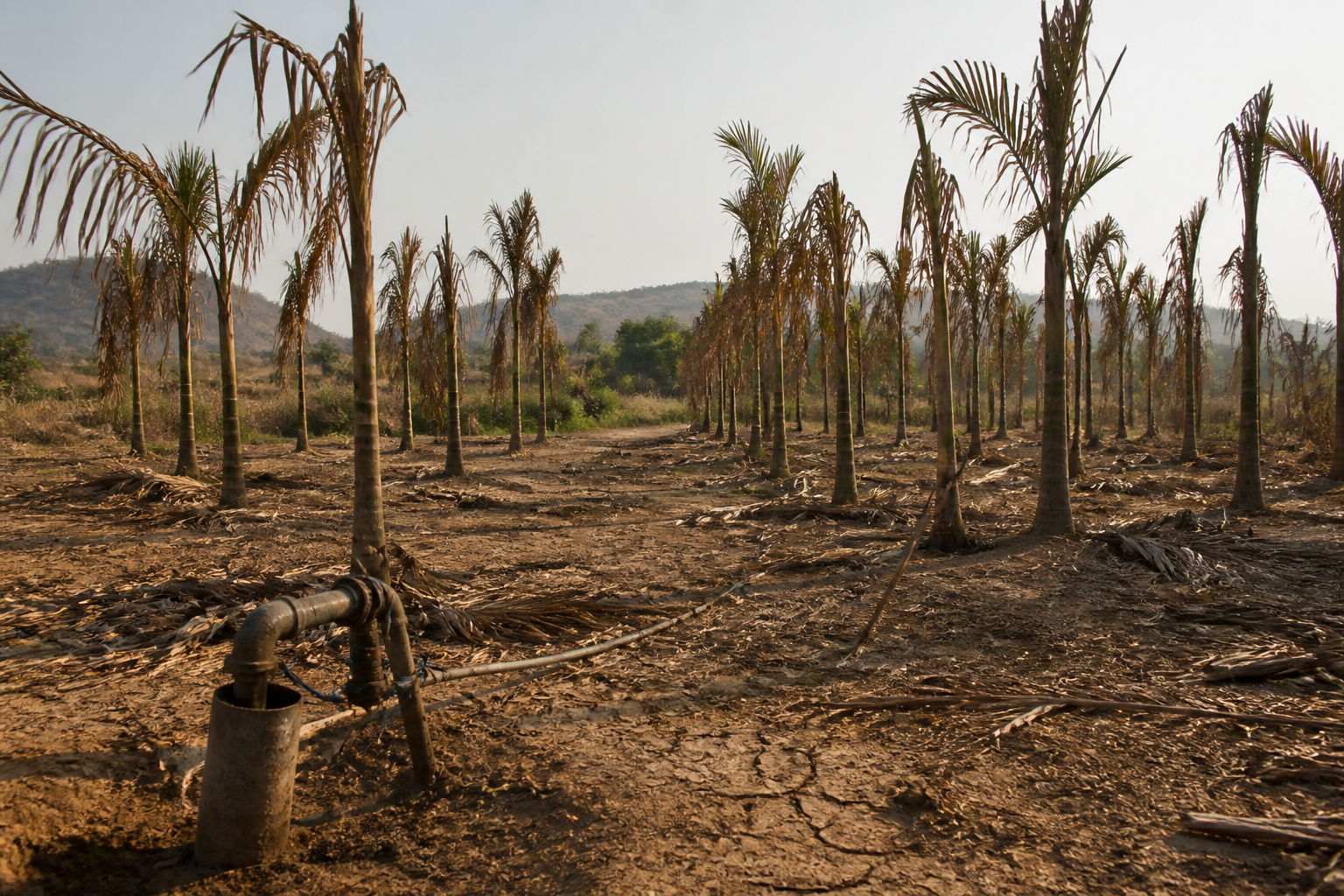
Tumakuru’s groundwater crisis is now visible in the drying areca farms of Chikkanahalli, where farmer Nagaraju has spent ₹32 lakh on 12 borewells and still cannot secure enough water for his crop. His experience, reported from Tovinakere in the district, shows how a farming economy built around borewell irrigation is becoming increasingly exposed to rainfall failure and falling underground reserves.
Nagaraju planted 1,000 areca saplings 12 years ago and added another 1,200 five years later. The plantation once produced a bumper crop, and two borewells were initially sufficient. As water availability declined, he drilled two more wells two years ago. This year, after the monsoon failed, two of the four borewells on his four-acre farm went dry. The remaining two reportedly produced only about half an inch of water, insufficient for 2,200 areca plants.
Over a two-month period, Nagaraju drilled eight additional borewells, including five deeper than 1,000 feet. None yielded water. The report states that his existing and new borewells have cost ₹32 lakh in total. Before drilling, he had consulted geologists and local water experts to identify possible water sources, but those assessments did not produce a working well.
The economics of this search are severe. According to Nagaraju, drilling a 1,000-foot borewell costs about ₹1.80 lakh, while a 1,100-foot well costs ₹2.35 lakh, a 1,200-foot well ₹3 lakh and a 1,300-foot well ₹3.75 lakh. One borewell drilled to 1,320 feet still failed to find water. The expenditure is therefore not only a farm investment; it is also a repeated cost of trying to keep an existing plantation alive after the local water system has weakened.
The immediate challenge is the crop’s dependence on regular water. Areca palms take years to mature, which means that a plantation cannot be replaced or relocated quickly when irrigation fails. Nagaraju’s first planting was 12 years old and his second was five years old. The trees were approaching or had reached productive stages when heat and water stress began damaging them. The report describes individual trees drying as water ran out.
The problem is not confined to one farm. The report states that areca cultivation has expanded across Tumakuru district to 94,033 hectares. As the cultivated area increased, farmers relied more heavily on borewells because the crop requires substantial quantities of water. That combination has created a direct link between crop expansion and groundwater pressure: more land under areca means more demand for irrigation, while failed rainfall reduces the recharge available to wells.
This is the central urban-system lesson in the Tumakuru case. Groundwater is often treated as a private farm resource because it is accessed through an individual borewell. In practice, however, the underground reserve is shared across a wider landscape. When many farms draw from the same aquifer, the success of one borewell is connected to the performance of neighbouring wells, the amount of rainfall entering the ground and the volume of water demanded by local land use.
The reported figures also show why deeper drilling is not a simple solution. Nagaraju’s wells extend to depths of up to and beyond 1,300 feet, yet the investment did not secure water. A deeper borewell may increase the cost of access without guaranteeing a viable source. The report does not establish the geological reasons for each failure, but the experience demonstrates the uncertainty farmers face when underground reserves are difficult to locate and recharge is inadequate.
Water access is especially constrained in parts of the district that do not have a river-water supply system. The report identifies Madhugiri, Pavagada and Koratagere taluks as areas where such supply is absent. In these places, the sequence described by the report is stark: rainfall must arrive, tanks must fill and borewells must recover. If any link fails, farms remain dependent on the next uncertain source.
The same dependence affects the possibility of emergency supply. Nagaraju considered using tankers to irrigate the areca plantation, but the report says tractor operators were not providing tankers for water delivery. This detail matters because it shows that a water crisis is also a logistics crisis. Even when farmers are willing to pay for alternative supply, the local transport and distribution network may not be available at the scale or frequency required by a standing plantation.
Another farmer quoted in the report, Srikantamurthy of Adalagere in Gubbi taluk, described the situation as a shift from trying to earn from areca to simply trying to save the crop. That distinction captures the financial pressure created by water-intensive cultivation. Capital that might otherwise support farm operations, household needs or future investment is being diverted into borewell drilling and emergency water searches, without any guarantee of recovery.
The district’s reported 94,033-hectare areca area makes the issue larger than individual farm distress. It raises a planning question about whether crop expansion has been matched by a reliable water assessment. The source report does not provide a district-wide groundwater balance, a crop-water audit or official figures for recharge and extraction. It also does not identify a government relief package, a tanker programme or a formal restriction on new borewells. Those gaps are important because they limit what can be concluded about the scale of the crisis and the institutional response.
What is established is the mismatch between cultivation demand and available water at the farm level. Four borewells on one four-acre plantation could no longer provide sufficient water. Eight more attempts failed. A farmer who sought technical guidance before drilling still faced repeated losses. Across the district, the report says that 75% of borewells have failed, although it does not specify the survey, measurement period or authority behind that estimate. The figure therefore requires formal corroboration, but it points to the need for closer public monitoring of groundwater conditions.
The institutional question is also clear. Individual farmers are bearing the cost of a resource problem that extends beyond individual plots. Borewell permissions, groundwater assessment, crop planning, tank and watershed management, emergency water supply and agricultural support involve different administrative responsibilities. The supplied report does not establish how these responsibilities are currently coordinated in Tumakuru. Without that information, the financial burden remains visible at the farm level while the wider management framework remains difficult to assess.
For rural settlements and nearby towns, groundwater stress can affect more than agriculture. Farms, households, livestock, tanker operators and local businesses may compete for the same limited supply. The source material focuses on areca cultivation and does not quantify these wider demands, but the dependence it documents indicates why groundwater management cannot be separated from local infrastructure planning. A borewell is an access point; it is not, by itself, a water security system.
Tumakuru’s areca crisis therefore represents a structural risk created by the interaction of rainfall variability, crop expansion and borewell dependence. The immediate evidence comes from one farmer’s failed wells and the wider figures reported for the district. The next facts that require verification are the 75% borewell failure estimate, the current groundwater levels across the affected taluks, the extent of areca expansion over time and the availability of public or private emergency water supply.
Until those measurements are brought together, the district’s farmers will continue to make high-cost decisions with incomplete information. Nagaraju’s ₹32 lakh expenditure shows the consequence when groundwater assessment fails to translate into dependable water access. The larger question for Tumakuru is whether its agricultural landscape can continue expanding water-intensive cultivation while relying on a resource that individual farmers cannot independently restore or secure.
