


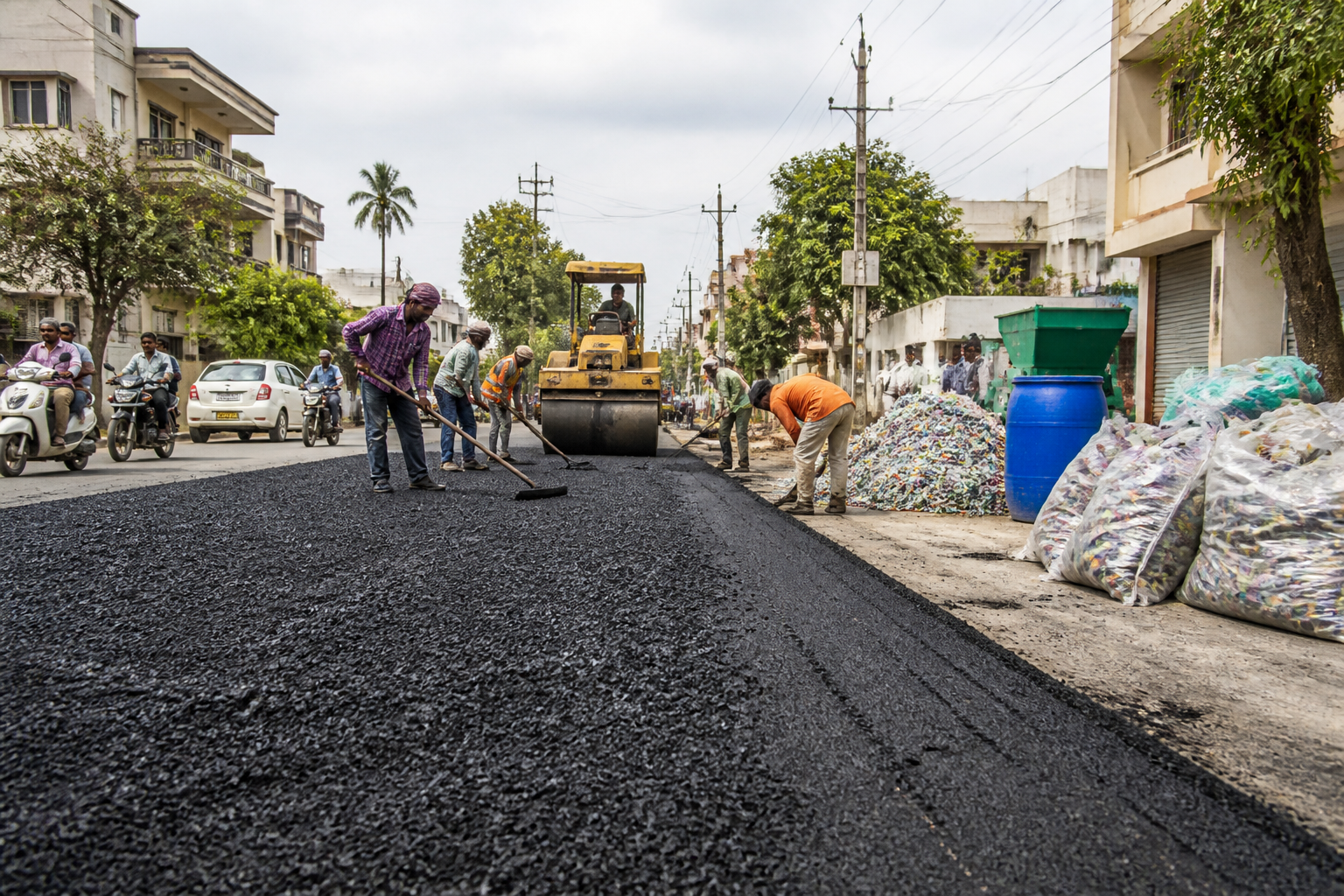
Hubballi-Dharwad’s recognition by the Central Pollution Control Board (CPCB) for using plastic waste in road construction has reopened a question that Bengaluru has encountered before: can a city reduce the burden of non-recyclable plastic without transferring the environmental risk to roads, air and water?
The answer emerging from the Hubballi-Dharwad experience is neither a simple endorsement nor a rejection. The municipal corporation has completed a 1.1-km road at Lingaraj Nagar in Hubballi using 8% shredded plastic waste blended with bitumen in the asphalt mix. The initiative has been highlighted under the National Clean Air Programme (NCAP) as one of the best practices recognised during Swachh Vayu Sarvekshan 2026.
According to the CPCB material cited in the report, the approach has reduced the quantity of plastic waste requiring conventional disposal, lowered bitumen consumption and produced roads with stronger resistance to water damage and potholes. The Hubballi-Dharwad Municipal Corporation has also reported savings of approximately Rs 1.5 lakh per kilometre compared with conventional bituminous roads. A further 1.7-km stretch is planned in Shivalli village using the same technology.
These gains matter because the method links two civic problems that are usually administered separately. Road construction is treated as an infrastructure and public works function, while plastic waste is handled through solid waste management systems. Plastic-modified roads bring the two systems together, but they also require the municipality to coordinate waste collection, segregation, processing, asphalt production, road laying and performance monitoring.
The process described in the report begins with the collection of non-recyclable plastic waste. The material is segregated, cleaned, dried and shredded before being blended with hot aggregate and bituminous mix under controlled conditions. This is not the same as sending mixed waste directly to a road site. Its performance depends on the quality of the feedstock, the proportion of plastic used, the temperature and mixing process, and the ability of authorities to maintain those controls over time.
That distinction is central to the debate now being revived in Bengaluru. City-based solid waste management experts have called for the city to bring back waste plastic-based road construction, noting that Bengaluru was the first city in the country to adopt the use of plastic waste in road construction. The appeal is understandable in a city where non-recyclable plastic can move from collection points to landfills, open dumping sites and water channels.
But a road programme cannot by itself solve the plastic waste problem. The report notes that the quantity of plastic that can be used in road construction is limited. Plastic waste would also need to be assessed for other applications, rather than being directed into roads simply because roads offer a visible outlet. This places a boundary around the model: it may be a useful treatment pathway for a defined stream of waste, but it cannot substitute for reducing plastic consumption, improving segregation or expanding recycling.
The available air-quality data adds an important but limited dimension. Hubballi-Dharwad’s PM10 concentration declined from 79 micrograms per cubic metre in 2017-18 to 61 micrograms per cubic metre in 2024-25, a reduction of 22.78%, according to the report. The figure provides evidence of an improvement in measured particulate levels, but it does not establish that plastic-modified roads caused the decline. Air quality is shaped by multiple factors, and the supplied material does not isolate the contribution of this road-building method.
The CPCB recognition is therefore best understood as recognition of a resource-efficient civic practice, not as proof that plastic roads are a complete clean-air intervention. The distinction matters for policy. If the practice is presented primarily as an air-pollution solution, municipalities may claim benefits that the available evidence does not demonstrate. If it is evaluated as a controlled waste-use and road-performance intervention, its measurable advantages and risks can be examined more precisely.
Dr Anjaneyappa, a professor at RV College of Engineering, said adding polymer to bitumen modifies its properties and can improve strength, durability, water resistance and resistance to deformation. He also said the use of plastic waste in road construction is advisable when an appropriate procedure is followed and quality is maintained. While shredded plastic increases the cost of mixing, he said the additional expense can be justified by improved durability and performance.
The institutional challenge is turning those conditions into routine administrative practice. A municipal corporation would need a reliable chain from waste collection to processing, along with specifications for the kind of plastic that can enter the mix. It would also need records of the quantity used, the location of each road stretch, the construction method and the road’s performance after exposure to traffic and monsoon conditions.
The report does not establish how long the Lingaraj Nagar road has been monitored, how its performance compares with a similar conventional road or whether the claimed savings include the full cost of collection, cleaning, drying and shredding. Those are not minor accounting questions. A lower construction cost at the laying stage may not represent a lower public cost if upstream waste handling is excluded or if additional monitoring and maintenance are required.
Production safety is another unresolved part of the system. Experts have cautioned that adding plastic to bitumen aggregates at the production plant produces a different type of smoke, which needs to be handled differently. This places the asphalt plant, rather than only the road site, at the centre of environmental compliance. Controls over worker exposure, emissions and operating conditions would need to be part of the implementation framework.
Water and soil risks also require continuing assessment. The report describes leaching and pollution of water bodies as low-risk aspects, but experts still caution that the impact on water bodies, soil and air must be considered. Low risk is not the same as no risk, particularly in a city where roads, drains, lakes and groundwater systems are closely connected. Monitoring would be especially relevant where road construction takes place near water bodies or drainage channels.
For Bengaluru, the administrative history makes the issue more significant. The city’s earlier adoption of plastic waste in road construction suggests that the question is not whether the technology is entirely new, but whether the city can rebuild the institutional discipline needed to use it responsibly. The central issue is therefore not the announcement of another pilot. It is whether the city can connect its waste-management contracts, road tendering systems and quality-control mechanisms without weakening any of them.
The Hubballi-Dharwad example offers a reference point because it combines a defined road stretch, a stated plastic proportion, a reported cost comparison and a planned extension. It also shows why public claims should be accompanied by transparent documentation. The more a municipality can disclose about the plastic stream, processing conditions, road specifications, costs and performance, the easier it becomes to distinguish a durable public works practice from a short-term waste-disposal claim.
There is also a demand-side question. Odette Katrak, founder of Beautiful Bharat, said projects that put tonnes of waste plastic to use offer hope, but warned that concerns remain over effects on water bodies, soil and air. She also stressed that using waste plastic in roads should not become an excuse to consume more plastic, and that reducing plastic consumption must continue as a parallel message.
That warning defines the policy boundary. Waste-based road construction can potentially reduce the volume of selected plastic waste going to conventional disposal, lower bitumen use and improve road performance. It cannot justify continued growth in single-use plastic, replace source segregation or remove the need to reduce consumption. A circular urban system must address both the waste already generated and the conditions that generate it.
The evidence currently supports a cautious conclusion. Hubballi-Dharwad has demonstrated a specific application of shredded plastic in a 1.1-km road, reported construction savings and received CPCB recognition. The city has also planned a further 1.7-km stretch. Bengaluru’s renewed interest is grounded in an earlier local precedent and a continuing waste-management problem. What remains to be established is the long-term performance, full-system cost, emissions control and environmental impact of the approach at larger scale. Those are the measures that should determine whether plastic-modified roads become a dependable urban infrastructure tool rather than simply a persuasive answer to a difficult waste stream.
