


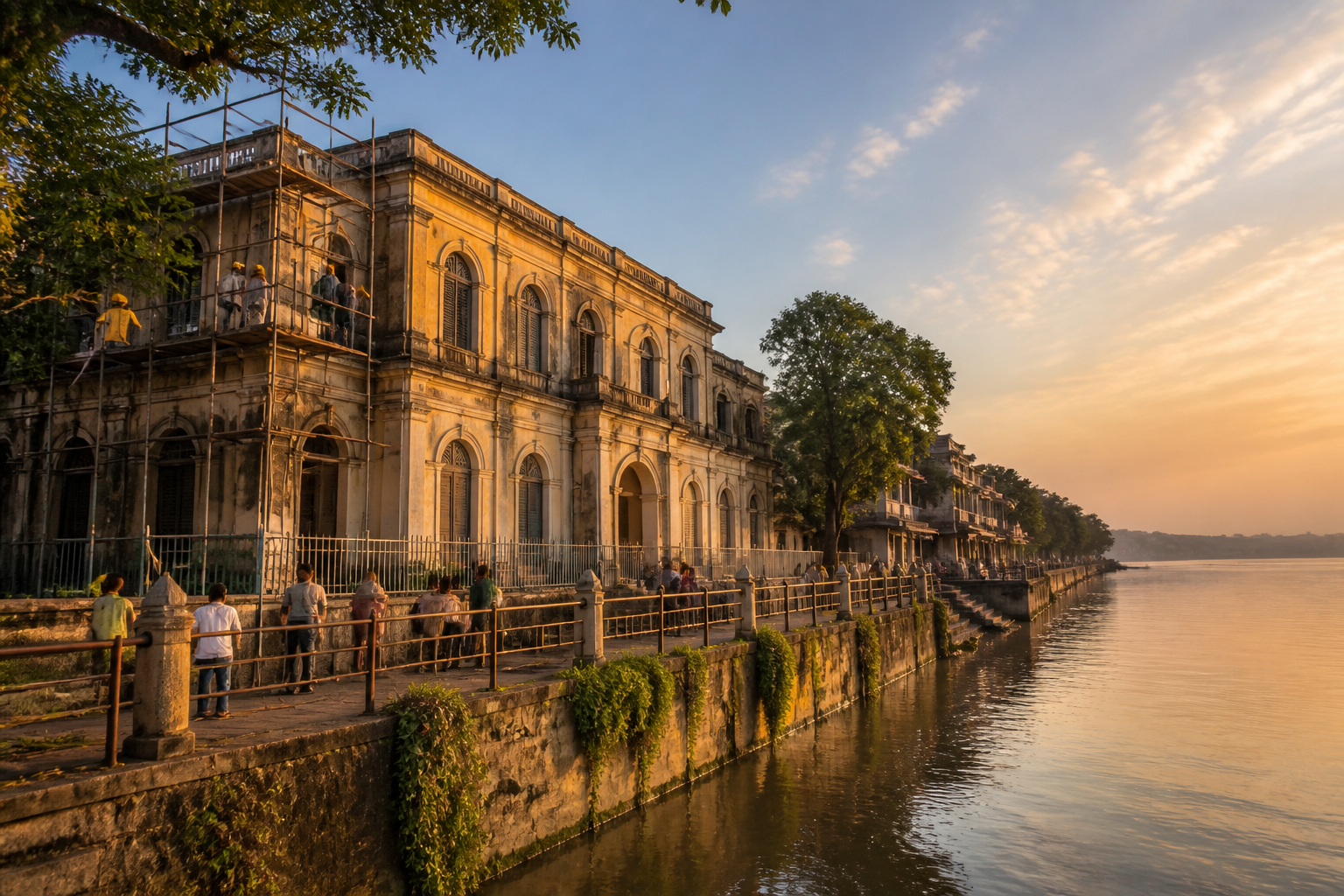
The Chandernagore heritage project has moved from prolonged conservation uncertainty towards implementation, with West Bengal clearing around ₹5.74 crore for the restoration of the Registry Building, a former French courthouse built in 1875. The decision is more than a rescue of a deteriorating structure: it places a contested historic building inside a wider attempt to use the town’s colonial-era urban fabric for public facilities, river tourism and local employment.
The two-storey Registry Building stands at one end of Chandernagore’s Strand, facing Rani Ghat. It was once declared condemned and faced a demolition order in 2004. Its restoration has been under discussion since 2016, while efforts to formally recognise its heritage value continued until it was listed in 2017 through the installation of a blue plaque by the West Bengal Heritage Commission.
The project’s long gestation illustrates one of the central problems of heritage management in Indian towns: identifying a historic building is considerably easier than securing the money, institutional agreement and viable use needed to keep it standing. In this case, the building survived changing administrations, two memoranda of understanding signed between the French side and the state government in 2018 and 2021, and the disruption caused by the Covid pandemic. The latest finance approval and proposed tender process provide the first clear implementation milestone described in the report.
The planned intervention also departs from the idea that conservation means freezing a building in its old form. Conservation architect Aishwarya Tipnis, who has led the initiative on behalf of the French embassy, presented a layout that would adapt the structure into a community facility. Proposed uses include a visitor information centre, café and library. Additional chief secretary, tourism, Barun Kumar Roy said the building could also support Indo-French language and cultural activities, while job-oriented courses could train young people as tourist guides, translators, chefs and sommeliers.
That proposed mix matters because a heritage building that is restored but disconnected from everyday community use can quickly become a ceremonial object rather than a functioning urban asset. The Registry Building’s future use, as described in the report, is intended to connect conservation with local services, visitor activity and skills. The precise operating model, maintenance responsibilities and revenue arrangements have not been established in the supplied material, but the proposed programme indicates an effort to make the building useful to residents as well as tourists.
Chandernagore’s heritage value is not confined to one building. The former French trading outpost contains a wider network of structures, streets and cultural traces shaped by commerce, education, language, architecture and food. A mapping exercise carried out in 2012 produced an inventory of 99 heritage buildings, with seed funding from the French heritage non-profit Vieilles Maisons Françaises. The inventory was later made available online, creating a documented base for identifying the town’s built heritage beyond the Registry Building.
The Registry House once stood within the campus of the Hotel de France, which now houses the subdivisional court. According to Tipnis, the two were separated when the Women’s Polytechnic was built between them. This history shows how institutional expansion can fragment a historic urban precinct even when individual buildings survive. Restoration alone cannot recreate the original relationship between structures; it must also consider movement, access, public space and the uses that surround the protected asset.
The state government’s stated ambition is to place Chandernagore within a larger river tourism circuit along the Ganges. The proposed route would link Portuguese heritage in Bandel, Dutch heritage in Chinsurah, French heritage in Chandernagore, Danish heritage in Serampore and British influence in Barrackpore. The tourism department has placed orders for two vessels with Garden Reach Shipbuilders and Engineers and has said it will buy more electric vessels for a river tourism programme focused on colonial history and the freedom struggle.
This approach treats the river not simply as a scenic edge but as connective infrastructure between multiple historic settlements. The quality of such a circuit, however, will depend on how well river access, landing points, pedestrian routes, heritage sites and local services are integrated. The supplied report does not provide details on vessel capacity, routes, fares, terminals, operating dates or the institutional body that will coordinate the sites. Those details will determine whether the circuit becomes a practical visitor network or remains a collection of separately promoted destinations.
The Strand already functions as Chandernagore’s most visible public-facing heritage space. During a three-day festival, it was illuminated with displays depicting French themes including the Eiffel Tower and the Louvre Museum. Food and book stalls, performance stages and local student participation turned the riverfront into a temporary cultural venue. The event demonstrated the Strand’s capacity to host public activity, but a festival is different from a sustained urban programme. Regular maintenance, crowd management, accessibility and protection of historic fabric will be necessary if increased visitation is to support rather than burden the area.
The proposed uses for the Registry Building suggest that the project is also being framed as a livelihoods intervention. Training guides, translators, chefs and sommeliers could create pathways for young residents to participate in the tourism economy. The plan to promote homestays points towards a distributed model in which visitor spending reaches neighbourhoods rather than remaining limited to a single attraction or riverfront event. The report does not establish how many jobs or homestays are expected, so the employment effect cannot yet be measured.
The project’s institutional structure is shared across several actors. The state tourism department is responsible for the restoration funding and broader tourism planning. The finance department has approved the reported allocation. The French embassy has supported the conservation initiative, while the West Bengal Heritage Commission’s listing provides formal heritage recognition. Chandernagore’s local political representatives and civic stakeholders are also seeking additional interventions, including a light-and-sound show on freedom fighters, structural reforms at Prabartak Sangha and repairs to the Strand’s Clock Tower.
These overlapping responsibilities can provide access to expertise and funding, but they can also make accountability difficult. A heritage precinct requires decisions about structural safety, conservation standards, public programming, commercial activity, traffic, sanitation and long-term maintenance. The source material confirms the restoration allocation and the expected tender process, but it does not identify a single authority responsible for coordinating all these functions. The next stages will therefore reveal whether the project is being implemented as a connected urban plan or as a series of individual works.
The building’s history also gives the initiative a strong institutional and diplomatic dimension. French ambassador Thierry Mathou described Chandernagore as part of a wider history of encounters and said France wanted to contribute to building on the town’s heritage. He proposed an annual French festival featuring culture, cinema, artists, cuisine and the economy. He also said a large French business delegation would visit Bengal in December for an investment conclave.
Such cultural diplomacy can help mobilise attention around heritage, but the urban test remains local: whether residents can access the restored building, whether surrounding public spaces improve, and whether the economic benefits are distributed beyond official events. The Registry Building’s proposed community role is therefore as important as its French association. Its success will depend on whether the Indo-French narrative is presented as a living part of Chandernagore’s Bengali social history rather than as a detached colonial display.
The decision to restore a building once marked for demolition confirms a shift in the way Chandernagore’s past is being treated. The town is no longer being presented only as a place with surviving monuments; it is being positioned as a linked cultural landscape with riverfront spaces, civic institutions, historic buildings and potential visitor routes. The 99-building inventory provides the evidence base for that wider understanding, while the Registry Building offers a test of whether documentation can lead to funded and functional conservation.
What is confirmed so far is the finance approval, the proposed tender process, the intended adaptive uses and the government’s broader river tourism ambition. What remains unclear is the implementation timetable, the final conservation design, the operating arrangements for the community facility, the structure of the river circuit and the safeguards for the heritage precinct. Those details will decide whether Chandernagore’s revival becomes a durable urban regeneration model or remains concentrated around festivals and announcements. The tender, restoration work and future public programming will be the next milestones to watch.
