


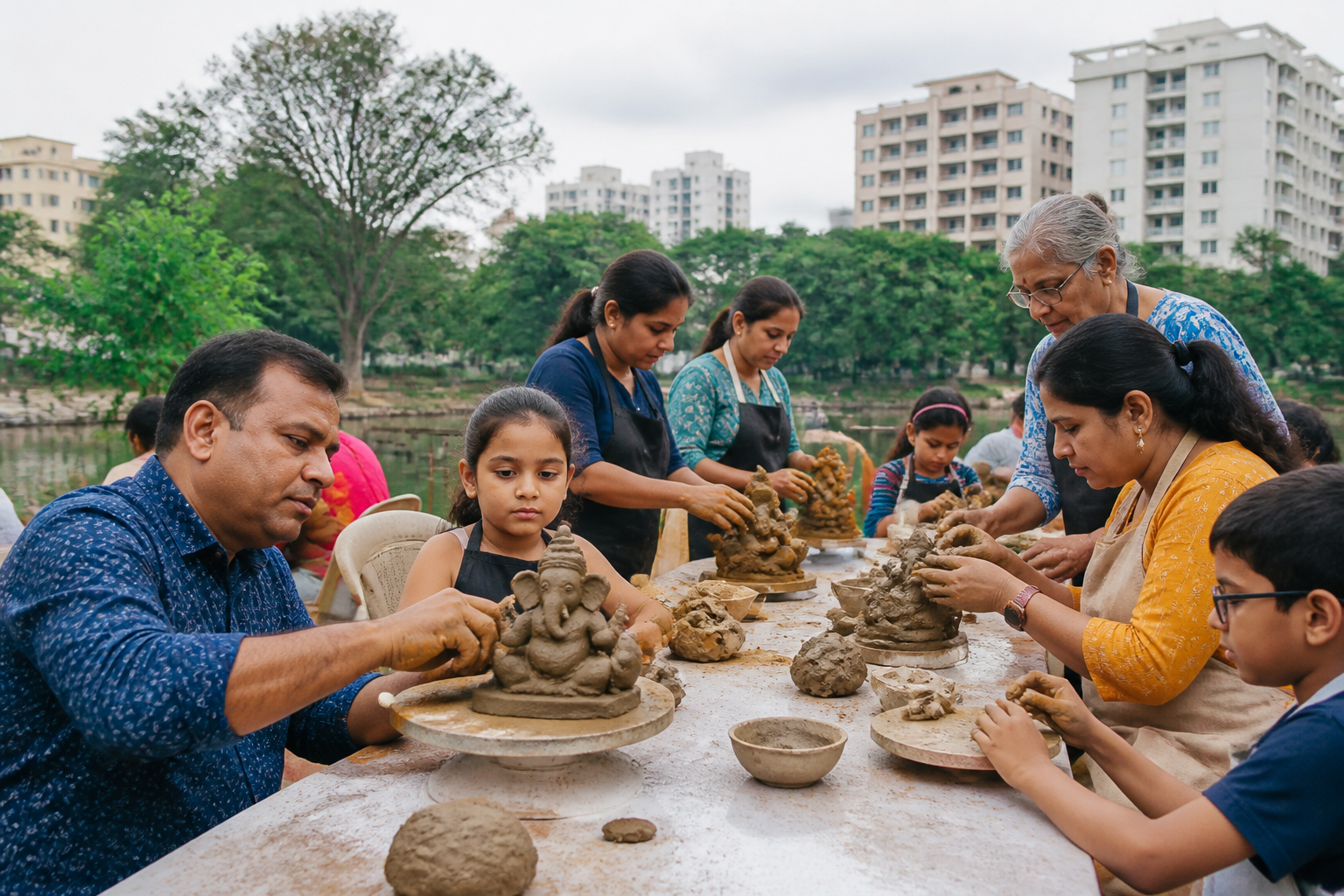
Eco-friendly Ganesha idols are gaining ground across Bengaluru as citizen groups, lake activists and resident welfare associations organise clay-making workshops and encourage families to move away from Plaster-of-Paris idols ahead of Ganesh Chaturthi.
Several neighbourhood groups held workshops in the weeks before the festival, with many sessions offered free of charge. Children and families were invited to make idols using natural clay and mud. The idols made during these sessions are expected to be installed in homes this weekend, ahead of Ganesh Chaturthi on Monday.
Organisers said the workshops are intended to make festive celebrations more sustainable while retaining their cultural and devotional significance. Their approach goes beyond distributing alternative idols: participants make the idols themselves and learn about the environmental consequences of the materials used in celebrations.
“Children are the best ambassadors of change. If they learn sustainable practices at a young age, they carry those values throughout their lives and influence their families as well,” said NH Subramanian, secretary of the Benniganahalli Kere Community Development Trust.
The community-led effort is increasingly becoming part of Bengaluru’s annual festive calendar. HSR Citizen Forum has conducted clay idol-making sessions for more than a decade, helping hundreds of children learn about environmentally responsible celebrations, according to the report.
The shift is also being supported by stricter enforcement from civic authorities and years of awareness campaigns by environmental organisations. The move away from Plaster of Paris is significant for a city where festival-related immersion activities have raised concerns about the impact of non-biodegradable materials on lakes and other water bodies.
Organisers are paying attention to the source of the clay used in the workshops. They said the material is obtained from authentic suppliers and remains completely biodegradable, an assurance intended to address concerns among families about whether sustainable celebrations can preserve traditional practices.
The workshops also create a direct link between household celebrations and the wider urban environment. By involving families in the making of the idols, organisers are seeking to turn an environmental message into a practical activity that children can understand and carry into their homes.
The reported increase in community workshops reflects a broader citizen-led response to the environmental pressures associated with public and household festivities. Instead of treating sustainability as a separate campaign, neighbourhood groups are incorporating it into the preparation for Ganesh Chaturthi.
With the festival approaching, the idols made at these workshops will be used in homes across Bengaluru. Organisers and civic authorities are continuing to encourage residents to choose biodegradable materials for this year’s celebrations.
