


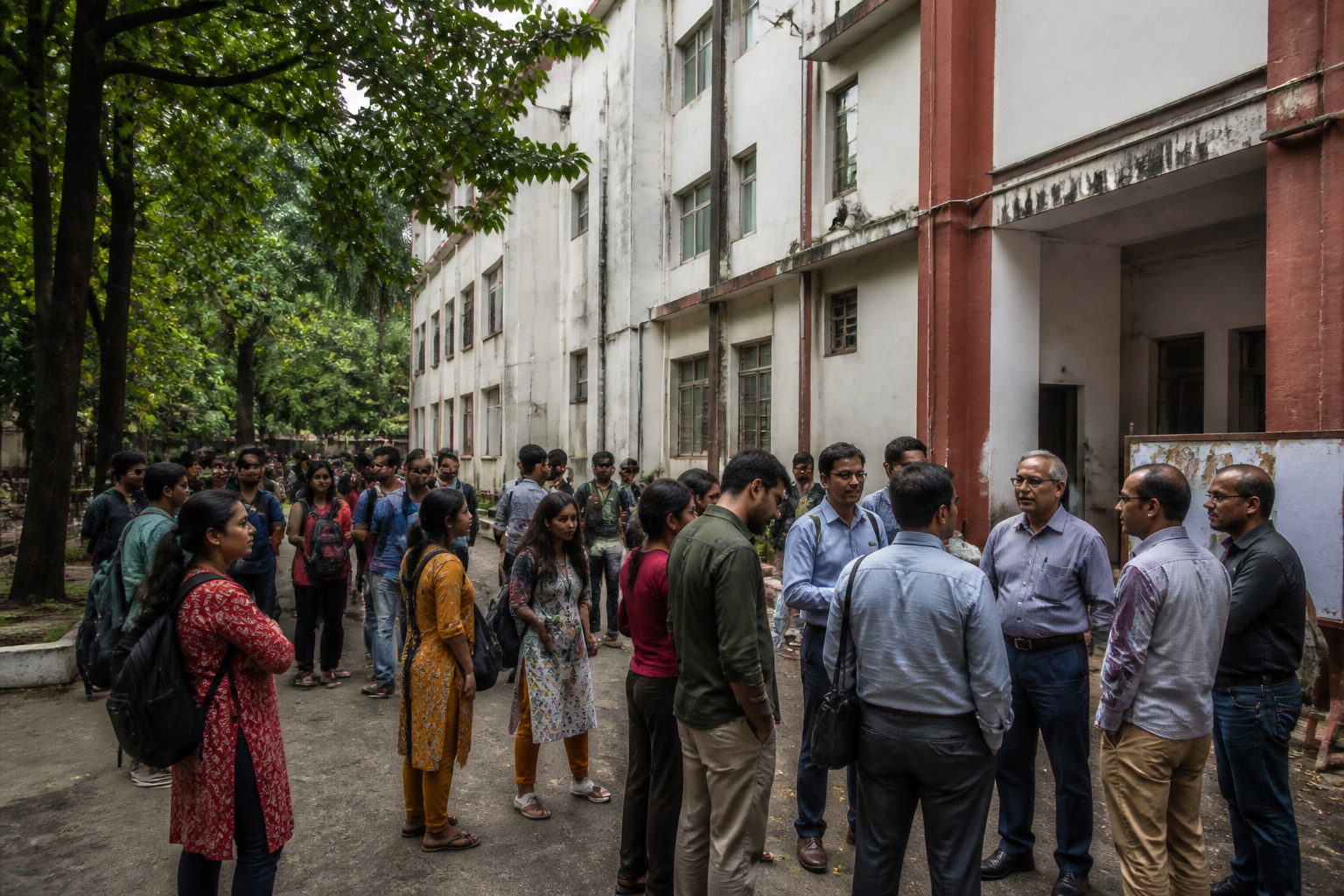
Jadavpur University teachers have warned that the West Bengal government’s proposed Inter-University Transfer Bill, 2026, could weaken academic support for first-generation students if senior faculty are moved to newer universities in the districts.
The teachers raised the concern at a news conference after Chief Minister Suvendu Adhikari said in the Assembly on Thursday that transfers would be used to strengthen weaker universities and would also “punish” teachers, particularly those at Jadavpur University. The Bill was passed hurriedly, according to the chief minister, with a “specific objective in mind”.
Partha Pratim Roy, a physics professor at Jadavpur University and president of the Jadavpur University Teachers’ Association, said many students at the established university came from disadvantaged backgrounds and depended on guidance and mentoring from senior faculty.
“The chief minister is saying that the transfer of senior university teachers is required to shore up the standard of weaker universities in the districts and help the students there. A large section of students, many of whom come from disadvantaged backgrounds, also study at Jadavpur University,” Roy said. “If senior professors are transferred from JU, it will impair the interests of those students.”
The dispute centres on how the proposed transfer policy would balance staffing shortages at newer universities with the academic needs of established institutions. Higher Education Minister Jagannath Chattopadhyay told the Assembly that several Jadavpur University departments had an average of 40 teachers and contrasted them with universities facing shortages.
Mahakaya Chatterjee of the Calcutta University Teachers’ Association said the higher number of teachers at Jadavpur University reflected its larger student population. “It’s a simple question of demand and supply,” said Chatterjee, an economics professor at Calcutta University.
Suvodoy Dasgupta of the West Bengal College and University Teachers’ Association said the government had presented two different purposes for the legislation: improving standards at newer universities and acting against Jadavpur University teachers who had challenged elected state and central governments.
“If punishment of JU teachers is at the heart of the Bill, then this can never improve the standards of the weaker universities,” Dasgupta said.
Adhikari has also accused Jadavpur University teachers of “brainwashing” students against the government. Several teachers supported student protests and joined marches after an August 20 campus rampage allegedly involving supporters of the ABVP, the student wing of the RSS.
Roy rejected the allegation. “We do not believe in brainwashing our students. We love to teach and that is what we have been doing,” he said.
Teachers also warned that compulsory transfers could affect the university’s ability to attract researchers and senior academics. Roy said many post-doctoral students from abroad joined Jadavpur University because of its research environment and reputation as the best state-aided university in the country, according to the Union education ministry’s ranking cited by him. He said the prospect of transfer from Calcutta to a university in Cooch Behar could discourage such appointments.
The government’s next steps on implementing the Inter-University Transfer Bill, including the process for identifying teachers and universities covered by the proposed system, will determine its immediate impact on faculty deployment and university operations.
